

Pakistan eyes Google collaboration for community-driven innovation and AI adoption

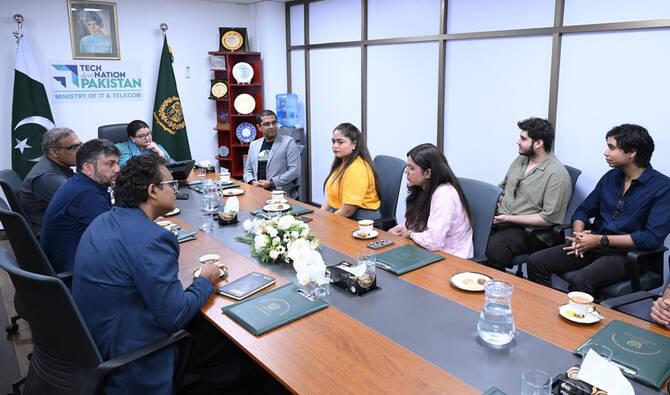
Pakistan’s IT Minister Shaza Fatima Khawaja (fourth right) meets Google’s Regional AI Developer Ecosystem and Communities team in Islamabad, Pakistan, on July 11, 2025. (PID)
Short Url
Updated 12 July 2025
Follow

Pakistan eyes Google collaboration for community-driven innovation and AI adoption

  • Pakistan is currently focused on AI training in the fields of education, workforce development and industrial innovation
  • Minister says enhanced collaboration will accelerate Pakistan’s integration into the global AI ecosystem, digital empowerment

ISLAMABAD: Pakistan and American multinational corporation and technology giant Google are seeking to collaborate with each other in community-driven innovation and the adoption of artificial intelligence (AI) in the South Asian country, according to the Pakistani IT ministry.

The statement came after IT Minister Shaza Fatima Khawaja’s meeting with Google’s Regional AI Developer Ecosystem and Communities team to explore strategic collaboration in advancing Pakistan’s AI landscape.

The Google team provided an overview of their developer ecosystem, contributions of Google Developer Groups (GDGs), community-based AI initiatives, and impactful platforms like Taleemabad.

In the wider policy discussion, Khawaja emphasized the government’s focus on AI training across three critical domains: mainstream education, workforce development including freelancers, and industrial innovation.

“She stressed the need for inclusive access to tools such as the AI Seekho program, sandbox environments, and cloud credits,” the IT ministry said. 

“She called for enhanced collaboration between Google and the Ministry of IT & Telecommunication (MoITT) to accelerate Pakistan’s integration into the global AI ecosystem and promote equitable digital empowerment.”

During the meeting, Khawaja also had an interactive session with the N+1 team, a group of young Pakistani developers recently selected among the global top 10 in the Google Solution Challenge. The team proudly represented Pakistan at the regional showcase in the Philippines.

Khawaja praised their achievement and called it a testament to the country’s emerging talent pool and the importance of nurturing such success stories through structured support and mentorship, according to the IT ministry.

On Friday, Google said it has expanded access to its advanced video generation model, Veo 3, allowing users in Pakistan and over 150 other countries to create eight-second videos from photos with sound.

The move comes amid a global surge in interest in creative AI tools, with content creators using different platforms to generate video stories and bring still images to life. With Pakistan’s growing pool of digital creators, the rollout is expected to spur local innovation in short-form content.


Rating firm S&P says it won’t rush Iran war downgrades, sees risks for countries like Pakistan

Updated 12 March 2026
Follow

Rating firm S&P says it won’t rush Iran war downgrades, sees risks for countries like Pakistan

  • Agency says it is monitoring indebted energy importers as higher oil prices strain finances
  • Gulf economies seen better placed to weather shock, though Bahrain flagged as vulnerable

LONDON: S&P Global ‌said it would not make any knee-jerk sovereign rating cuts following the outbreak of war in the ​Middle East, but warned on Thursday that soaring oil and gas prices were putting a number of already cash-strapped countries at risk.

The firm’s top analysts said in a webinar that the conflict, which has involved US and Israeli strikes ‌against Iran and Iranian ‌strikes against Israel, ​US ‌bases ⁠and Gulf ​states, ⁠was now moving from a low- to moderate-risk scenario.

Most Gulf countries had enough fiscal buffers, however, to weather the crisis for a while, with more lowly rated Bahrain the only clear exception.

Qatar’s banking sector could ⁠also struggle if there were significant ‌deposit outflows in ‌reaction to the conflict, although there ​was no evidence ‌of such strains at the moment, they ‌said.

“We don’t want to jump the gun and just say things are bad,” S&P’s head global sovereign analyst, Roberto Sifon-Arevalo, said.

The longer the crisis ‌was prolonged, though, “the more difficult it is going to be,” he ⁠added.

Sifon-Arevalo ⁠said Asia was the second-most exposed region, due to many of its countries being significant Gulf oil and gas importers.

India, Thailand and Indonesia have relatively lower reserves of oil, while the region also had already heavily indebted countries such as Pakistan, Bangladesh and Sri Lanka whose finances would be further hurt by rising energy prices.

“We ​are closely monitoring ​these (countries) to see how the credit stories evolve,” Sifon-Arevalo said.