



JEDDAH: Saudi Arabia’s honey sector is experiencing a quiet revolution, one that blends centuries-old beekeeping traditions with the precision of modern sustainable agriculture.
Once an overlooked element of rural life, honey production in the Kingdom is now gaining global recognition, fueled by organic certification, government support and the determination of pioneering beekeepers.
Among the leading figures shaping this transformation is Jassim Almughrabi, Saudi Arabia’s first certified organic honey producer and owner of Mughrabi Apiaries.

With decades of experience, including his tenure as a honeybee specialist at the Ministry of Agriculture, Almughrabi discussed with Arab News the profound shift that has taken place in recent years.
“After the government showed strong interest in organic agriculture, things became much more comfortable for us,” he said.
“I had already registered as an organic honey producer, but when the Ministry of Agriculture started giving support and donations to beekeepers who wanted to convert from conventional to organic, our production improved significantly.”
This institutional backing has allowed local beekeepers to grow their operations and expand into new markets.
Almughrabi highlighted how the ministry not only facilitated certifications but also opened doors for beekeepers to participate in national exhibitions like BIOFACH Saudi Arabia, a major event now held annually in Riyadh.

Saudi beekeepers are now a regular participant in BIOFACH, the annual international exhibition for organic products sponsored by Saudi Arabia's Ministry of Environment, Water, and Agriculture. (SPA)
“Through the Organic Cooperative Society, we are even allowed to participate free of charge,” he said. “The government really helped us spread our presence in the field, and we thank them for that.”
At the heart of Saudi Arabia’s beekeeping heritage lies a deep knowledge of traditional methods, especially in the mountainous regions of Makkah, Madinah, Abha, Al-Baha and Taif.
For centuries, beekeepers in these areas used hollowed logs to house bees, drawing from nature to sustain their practices. While this form of beekeeping still holds cultural value, a shift began around 45 years ago when the ministry encouraged farmers to adopt modern beehive systems.

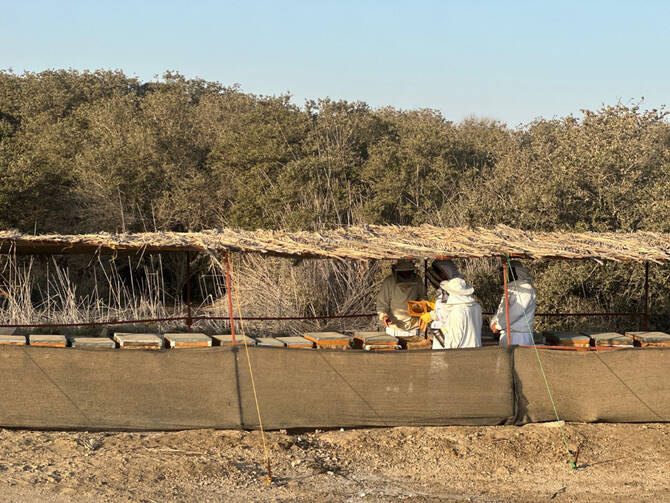
Mangrove trees along the Kingdom's Arabian Gulf coast pllay an important role in beekeeping. (Supplied)
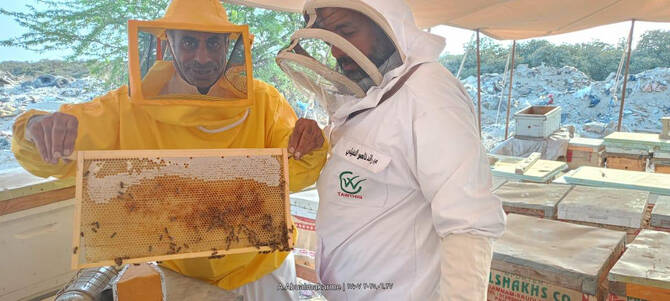
“I was working in the Ministry of Agriculture back then,” said Almughrabi. “We conducted training courses to help traditional beekeepers transition to modern methods, like the Langstroth hive used in Europe and America. Now, more than 15,000 beekeepers across the Kingdom have adopted these techniques.”
This has transformed the industry, making Saudi honey a highly sought-after commodity.
Mansour Al-Mgaslah, beekeeper and supervisor of the Mangrove Honey Production Initiative said: “The honey sector in the Kingdom has witnessed a remarkable transformation in recent years, driven by a growing awareness of the importance of sustainable beekeeping practices.

Mangrove flowers help sustain bee populations. (Supplied)
“Beekeepers are now committing to environmental and health standards and adopting modern technologies to preserve the health of both bees and plants.”
This transition is not without its challenges. Desertification, pesticide use, and climate change are pressing environmental issues that threaten both bee populations and floral diversity.
However, both Almughrabi and Al-Mgaslah believe sustainable beekeeping offers practical solutions. By encouraging vegetation restoration and reducing chemical dependencies, beekeepers can help preserve ecosystems that bees and honey production rely on.

Beekeeping boxes set up for harvesting. (Supplied)
“Some of the major challenges include the shrinking of natural pastures and increasing desertification,” said Al-Mgaslah. “Sustainable beekeeping helps restore ecological balance by preserving bees as sensitive and effective environmental indicators.”
Al-Mgaslah shared the sentiment.
“Biodiversity is not just an environmental value. It is essential for ensuring the continuity of high-quality honey production,” he said. “Native plants such as sidr, samar, talh and mangrove provide bees with rich and pure nectar sources. Supporting this biodiversity contributes to building a more resilient and stable ecosystem.”
Opinion
This section contains relevant reference points, placed in (Opinion field)
Almughrabi says government schemes have already begun to yield results. “When Saudi Crown Prince Mohammed bin Salman launched the Saudi Green Initiative, valleys were protected from overgrazing and greenery started returning,” he said.
“This led to a noticeable increase in honey production. Ten years ago, we produced less than 1 kilogram of honey per hive. Now, we sometimes get 1.5 to 2 kilograms.”
The role of native bees and local flora in this equation cannot be overstated. Indigenous bee species, such as the Arabian honeybee, have shown better resilience and adaptability to the Kingdom’s varied climate.

Saudi Arabia’s honey industry is proving that sustainability, tradition, and innovation can work in harmony. (Supplied)
In contrast, imported bees often struggle to survive beyond one or two harvest cycles.
“In the middle of Saudi Arabia, beekeepers often use imported bees,” said Almughrabi. “But they aren’t as strong. Local bees are very good, very strong, and after the harvest we can even transport them to other regions like Jazan or Al-Lith, where the climate is warmer in winter. We don’t have to buy new bees every year.”
The cornerstone of Saudi Arabia’s sustainable honey movement is its organic certification system, monitored by the Ministry of Environment, Water and Agriculture. The process is rigorous and includes criteria such as pesticide-free pastures, natural nutrition without antibiotics or sugar, and complete traceability from hive to shelf.

With an organic certification system in place, Saudi Arabia's honey industry is poised to export to the world market. (Supplied)
“To be certified organic in the Kingdom means that your honey is free from any chemical or industrial interventions at every stage,” said Al-Mgaslah. “Beekeepers must meet strict environmental and documentation standards, and the certification is granted only through authorized, ministry-recognized bodies.”
With international demand for clean, traceable, and eco-conscious products on the rise, both experts believe Saudi Arabia is poised for a golden era in honey exports.
“The Kingdom holds an exceptional opportunity to become a global leader in organic honey production,” said Al-Mgaslah.

Locally produced honey. (Supplied)
“Thanks to its unique botanical diversity, rich heritage, and government support, Saudi honey can meet the growing global demand for authentic, natural products.”
Almughrabi added: “We believe the future of Saudi honey lies in expanding exports and entering niche markets that value quality and authenticity. With continued support, we can make Saudi honey a global name.”
In a land long associated with arid deserts, Saudi Arabia’s honey industry is proving that sustainability, tradition, and innovation can work in harmony. The result is more than just honey — it is a model for agricultural resilience and cultural pride.


