

Lebanese president rules out normalization with Israel

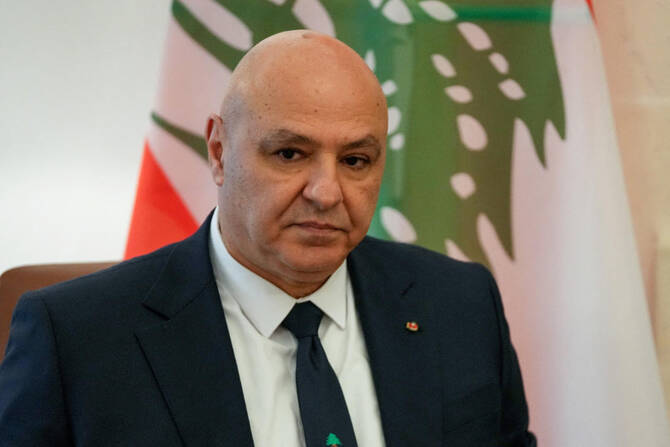
Lebanese President Joseph Aoun looks on during a meeting with Cyprus' President Nikos Christodoulides at the Presidential Palace in Nicosia, Cyprus July 9, 2025. Petros Karadjias/Pool via REUTERS
Short Url
Updated 11 July 2025
Follow

Lebanese president rules out normalization with Israel

  • Joseph Aoun calls on Israel to withdraw from the five points near the border it still occupies in southern Lebanon
  • He expressed hope for peaceful relations with Israel in the future

BEIRUT: Lebanese President Joseph Aoun ruled out normalization between his country and Israel on Friday, while expressing hope for peaceful relations with Beirut’s southern neighbor, which still occupies parts of southern Lebanon.

Aoun’s statement is the first official reaction to Israeli Foreign Minister Gideon Saar’s statement last week in which he expressed his country’s interest in normalizing ties with Lebanon and Syria.

Aoun “distinguished between peace and normalization,” according to a statement shared by the presidency.

“Peace is the lack of a state of war, and this is what matters to us in Lebanon at the moment. As for the issue of normalization, it is not currently part of Lebanese foreign policy,” the president said in front of a delegation from an Arab think tank.

Lebanon and Syria have technically been in a state of war with Israel since 1948, with Damascus saying that talks of normalization were “premature.”

The president called on Israel to withdraw from the five points near the border it still occupies. Israel was required to fully withdraw from southern Lebanon under a November ceasefire seeking to end its war with Iran-backed Hezbollah.

Aoun said that Israeli troops in Lebanon “obstruct the complete deployment of the army up to the internationally recognized borders.”

According to the ceasefire agreement, Hezbollah must pull its fighters north of the Litani River, around 30 kilometers (20 miles) from the border with Israel, leaving the Lebanese army and UN peacekeepers as the only armed parties in the area.

The United States has been calling on Lebanon to fully disarm Hezbollah, and Lebanese authorities sent their response to Washington’s demand this week.

The response was not made public, but Aoun stated that Beirut was determined to “hold the monopoly over weapons in the country.”

The implementation of this move “will take into account the interest of the state and its security stability to preserve civil peace on one hand, and national unity on the other,” hinting that Hezbollah’s disarmament will not be done through force.

Hezbollah, a powerful political force in Lebanon, is the only non-state actor to have officially retained its weaponry after the end of Lebanon’s 15-year civil war in 1990, as parts of southern Lebanon were still under Israeli occupation at the time.

The Lebanese group was heavily weakened following its year-long hostilities with Israel, which escalated into a two-month war in September.


Syria Kurds chief says ‘all efforts’ being made to salvage deal with Damascus

Updated 25 December 2025
Follow

Syria Kurds chief says ‘all efforts’ being made to salvage deal with Damascus

  • Abdi said the Syrian Democratic Forces (SDF), the Kurds’ de facto army, remained committed to the deal
  • The two sides were working toward “mutual understanding” on military integration and counter-terrorism

DAMASCUS: Syrian Kurdish leader Mazloum Abdi said Thursday that “all efforts” were being made to prevent the collapse of talks on an agreement with Damascus to integrate his forces into the central government.
The remarks came days after Aleppo saw deadly clashes between the two sides before their respective leaders ordered a ceasefire.
In March, Abdi signed a deal with Syrian President Ahmed Al-Sharaa to merge the Kurds’ semi-autonomous administration into the government by year’s end, but differences have held up its implementation.
Abdi said the Syrian Democratic Forces (SDF), the Kurds’ de facto army, remained committed to the deal, adding in a statement that the two sides were working toward “mutual understanding” on military integration and counter-terrorism, and pledging further meetings with Damascus.
Downplaying the year-end deadline, he said the deal “did not specify a time limit for its ending or for the return to military solutions.”
He added that “all efforts are being made to prevent the collapse of this process” and that he considered failure unlikely.
Abdi also repeated the SDF’s demand for decentralization, which has been rejected by Syria’s Islamist authorities, who took power after ousting longtime ruler Bashar Assad last year.
Turkiye, an important ally of Syria’s new leaders, sees the presence of Kurdish forces on its border as a security threat.
In Damascus this week, Turkish Foreign Minister Hakan Fidan stressed the importance of the Kurds’ integration, having warned the week before that patience with the SDF “is running out.”
The SDF control large swathes of the country’s oil-rich north and northeast, and with the support of a US-led international coalition, were integral to the territorial defeat of the Daesh group in Syria in 2019.
Syria last month joined the anti-IS coalition and has announced operations against the jihadist group in recent days.