

Islamabad, Moscow sign protocol to restore and modernize Pakistan Steel Mills

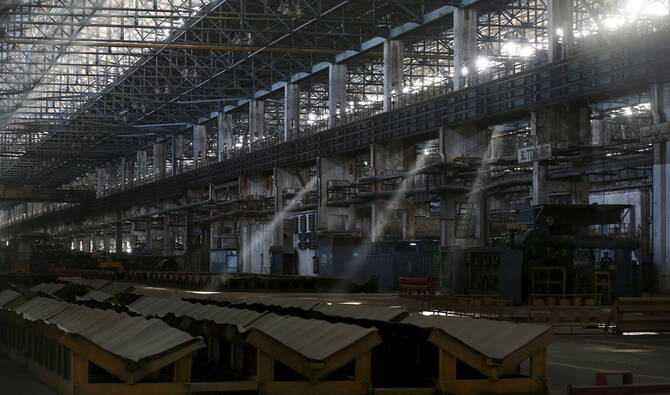
A general view of the deserted hot strip mill department of the Pakistan Steel Mills (PSM) on the outskirts of Karachi, Pakistan, February 8, 2016. (Reuters/File)
Short Url
Updated 11 July 2025
Follow

Islamabad, Moscow sign protocol to restore and modernize Pakistan Steel Mills

  • The Pakistan Steel Mills has been non-operational since 2015 due to years of financial mismanagement, political interference and mounting losses
  • Both sides discussed plans to modernize the major steel complex on the sidelines of the recent INNOPROM Annual Industrial Forum in Yekaterinburg

ISLAMABAD: Pakistan and Russia have signed a protocol to restore and modernize the Pakistan Steel Mills (PSM) in Karachi, Pakistani state media reported on Friday.

The development comes days after the two sides discussed plans to modernize the major steel complex and expand industrial cooperation on the sidelines of the INNOPROM Annual Industrial Forum in Yekaterinburg.

INNOPROM, Russia’s largest annual industrial trade fair, brings together government delegations, business leaders and technology firms from over 30 countries to explore partnerships in manufacturing, engineering and high-tech industries.

The protocol was signed at the Pakistan Embassy in Moscow by Pakistan’s Secretary of Industries and Production Saif Anjum and Russian General Director of Industrial Engineering LLC Vadim Velichko, reaffirming the long-standing industrial partnership.

“The project aims to restart and expand steel production [in Pakistan], marking a new chapter in bilateral cooperation,” read a report on Radio Pakistan broadcaster.

The PSM, once Pakistan’s flagship industrial complex, was built in the 1970s with Soviet assistance. While it symbolized national self-sufficiency, the mill has been non-operational since 2015 due to years of financial mismanagement, political interference and mounting losses.

Moscow is also expected to finalize an agreement with Islamabad this summer to construct a new steel mill in Karachi, Russian Consul-General Andrey B. Fedorov told Arab News this month.

Technical experts from Russia have already inspected the proposed site for the new facility, and another delegation is expected soon to draft a detailed roadmap.

Russia has a long history of industrial cooperation with Pakistan, having previously built key infrastructure projects such as the Guddu Power Station in Sindh in the 1980s, one of the country’s major electricity producers.
Moscow and Islamabad have expanded cooperation in recent years despite global tensions over the war in Ukraine.


UNESCO lists Pakistan’s ancient Bareendo instrument as endangered cultural heritage

Updated 9 sec ago
Follow

UNESCO lists Pakistan’s ancient Bareendo instrument as endangered cultural heritage

  • 5,000-year-old Sindhi clay wind instrument placed on UNESCO urgent safeguarding list
  • Only two known practitioners remain as Pakistan launches four-year preservation plan

ISLAMABAD: Pakistan’s 5,000-year-old folk instrument Bareendo has been added to UNESCO’s Intangible Cultural Heritage list for urgent safeguarding, the UN agency said this week, placing it among cultural traditions considered at immediate risk of disappearing.

Believed to originate in the ancient Indus Valley Civilization, the clay wind instrument is the oldest known surviving musical form in the southern Sindh province. Its soft, breath-driven tones have accompanied Sufi devotional gatherings, winter festivals and village ceremonies for generations, forming a core part of Sindh’s musical and spiritual identity.

The inscription was approved at the 20th Session of UNESCO’s Intergovernmental Committee for Intangible Cultural Heritage, which documents vulnerable cultural practices globally, from oral folklore to craftsmanship, to ensure they are preserved and passed on.

UNESCO announced the listing on X on Tuesday:

“New inscription on the Urgent Safeguarding List of Intangible Heritage: Boreendo, Bhorindo: ancient dying folk musical instrument, its melodies, knowledge, and skills.”

Pakistan’s Permanent Delegate to UNESCO, Ambassador Mumtaz Zahra Baloch, welcomed the move, calling it the recognition of a tradition preserved through centuries of community transmission.

“Bareendo is not only an emblem of the Indus Valley’s cultural continuity but also a living expression of Sindh’s artistic and spiritual heritage,” she was quoted as saying by Pakistan’s Embassy in France. 

“This recognition by UNESCO reaffirms Pakistan’s commitment to the protection and promotion of our diverse cultural traditions.”

Only two people are believed to retain full mastery of Bareendo today, musician Ustaad Faqeer Zulfiqar and master potter Allah Jurio, underscoring why the nomination was marked urgent, the embassy said. 

The nomination followed an intensive consultation process between the Sindh government, Pakistan’s Mission to UNESCO and UNESCO headquarters in Keti Mir Muhammad Loond village and led to a four-year safeguarding strategy (2026–2029). Planned measures include a community music school, integration into formal and informal education and digital archiving to open access beyond Sindh’s rural belt.

With this recognition, Bareendo joins existing UNESCO-listed intangible traditions like Suri Jagek (the astronomical knowledge of the Kalash people), Falconry, and Nowruz, the regional spring new year.