RUIDOSO, N.M.: At least 200 homes were damaged during a deadly flash flood in the mountain village of Ruidoso, and local emergency managers warned Wednesday that number could more than double as teams survey more neighborhoods.
Gov. Michelle Lujan Grisham was among the officials who took an aerial tour of Ruidoso and the surrounding area as they looked to bolster their case for more federal assistance for the community, which has been battered over the past year by wildfires and repeated flooding.
The governor said the state has received partial approval for a federal emergency declaration, freeing up personnel to help with search and rescue efforts and incident management. She called it the first step, saying Ruidoso will need much more.
“We will continue working with the federal government for every dollar and resource necessary to help this resilient community fully recover from these devastating floods,” she said.
An intense bout of monsoon rains set the disaster in motion Tuesday afternoon. Water rushed from the surrounding mountainside, overwhelming the Rio Ruidoso and taking with it a man and two children who had been camping at a riverside RV park. Their bodies were found downstream. One person is still unaccounted for.
Lujan Grisham expressed her condolences and wished a speedy recovery for the parents of the 4-year-old girl and 7-year-old boy who were killed. She said it will be an emotional journey.
“There are no words that can take away that devastation,” she said. “We are truly heartsick.”
Congresswoman Melanie Stansbury, whose district includes Ruidoso and surrounding Lincoln County, told reporters more rain is coming and that residents remain at risk. She urged people to follow emergency orders, saying “we cannot lose another life.”
A community rebuilds — again
Broken tree limbs, twisted metal, crumpled cars and muddy debris remain as crews work to clear roads and culverts wrecked by the flooding.
Tracy Haragan, a lifelong Ruidoso resident on the verge of retirement, watched from his home as a surging river carried away the contents of nine nearby residences.
“You watched everything they owned, everything they had — everything went down,” he said.
A popular summer retreat, Ruidoso is no stranger to tragedy. It has spent a year rebuilding following destructive wildfires last summer and the flooding that followed.
This time, the floodwaters went even higher, with the Rio Ruidoso rising more than 20 feet on Tuesday to set a record. Officials said the area received about 3.5 inches of rain over the South Fork burn scar in just an hour and a half.
“It is such a great town, it just takes a tail-whipping every once in a while,” Haragan said. “We always survive.”
Requests for aid
The river runs thick with sediment that can settle and raise future water levels. Stansbury said already-promised federal funding to remove silt from the riverbed would help mitigate future flooding, but that the community would need continued help for the next decade after suffering successive catastrophes.
Lujan Grisham said the federal government likely will advance $15 million — from the Department of Agriculture and the Federal Emergency Management Agency — to jumpstart recovery efforts. That amount could climb to more than $100 million in the coming months as Ruidoso tries to rebuild and mitigate future floods.
The governor said officials need to rethink how funding is doled out to reduce the risks of future flooding, in efforts that might restore watersheds and forests.
Ruidoso has also recently requested $100 million in federal aid to convert flood-prone private land to public property after successive years of violent flooding.
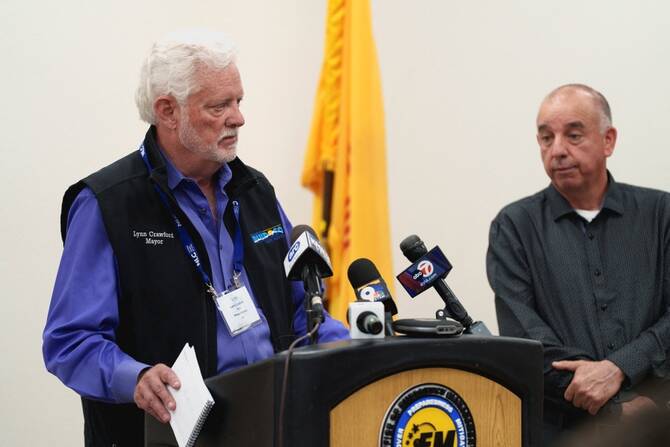
The mayor emphasized Thursday that the flood damage was far greater than he and others had realized, highlighting damage to water lines and distribution points for potable drinking water.
“Things have changed,” Crawford said. “There was a lot more damage than what we had assumed and what we thought in the beginning. ... We’ve had to take a step back to move forward.”


As many as 200 homes damaged as officials survey the aftermath of a deadly New Mexico flood
https://arab.news/gpaz8
As many as 200 homes damaged as officials survey the aftermath of a deadly New Mexico flood


Prabowo, Trump expected to sign Indonesia-US tariff deal in January 2026
- Deal will mean US tariffs on Indonesian products are cut from a threatened 32 percent to 19 percent
- Jakarta committed to scrap tariffs on more than 99 percent of US goods
JAKARTA: Indonesia expects to sign a tariff deal with the US in early 2026 after reaching an agreement on “all substantive issues,” Jakarta's chief negotiator said on Tuesday.
Indonesia’s Coordinating Minister for Economic Affairs Airlangga Hartarto met with US trade representative Jamieson Greer in Washington this week to finalize an Indonesia-US trade deal, following a series of discussions that took place after the two countries agreed on a framework for negotiations in July.
“All substantive issues laid out in the Agreement on Reciprocal Trade have been agreed upon by the two sides, including both the main and technical issues,” Hartarto said in an online briefing.
Officials from both countries are now working to set up a meeting between Indonesian President Prabowo Subianto and US President Donald Trump.
It will take place after Indonesian and US technical teams meet in the second week of January for a legal scrubbing, or a final clean-up of an agreement text.
“We are expecting that the upcoming technical process will wrap up in time as scheduled, so that at the end of January 2026 President Prabowo and President Trump can sign the Agreement on Reciprocal Trade,” Hartarto said.
Indonesian trade negotiators have been in “intensive” talks with their Washington counterparts since Trump threatened to levy a 32 percent duty on Indonesian exports.
Under the July framework, US tariffs on Indonesian imports were lowered to 19 percent, with Jakarta committing to measures to balance trade with Washington, including removing tariffs on more than 99 percent of American imports and scrapping all non-tariff barriers facing American companies.
Jakarta also pledged to import $15 billion worth of energy products and $4.5 billion worth of agricultural products such as soybeans, wheat and cotton, from the US.
“Indonesia will also get tariff exemptions on top Indonesian goods, such as palm oil, coffee, cocoa,” Hartarto said.
“This is certainly good news, especially for Indonesian industries directly impacted by the tariff policy, especially labor-intensive sectors that employ around 5 million workers.”
In the past decade, Indonesia has consistently posted trade surpluses with the US, its second-largest export market after China.
From January to October, data from the Indonesian trade ministry showed two-way trade valued at nearly $36.2 billion, with Jakarta posting a $14.9 billion surplus.


