
RIYADH: Across the global construction sector, long considered one of the most resistant to digitization, a quiet revolution is unfolding.
Artificial intelligence is no longer a mere buzzword confined to laboratories and boardrooms. It is increasingly present in the urban fabric, embedded into scaffolding, concrete and command centers.
One company at the heart of this shift is viAct, a Hong Kong-based AI firm co-founded by Gary Ng and Hugo Cheuk. Their aim is to make construction safer, smarter and significantly more productive using a scenario-based AI engine built for complex, high-risk environments.
“Despite being one of the most labor-intensive and hazardous industries, construction remains vastly under-digitized,” Ng told Arab News. “We saw this as an opportunity to bring AI-driven automation and insights to frontline operations.

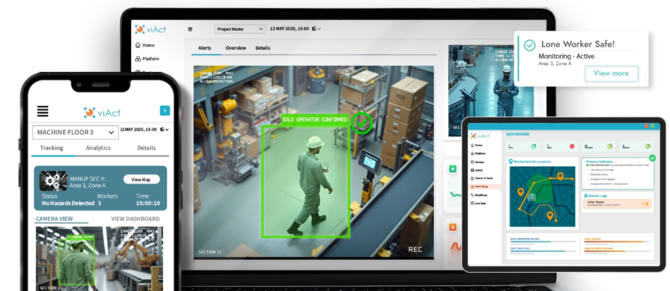
Unlike conventional surveillance tools that simply record footage, viAct’s platform acts like a digital foreman. It interprets real-time visual data to detect unsafe practices, productivity gaps and anomalies, all without human supervision.
At the core of the platform are intelligent video analytics powered by edge computing. By processing visuals from jobsite cameras and sensors, viAct can flag whether a worker has entered a restricted zone, whether proper personal protective equipment is being worn, or if a crane is operating unsafely.
“This is not just about object detection,” said Ng. “Our AI understands context. It recognizes behaviors — like a worker being too close to the edge without a harness or a truck reversing unsafely — and acts in real time.”
That ability to contextualize data is crucial in megaprojects, where risks multiply with size.
The firm’s technology has already been deployed across East Asia and parts of Europe. Now, the company is eyeing Saudi Arabia and the wider Gulf region, where giga-projects are transforming skylines at record speed.
Opinion
This section contains relevant reference points, placed in (Opinion field)
Ng confirmed viAct is in active discussions to enter the Saudi market.
“Saudi Arabia’s Vision 2030 is deeply aligned with our mission,” he said. “There’s a growing demand for AI in infrastructure — not just for safety, but also for efficiency, environmental compliance, and transparency.
From NEOM and The Line to Qiddiya and Diriyah Gate, Saudi Arabia is leading one of the most ambitious construction booms in the world. These projects involve thousands of workers, advanced logistics and constant oversight.
However, traditional safety audits and manual inspections are no longer sufficient. “With projects of this scale, real-time monitoring is not a luxury — it’s a necessity,” said Ng.
While viAct hasn’t yet launched in the Kingdom, its platform is fully prepared for Arabic localization and regional compliance standards, including Saudi labor laws and Gulf Cooperation Council safety codes.
What sets viAct apart is how seamlessly it integrates with existing infrastructure. Rather than requiring expensive proprietary equipment, the platform works with standard CCTV cameras and can be deployed in both urban and remote sites.

“Our system is plug-and-play,” said Ng. “You don’t need to overhaul your entire setup to use AI. That makes it ideal for companies in transition or for phased construction timelines.”
Its use of edge AI, meaning data is processed on site rather than in a distant cloud, allows viAct to deliver insights even in areas with weak internet connectivity. This feature is particularly useful in Saudi Arabia’s more isolated development zones or early-phase sites with minimal setup.
Its software is also highly customizable. For instance, a client building a hospital might prioritize fall detection and material delays, while a contractor working on an airport runway may need to monitor large machinery and perimeter access.
As automation reshapes industries, many worry that people are being replaced by machines. But Ng insists that viAct’s goal is not to eliminate workers — it is to protect them.
“We’re not building robots to take over,” he said. “We’re building tools that enhance human judgment and ensure safety. When a worker is alerted to a risk before an accident occurs, that’s AI doing its best job.”
In fact, many of viAct’s clients report that once site workers understand the system is not spying on them, but rather observing unsafe situations, adoption becomes smoother. Managers gain better oversight and laborers gain peace of mind.
“We see this as a collaboration between human intelligence and artificial intelligence,” Ng said. “Each has strengths. Together, they’re far more effective.”

Gary Ng co-founded viAct, a Hong Kong-based AI firm, with Hugo Cheuk. (Supplied)
Deploying AI in construction also brings ethical questions to the forefront, particularly in projects run by government entities or involving public infrastructure. Ng is upfront about these concerns.
“All our solutions are GDPR-compliant and privacy-first,” he said, referring to the EU’s General Data Protection Regulation, a comprehensive set of rules designed to protect the personal data of individuals.
“We don’t use facial recognition and we don’t track individuals. The focus is purely on safety, compliance and productivity.”
Workers are anonymized in the system, with all data encrypted and stored securely. Dashboards used by contractors and project leads include logs, alerts and safety scores, allowing for clear documentation and accountability without compromising personal privacy.
This is especially important in the Gulf, where projects often involve multinational labor forces and cross-border stakeholders

Looking ahead, viAct plans to double down on its expansion in the Middle East, continue advancing its AI models and advocate for ethical AI deployment in high-risk sectors.
The company is also exploring ways to integrate predictive analytics, allowing clients to foresee and prevent incidents before they occur. This could eventually shift AI’s role from reactive to proactive, forecasting safety breaches, delivery delays or environmental compliance issues in advance.
Ng believes this kind of intelligent foresight will soon become standard across the construction industry.
“It’s not about replacing humans,” he said. “It’s about building a smarter site, one where decisions are faster, risks are fewer, and lives are safer.”
In the age of giga-projects, that is a future Saudi Arabia is already building.

Caption