Pakistan army chief calls visits to US, Gulf, Central Asia ‘successful diplomatic maneuver’

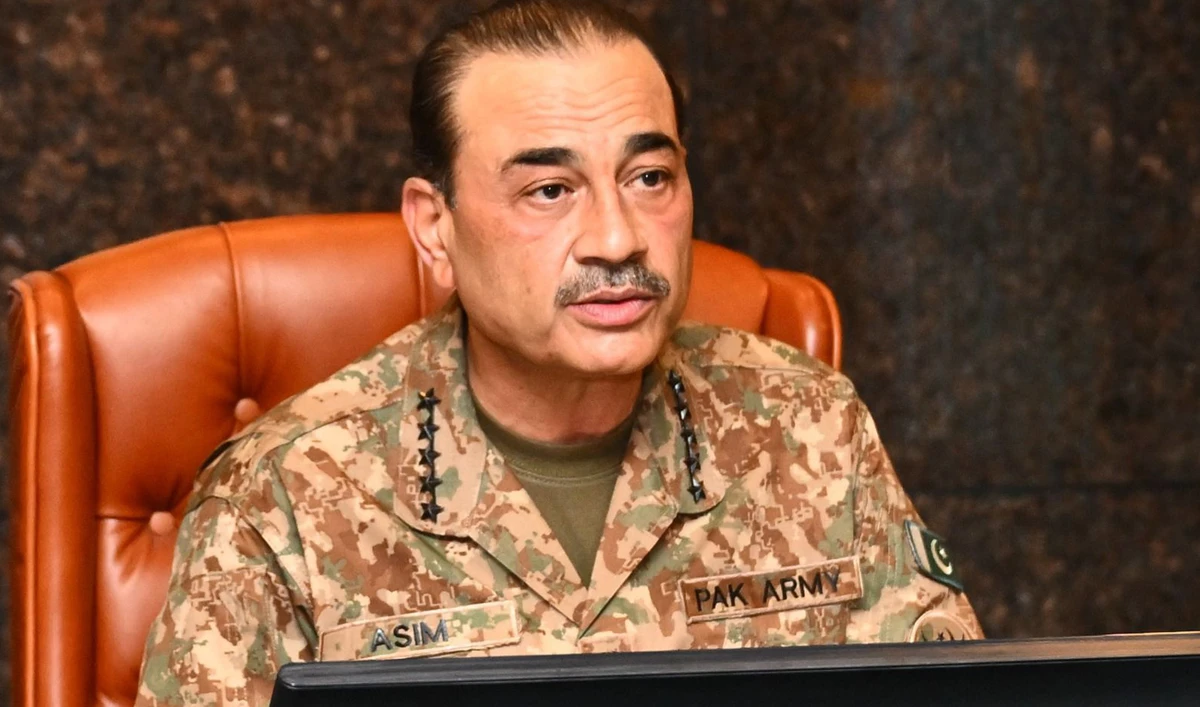
In this handout photograph, taken and released by Pakistan’s Inter-Services Public Relations (ISPR), Pakistan Army Chief Field Marshal Syed Asim Munir speaks during the 271st Corps Commanders’ Conference at the General Headquarters (GHQ) in Rawalpindi on July 10, 2025. (Handout/ISPR)
Short Url
Updated 10 July 2025
Follow

Pakistan army chief calls visits to US, Gulf, Central Asia ‘successful diplomatic maneuver’

  • Munir’s remarks preset rare public statement by military on the country’s high-level diplomatic outreach
  • Says meetings with Trump, other US leaders allowed Pakistan to present views on bilateral, regional issues

ISLAMABAD: Pakistan’s army chief, Field Marshal Syed Asim Munir, on Thursday described his recent visits to the United States, Gulf nations and Central Asia as a “successful diplomatic maneuver,” in a rare public statement by the military on the country’s high-level foreign policy engagements.

Munir made the remarks during a closed-door briefing to senior commanders at the 271st Corps Commanders’ Conference, held at the General Headquarters (GHQ) in Rawalpindi, according to a statement issued by the military’s media wing.

In May and June, Prime Minister Shehbaz Sharif, accompanied by senior ministers and Munir, visited Saudi Arabia, the UAE, Turkiye, Iran, and Azerbaijan as part of Islamabad’s broader diplomatic outreach in the wake of its four-day confrontation with India in May and as tensions escalated in the Middle East.

Last month, Munir was also hosted to a unprecedented two-hour-long lunch by US President Donald Trump at the White House, with no civilian leaders present. The two leaders discussed regional conflicts including India-Pakistan and Iran-Israel tensions, as well as economic development, trade, cryptocurrency, critical minerals and IT.

“The COAS shared details of Pakistan’s proactive and successful diplomatic maneuver, including recent visits to Iran, Turkiye, Azerbaijan, KSA and UAE, where the COAS accompanied the honorable prime minister,” the army’s media wing said in a statement.
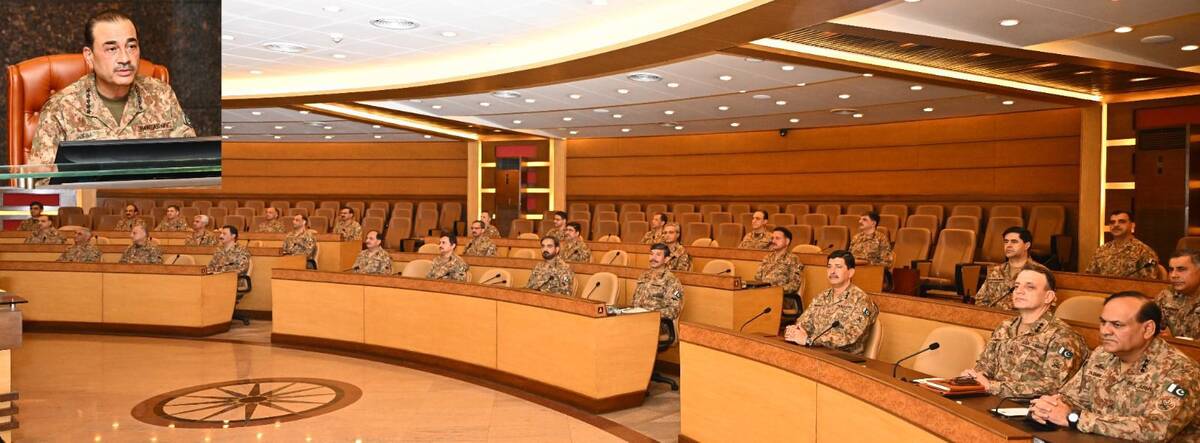


In this combination of handout photographs, taken and released by Pakistan’s Inter-Services Public Relations (ISPR), Pakistan Army Chief Field Marshal Syed Asim Munir speaks during the 271st Corps Commanders’ Conference at the General Headquarters (GHQ) in Rawalpindi on July 10, 2025. (Handout/ISPR)

“Forum was also briefed on the historic and unique visit of the COAS to US, where meetings with top-tier leadership, afforded an opportunity to share firsthand, Pakistan’s objective perspective on bilateral, regional and extra-regional developments.”

According to the ISPR, the commanders’ forum also conducted a “holistic review” of internal and external security dynamics, with particular focus on developments in the Middle East and Iran. It said the growing global trend toward the use of force as a preferred policy tool highlighted the need for “persistent development of self-reliant capabilities, national unity and resolve.”

Pakistan has long accused India of supporting militant groups that carry out attacks inside its Khyber Pakhtunkhwa and Balochistan provinces, an allegation New Delhi denies. The military’s statement said Indian intelligence agencies were continuing to back anti-Pakistan proxies.

“Forum strongly asserted that it is imperative to take decisive and holistic actions at all levels against the Indian-backed and sponsored proxies,” the ISPR said.

Pakistan’s powerful military has ruled the country directly for nearly half of its history and retains significant influence over foreign and security policy, even under civilian governments. In recent weeks, top officials have increasingly described the current governance model as a “hybrid system” in which the military and civilian leaders co-share power.

Pakistani president arrives in Iraq to deepen trade, energy cooperation

Updated 20 December 2025
Follow

Pakistani president arrives in Iraq to deepen trade, energy cooperation

  • Visit follows recent high-level contacts as Islamabad seeks to expand limited commercial ties with Baghdad
  • Talks are expected to cover investment, manpower and facilitation of Pakistani pilgrims visiting holy sites in Iraq

ISLAMABAD: President Asif Ali Zardari arrived in Iraq on Saturday on an official visit aimed at expanding cooperation in trade, energy and investment, as Pakistan seeks to deepen ties with Baghdad after years of limited engagement.

Pakistan and Iraq established diplomatic relations in 1947 and have traditionally maintained cordial ties, though commercial links remain modest, with officials and business groups identifying scope for cooperation in construction services, pharmaceuticals, manpower and agricultural exports.

“President Asif Ali Zardari arrived in Baghdad on a four-day official visit to Iraq,” his office said in a post on X. “He was received by Culture Minister Dr. Ahmed Fakkak Al-Badrani. During the visit, meetings with senior Iraqi leadership are expected to advance cooperation and further strengthen Pakistan-Iraq relations.”

Zardari’s visit follows a series of recent high-level contacts between the two countries, reflecting efforts to broaden bilateral engagement beyond traditional diplomatic ties and explore collaboration across economic, political and people-to-people domains.

According to Pakistan’s foreign office, the president is expected to hold meetings with Iraq’s senior leadership to discuss cooperation in various areas such as trade and investment, energy, technology, education and manpower.

He is also expected to discuss regional and international issues with Iraqi officials.

Earlier this month, Pakistan’s Interior Minister Mohsin Naqvi met his Iraqi counterpart, Abdul Ameer Al-Shammari, on the sidelines of meetings in Brussels, where both sides agreed to enhance cooperation on security and facilitate travel for Pakistani Shia pilgrims to Najaf and Karbala.

The two officials discussed measures to ensure the smoother movement of these pilgrims and their compliance with visa regulations.