

Report: Japan, UK, Italy open to Saudi joining fighter-jet program

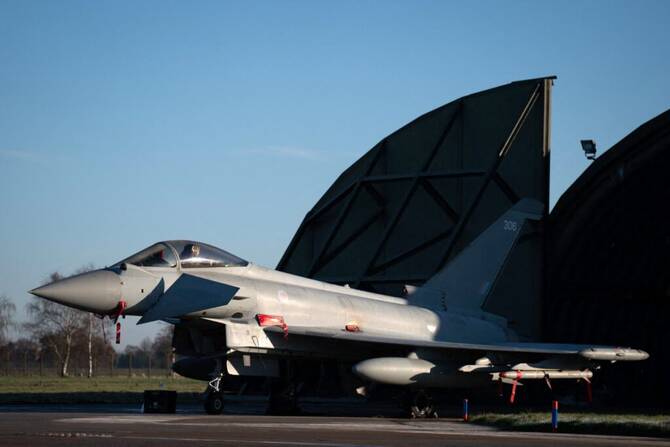
The Global Combat Air Program is a joint effort to develop a sixth-generation fighter. (FILE/AFP)
Short Url
Updated 10 July 2025
Follow

Report: Japan, UK, Italy open to Saudi joining fighter-jet program

  • Tech sharing, and other issues need resolution, says report
  • Riyadh ‘encouraged’ to boost its nascent aerospace industry

DUBAI: Japan, the UK and Italy are open to having Saudi Arabia join their next-generation fighter-jet initiative, but only once the project has reached a more advanced stage and key issues have been resolved, according to The Japan Times.

The Global Combat Air Program is a joint effort to develop a sixth-generation fighter.

It will likely remain a trilateral initiative until after the GCAP International Government Organization, or GIGO, and the industry-led joint venture Edgewing sign their first international contract, likely by the end of 2025, the newspaper reported recently.

The GIGO, officially inaugurated on Monday in Reading, England, was established last year to oversee government-level coordination for the program.

Edgewing, launched last month, brings together the UK’s BAE Systems, Italy’s Leonardo, and the Japan Aircraft Industrial Enhancement Co., and is responsible for designing and developing the aircraft.

“There is no preclusion in having Saudi Arabia join the program, but we first have to define certain criteria and clarify all the points,” one source told The Japan Times, speaking after a virtual meeting between the GCAP nations’ defense ministers on Monday.

Riyadh has been “encouraged” to build up its aerospace expertise — including potentially acquiring and assembling Eurofighter Typhoons — before entering the GCAP, the newspaper reported.

In addition to Saudi Arabia, several other countries are said to have expressed interest in joining the program. These include two unnamed European countries, as well as one Middle Eastern and one Asian nation, according to a source cited by The Japan Times.

The terms of participation and contributions of any future member states remain undefined. Any expansion of the program would require unanimous approval from Japan, the UK and Italy.

The GCAP aircraft will be Japan’s first major defense development with partners other than the US.

It is intended to replace the aging F-2 fighter jets used by Japan’s Air Self-Defense Force, as well as the Eurofighters operated by the UK and Italy. The new jets are scheduled to enter service by 2035.

With the conceptual design phase complete, the program is moving into detailed design and development, and a demonstrator flight is expected within two to three years.

Despite overall satisfaction with the program’s progress, some tensions remain, particularly around access to sensitive intellectual property and full technology sharing.

In April, Italy’s Defense Minister Guido Crosetto publicly criticized the UK for not fully disclosing technology to its partners, in an interview with Reuters.

It is a concern that The Japan Times understands is still unresolved.


Ghana’s president urged to rally African leaders behind push for slavery reparations

Updated 1 sec ago
Follow

Ghana’s president urged to rally African leaders behind push for slavery reparations

Ghana’s President John Dramani Mahama held talks with a global delegation seeking reparations for transatlantic slavery and colonialism, who urged him to rally other ​African leaders to choose “courage over comfort” and support the growing movement.
The delegation, made up of experts from Africa, the Caribbean, Europe, Latin America, and the United States, presented Mahama with priority actions under the African Union’s (AU) reparations agenda, it said in a statement on Friday. In February, the AU launched ‌a drive ‌to create a “unified vision” on what ‌reparations ⁠may ​look ‌like, from financial compensation and formal acknowledgments of past wrongs to policy reforms. At least 12.5 million Africans were kidnapped and forcibly transported by European ships, then sold into slavery from the 15th to the 19th centuries. Advocates say action is needed to confront today’s legacies, including racism. Calls ⁠for reparations have gained momentum but there is also a growing ‌backlash. Many European leaders have opposed ‍even discussing the matter, with ‍opponents arguing today’s states and institutions should not ‍be held responsible for historical wrongs.
While Ghana has been at the forefront of reparations advocacy in Africa, the delegation emphasized the need for “strategic coherence and unity” among political leaders ​across the continent.
They urged Mahama to encourage other leaders to “choose courage over comfort” by standing with ⁠civil society and affected communities in Africa and the diaspora in demanding reparations.
The delegation also met on Wednesday with Ghana’s Foreign Minister Samuel Okudzeto Ablakwa and Mahama’s envoy on reparations Ekwow Spio-Garbrah.
At a European Union–AU summit in Luanda, Angola’s capital, last month, leaders from both regions acknowledged the “untold suffering” caused by slavery and colonialism but stopped short of committing to reparations.
During the summit, Ghana’s Vice President Jane Opoku-Agyemang urged EU member states to support ‌a UN resolution Ghana is preparing to recognize slavery as one of the “gravest crimes against humanity.”