

At least 87 killed, 149 injured in rain-related incidents in Pakistan since June 26

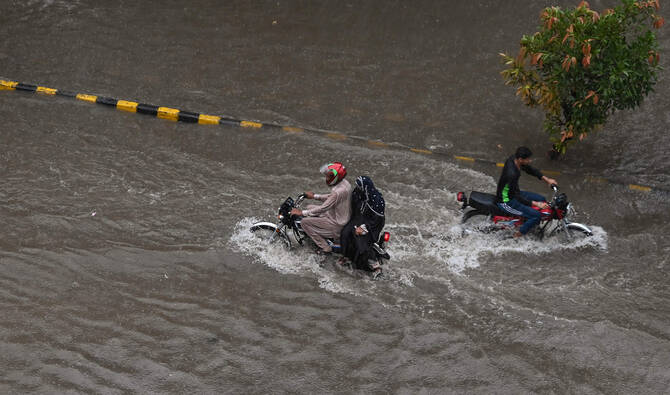
Commuters wade through a flooded street following heavy monsoon rains in Lahore on July 10, 2025. (AFP)
Short Url
Updated 10 July 2025
Follow

At least 87 killed, 149 injured in rain-related incidents in Pakistan since June 26

  • Those killed include 42 children, 29 men and 16 women, national disaster authority says in latest report
  • WHO, Pakistan government finalize contingency plan to maintain essential health services in high-risk districts

KARACHI: At least 87 people have been killed and 149 others injured in rain-related incidents across Pakistan since June 26, according to figures released Thursday by the country’s National Disaster Management Authority (NDMA).

Pakistan’s most populous province, Punjab, reported 29 deaths including 15 children, while the northwestern Khyber Pakhtunkhwa province recorded 30 deaths, 14 of them children. The southern province of Sindh reported 16 deaths, eight of them children, and the southwestern province of Balochistan saw 11 fatalities, five of them children. One man lost his life in Azad Jammu and Kashmir, the NDMA said.

“The total number of 87 deceased include 42 children, 29 men and 16 women,” the NDMA report said, adding that 149 people were injured, 61 children, 52 men and 36 women.

Heavy rains have also damaged at least 242 houses nationwide, including 71 that were completely destroyed and 171 that were partially damaged.

Flood relief operations have been underway since late June, with authorities distributing tents, ration bags, blankets, sandbags, quilts, gas cylinders, mattresses, kitchen sets, mosquito nets, plastic mats, hygiene kits and food packets to affected families.

A total of 24 relief camps have been set up in Punjab and two in Sindh, providing shelter to 176 people. According to the NDMA, around 245 people have been rescued in 21 operations carried out across the country.

Meanwhile, the World Health Organization (WHO), in partnership with the Pakistani government, has finalized its Monsoon Contingency Plan 2025 to ensure a coordinated emergency response and maintain essential health services in high-risk districts.

The plan will be implemented in 10 districts in Punjab and Sindh, nine in Balochistan and four in Khyber Pakhtunkhwa.

“WHO stands with Pakistan and partners to be ready to save lives by supporting rapid response, surveillance and the continuity of essential health services in the event of a natural disaster,” Pakistani state media quoted WHO Representative Dr. Dapeng Luo as saying.

“In a context marked by the impacts of climate change, which are exacerbating risks, it is crucial to be ready to protect the health of all, particularly the most vulnerable,” Luo added.

Pakistan has also rolled out a location-based SMS alert system to warn citizens living in flood-prone areas about imminent weather threats.

Pakistan strikes $4 billion deal to sell weapons to Libyan force, officials say

Updated 22 December 2025
Follow

Pakistan strikes $4 billion deal to sell weapons to Libyan force, officials say

  • Pakistan’s defense industry spans aircraft, vehicles, and naval construction
  • The deal, spread over two-and-a-half years, includes JF-17 jets, officials say

KARACHI: Pakistan has reached a deal worth over $4 billion to sell military equipment to the Libyan National Army, four Pakistani officials said, despite a UN arms embargo ​on the fractured North African country.

The deal, one of Pakistan’s largest-ever weapons sales, was finalized after a meeting last week between Pakistan military chief Field Marshal Asim Munir and Saddam Khalifa Haftar, deputy commander-in-chief of the LNA, in the eastern Libyan city of Benghazi, said the four officials.

The officials, all involved in defense matters, declined to be identified because of the sensitivity of the deal.

Pakistan’s foreign ministry, defense ministry and military did not respond to requests for comment.

Any arms agreement with the LNA is likely to face scrutiny given Libya’s long-running instability following a 2011 NATO-backed uprising that toppled Muammar Qaddafi and split the country between rival authorities.

A copy of the deal before it was finalized that was ‌seen by Reuters listed ‌the purchase of 16 JF-17 fighter jets, a multi-role combat aircraft that has ‌been ⁠jointly ​developed by Pakistan ‌and China, and 12 Super Mushak trainer aircraft, used for basic pilot training.

One of the Pakistani officials confirmed the list was accurate while a second official said the arms on the list were all part of the deal but could not provide exact numbers.

One of the Pakistani officials said the deal included the sale of equipment for land, sea and air, spread over 2-1/2 years, adding it could also include the JF-17 fighter jets. Two of the officials said the deal was valued at more than $4 billion, while the other two said it amounted to $4.6 billion.

The LNA’s official media channel reported on Sunday that ⁠the faction had entered a defense cooperation pact with Pakistan, which included weapons sales, joint training and military manufacturing, without providing details.

“We announce the launch of a ‌new phase of strategic military cooperation with Pakistan,” Haftar said in remarks broadcast ‍on Sunday by Al-Hadath television.

Authorities in Benghazi also did ‍not immediately respond to a request for comment.

The UN-recognized Government of National Unity, led by Prime Minister Abdulhamid Dbeibah, controls ‍much of western Libya, while Haftar’s LNA controls the east and south, including major oilfields, and does not recognize the western government’s authority.

ARMS EMBARGO

Libya has been subject to a UN arms embargo since 2011, requiring approval from the UN for transfers of weapons and related material.

A panel of experts said in a December 2024 report to the UN that the arms embargo on Libya remained “ineffective.” The panel said some foreign ​states had become increasingly open about providing military training and assistance to forces in both eastern and western Libya despite the restrictions.

It was not immediately clear whether Pakistan or Libya had applied for ⁠any exemptions to the UN embargo.

Three of the Pakistani officials said the deal had not broken any UN weapons embargo.

One of the officials said Pakistan is not the only one to make deals with Libya; another said there are no sanctions on Haftar; and a third said Benghazi authorities are witnessing better relations with Western governments, given rising fuel exports.

PAKISTAN EYEING MARKETS

Pakistan has been seeking to expand defense exports, drawing on decades of counterinsurgency experience and a domestic defense industry that spans aircraft production and overhaul, armored vehicles, munitions and naval construction.
Islamabad has cited its Air Force’s performance in clashes with India in May.

“Our recent war with India demonstrated our advanced capabilities to the world,” military chief Munir said in remarks broadcast by Al-Hadath on Sunday.

Pakistan markets the Chinese co-developed JF-17 as a lower-cost multi-role fighter and has positioned itself as a supplier able to offer aircraft, training and maintenance outside Western supply chains.

Pakistan has also been deepening security ties with Gulf partners, signing a Strategic Mutual Defense Agreement ‌with Saudi Arabia in September 2025 and holding senior-level defense talks with Qatar.

The Libya deal would expand Pakistan’s footprint in North Africa as regional and international powers compete for influence over Libya’s fragmented security institutions and oil-backed economy.