UN mission in Libya urges immediate de-escalation in Tripoli

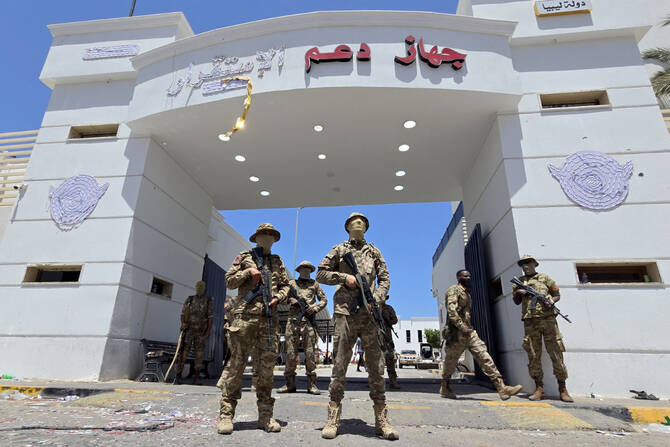
Libyan security forces stand guard outside a police building that they recaptured following overnight clashes in the southern district of Abu Salim in the capital Tripoli on May 13, 2025. (AFP/File)
Short Url
Updated 10 July 2025
Follow

UN mission in Libya urges immediate de-escalation in Tripoli

  • Call follows reports of continued military buildup in and around the capital city
  • Libya has had little stability since a 2011 NATO-backed uprising ousted longtime ruler Muammar Qaddafi

TRIPOLI: The UN Mission in Libya urged on Wednesday all Libyan parties to avoid actions or political rhetoric that could trigger escalation or renewed clashes in Tripoli, following reports of continued military buildup in and around the city.
Libyan Prime Minister Abdulhamid Al-Dbeibah ordered in May the dismantling of what he called irregular armed groups, which was followed by Tripoli’s fiercest clashes in years between two armed groups that killed at least eight civilians.
“The Mission continues its efforts to help de-escalate the situation and calls on all parties to engage in good faith toward this end ... Forces recently deployed in Tripoli must withdraw without delay,” the UN Mission said on social media.
A Tripoli-based Government of National Unity under Al-Dbeibah was installed through a UN-backed process in 2021 but the Benghazi-based House of Representatives no longer recognizes its legitimacy.
Libya has had little stability since a 2011 NATO-backed uprising ousted longtime autocrat Muammar Qaddafi. The country split in 2014 between rival eastern and western factions, though an outbreak of major warfare paused with a truce in 2020.
While eastern Libya has been dominated for a decade by commander Khalifa Haftar and his Libyan National Army, control in Tripoli and western Libya has been splintered among numerous armed factions. 


Purim parties shift to bomb shelters as Israelis celebrate under Iran war threat

Updated 6 sec ago
Follow

Purim parties shift to bomb shelters as Israelis celebrate under Iran war threat

  • Many cities had canceled or scaled down their Purim celebrations for the past two years due to the Israel-Hamas war
  • Purim, a holiday beloved by both religious and secular Jews, takes place in most of the Jewish world starting on Monday night

TEL AVIV: The Purim holiday is usually marked with boisterous street parades and costume parties to celebrate the Jewish victory over an ancient Persian ruler. This year, the celebrations moved into fortified bomb shelters as the country wages war against Iran’s modern-day leaders.
In Tel Aviv on Monday, people of all ages wearing sequined suits, bunny ears, pirate costumes and peacock feathers streamed into a mall’s underground parking lot that also functions as a bomb shelter for the traditional reading of the Purim story followed by a live band with dancing.
“It’s all about choosing happiness, choosing to be joyful, no matter what else is going on,” said Mariel Margulis, a Tel Aviv resident who had set up a tent in the parking garage and lived there for the past few days with her husband and 6-month old son. They dressed up as people having a bath, complete with bath robes, and their son, Amichai, as a rubber ducky, and created a bathtub play area for him next to their tent.
The story of Purim, told in the Book of Esther, follows Haman, an adviser to King Ahashverosh, as he plans to exterminate the Jews of the kingdom. The plan is foiled by Queen Esther and her cousin Mordechai. The story takes place in Shushan, Persia, in what is modern-day Iran.
“It feels biblical in proportions, what’s happening right now, and we’re doing the little bit we can, staying calm, staying joyful,” said Mariel. Nearby, Amichai slept through the loud “boos” from the crowd to drown out the name of Haman, the villain of the story, during a reading from the Book of Esther.
“It’s like the same plot of Purim with a different cast,” said Daniel Margulis, Mariel’s husband.
Purim, a holiday beloved by both religious and secular Jews, takes place in most of the Jewish world starting on Monday night. The holiday starts a day later in ancient walled cities, including Jerusalem.
In quiet times, families in colorful costumes throng downtown stretches, children eat copious amounts of traditional triangle cookies. It’s customary to dress up in costumes and drink large amounts of alcohol.
In Jerusalem, musicians set up on balconies overlooking the main drag and street parties in the stone alleys stretch into the evening.
Massive parties were planned this year after a two-year break. Many cities had canceled or scaled down their Purim celebrations for the past two years due to the Israel-Hamas war.
But celebrations were once again disrupted by war, after Israel and the US launched an attack against Iran on Saturday
“We came because the kids didn’t want to miss out on Purim, they were really excited to get dressed up,” said Elysa Rapoport, a Tel Aviv resident who works in investments. Her daughters dressed up as Barbie Cowgirl and Rumi from K-pop Demon Hunters.
With most Purim celebrations canceled, the family planned their walk to the Purim event to hopscotch between easy access to shelters. Iranian missiles have sent Israelis scurrying for shelters multiple times a day and night.
“This just feels surreal,” Rapoport said, looking over the celebrations, as hundreds of people gathered and danced under the parking lot’s fluorescent lights. Nearby, people and their dogs who had moved into the shelter for the duration of the war lounged on air mattresses, scrolling through their phones.
“It’s not the most optimal conditions, we’re used to our synagogue, but we’re here together with all of the nation of Israel,” said Gabi Grinshtain, a 39-year-old environmental consultant. “These are important days, and the setting is less important.”