KYIV: Russia targeted Ukraine with a record 728 drones overnight, hours after US President Donald Trump pledged to send more defensive weapons to Kyiv and aimed unusually sharp criticism at Russian President Vladimir Putin.
The attack was the latest in a series of escalating air assaults in recent weeks that have involved hundreds of drones in addition to ballistic missiles, straining Ukrainian air defenses at a perilous moment in the war, now in its fourth year.
Kyiv’s military downed almost all the drones but some of the six hypersonic missiles launched by Russia had caused unspecified damage, air force spokesperson Yurii Ihnat said on Ukrainian television.
President Volodymyr Zelensky, who will meet US envoy Keith Kellogg in Rome on Wednesday, said the strike showed the need for “biting sanctions” on the sources of income Russia uses to finance the war, including on those who buy Russian oil.
Trump said on Tuesday he was considering supporting a bill that would impose steep sanctions on Russia, including 500 percent tariffs on nations that buy Russian oil, gas, uranium and other exports.
“We get a lot of bull**** thrown at us by Putin ... He’s very nice all the time, but it turns out to be meaningless,” Trump said at a cabinet meeting.
When asked by a reporter what action he would take against Putin, Trump said: “I wouldn’t tell you. We want to have a little surprise.”
Separately, Europe is working on a new sanctions package against Moscow.
Trump, who returned to power this year promising a swift end to the war in Ukraine, has taken a more conciliatory tone toward Moscow in a departure from the Biden administration’s staunch support for Kyiv.
But initial rounds of talks between Russia and Ukraine to end the Kremlin’s February 2022 invasion have so far borne little fruit, with Moscow yet to accept an unconditional ceasefire proposed by Trump and accepted by Kyiv.
The US president’s promise to supply more defensive weapons appeared to reverse a Pentagon decision days earlier to stall some critical munitions supplies to Ukraine, despite increasing Russian attacks that have killed dozens in recent weeks.
Shortly after Wednesday’s attack, German Chancellor Friedrich Merz said that diplomatic means to resolve the war have been exhausted. He vowed to continue supporting Kyiv.
Following Trump’s new promise, Zelensky said on Tuesday he had ordered an expansion of contacts with the United States to ensure critical deliveries of military supplies, primarily air defense.
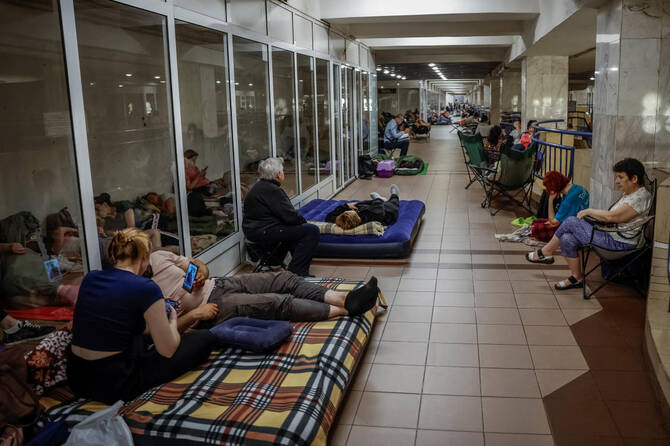
Residents of Kyiv and other major cities spent the night in air raid shelters including metro stations.
Part of Russia’s overnight strike was aimed at a western region close to NATO-member Poland. The northwestern city of Lutsk, some 200 km (125 miles) from Poland, was the main target, Zelensky said, listing 10 other provinces across Ukraine where damage was also reported.
Polish and allied aircraft were activated to ensure air safety, Poland’s military said.
In Lutsk, buildings were damaged but no deaths or injuries reported in what amounted to the biggest air strike of the war on the city of 200,000 people, regional authorities said.
A storage facility of a local enterprise and some parking structures were ablaze, said the city’s mayor, Ihor Polishchuk.
Ivan Rudnytskyi, governor of the Volyn region that includes Lutsk, said 50 Russian drones and five missiles were in the region’s airspace overnight.


![]()
![]()
![]()

Russia attacks Ukraine with 700 drones after Trump vows to send more weapons


Short Url
https://arab.news/j2uc3
Russia attacks Ukraine with 700 drones after Trump vows to send more weapons
- Zelensky calls for for 'biting sanctions' on the sources of income Russia uses to finance the war
- Residents of Kyiv and other major cities spend night in air raid shelters


Latest updates


© 2026 SAUDI RESEARCH & PUBLISHING COMPANY, All Rights Reserved And subject to Terms of Use Agreement.