

Turkiye urges dialogue after Pakistan-India tensions, condemns Israeli attacks on Iran and Gaza

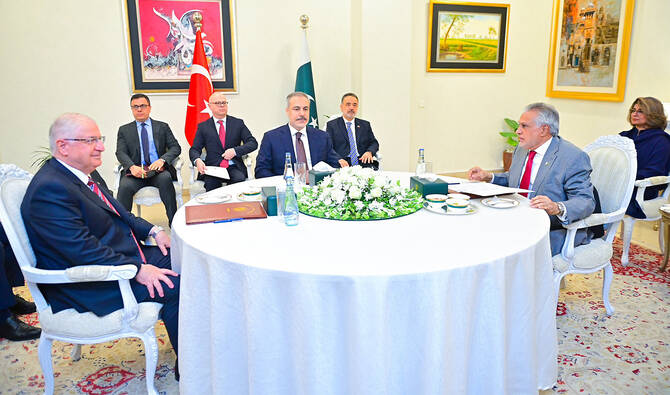
Pakistan's Foreign Minister Ishaq Dar (right) holds a meeting with Turkish Foreign Minister Hakan Fidan (center) and Defence Minister Yaşar Güler in Islamabad, Pakistan, on July 9, 2025. (Ministry of Foreign Affairs)
Short Url
Updated 09 July 2025
Follow

Turkiye urges dialogue after Pakistan-India tensions, condemns Israeli attacks on Iran and Gaza

  • Fidan praises Pakistan’s “calm attitude” during May tensions, warns of “severe results” of conflict between nuclear-armed states
  • Turkish foreign minister says Israeli strikes on Iran shift focus from Gaza “genocide,” calls for ceasefire, coordinated support for Palestinians

ISLAMABAD: Turkish Foreign Minister Hakan Fidan on Wednesday urged Pakistan and India to pursue “meaningful and efficient dialogue” to avoid future conflict, warning that an air war between the neighbors earlier this year highlighted the “severe” risks of escalation between two nuclear-armed states. 

In May 2025, the most intense India–Pakistan military confrontation in decades erupted following an April 22 attack in Indian-administered Kashmir, which killed 26 people. New Delhi, without providing evidence, said Islamabad was behind the assault, which denies the charge.

India responded on May 7 by launching a series of airstrikes targeting what it called suspected militant infrastructure in Pakistan. Pakistan retaliated with its own drone, artillery, and missile strikes. After four days of hostilities, a US-mediated ceasefire was agreed on May 10, halting the confrontation amid global alarm over the risk of escalation.

“In April-May, there has been tension experienced between Pakistan and India, which we closely followed, and all the international society has seen the wisdom-oriented and calm attitude of Pakistan,” Fidan said during a press conference in Islamabad.

“This tension has been an important indicator that when two nuclear powers come face to face that this is going to have very severe results,” he added. 

“We have actually seen this ceasefire as an important decision, and in order to eliminate similar tensions, we believe that there has to be meaningful and efficient dialogue between the parties. As Turkiye, we’re always ready to support this so that there will be peace and there will not be any clashes.”

Fidan, along with the Turkish defense minister, is visiting Pakistan as part of efforts to deepen bilateral ties and discuss regional security challenges, including the ongoing war in Gaza and rising tensions in the Middle East after Israel’s attacks on Iranian nuclear facilities and other targets last month.

“Unfortunately, the attacks have actually shaken the trust first toward the international regime on the prevention of nuclear expansions, and we have actually conveyed our messages to the parties [US, Iran] for the restart of the nuclear negotiations,” Fidan said.

“We’re in constant contact with Pakistan, and both countries are contacting both parties of the conflict. Turkiye believes that there has to be peaceful resolutions through negotiations, and we will continue to have a constructive contribution to this.”

Commenting on the Israeli military campaign in Gaza, which began in October 2023, Fidan said Turkiye condemned the ongoing Israeli attacks and supported an immediate and lasting ceasefire.

“Israel attacks are, and aggressions are, not just a risk for our region but for the whole world. At this current status quo, we do hope that the ceasefire will be permanent,” he said.

He added that the Israeli strikes on Iran had diverted international attention from what he described as the “massacre in Gaza and the genocide in Gaza.”

“Today, we [Turkiye and Pakistan] also discussed about the joint steps that we can take for our Palestinian brothers,” Fidan said.

“Within this plan, the Israel attacks and aggression should end, and we hope that peace will be brought to Gaza and calm will be established. We will continue to support the Palestinian people and the Palestinian cause.”


Pakistan terms climate change, demographic pressures as ‘pressing existential risks’

Updated 06 December 2025
Follow

Pakistan terms climate change, demographic pressures as ‘pressing existential risks’

  • Pakistan has suffered frequent climate change-induced disasters, including floods this year that killed over 1,000
  • Pakistan finmin highlights stabilization measures at Doha Forum, discusses economic cooperation with Qatar 

ISLAMABAD: Pakistan’s Finance Minister Muhammad Aurangzeb on Saturday described climate change and demographic pressures as “pressing existential risks” facing the country, calling for urgent climate financing. 

The finance minister was speaking as a member of a high-level panel at the 23rd edition of the Doha Forum, which is being held from Dec. 6–7 in the Qatari capital. Aurangzeb was invited as a speaker on the discussion titled: ‘Global Trade Tensions: Economic Impact and Policy Responses in MENA.’

“He reaffirmed that while Pakistan remained vigilant in the face of geopolitical uncertainty, the more pressing existential risks were climate change and demographic pressures,” the Finance Division said. 

Pakistan has suffered repeated climate disasters in recent years, most notably the 2022 super-floods that submerged one-third of the country, displaced millions and caused an estimated $30 billion in losses. 

This year’s floods killed over 1,000 people and caused at least $2.9 billion in damages to agriculture and infrastructure. Scientists say Pakistan remains among the world’s most climate-vulnerable nations despite contributing less than 1 percent of global greenhouse-gas emissions.

Aurangzeb has previously said climate change and Pakistan’s fast-rising population are the only two factors that can hinder the South Asian country’s efforts to become a $3 trillion economy in the future. 

The finance minister noted that this year’s floods in Pakistan had shaved at least 0.5 percent off GDP growth, calling for urgent climate financing and investment in resilient infrastructure. 

When asked about Pakistan’s fiscal resilience and capability to absorb external shocks, Aurangzeb said Islamabad had rebuilt fiscal buffers. He pointed out that both the primary fiscal balance and current account had returned to surplus, supported significantly by strong remittance inflows of $18–20 billion annually from the Middle East and North Africa (MENA) and Gulf Cooperation Council (GCC) regions. 

Separately, Aurangzeb met his Qatari counterpart Ali Bin Ahmed Al Kuwari to discuss bilateral cooperation. 

“Both sides reaffirmed their commitment to strengthening economic ties, particularly by maximizing opportunities created through the newly concluded GCC–Pakistan Free Trade Agreement, expanding trade flows, and deepening energy cooperation, including long-term LNG collaboration,” the finance ministry said. 

The two also discussed collaboration on digital infrastructure, skills development and regulatory reform. They agreed to establish structured mechanisms to continue joint work in trade diversification, technology, climate resilience, and investment facilitation, the finance ministry said.