

Presidents of five African nations to meet with Trump at White House

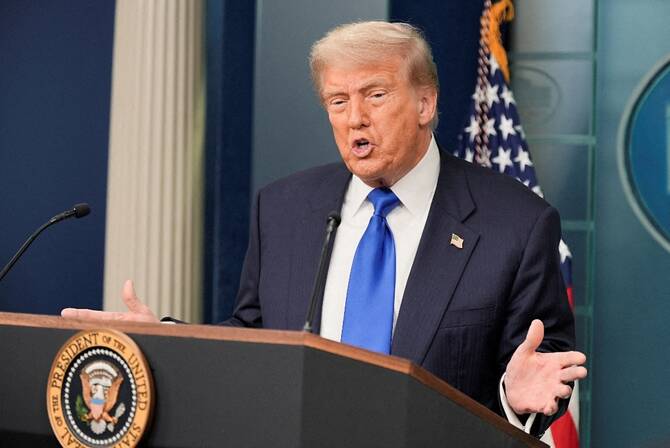
American President Donald Trump speaks to media in the Press Briefing Room at the White House in Washington, US. (Reuters)
Short Url
Updated 09 July 2025
Follow

Presidents of five African nations to meet with Trump at White House

  • The presidents of Senegal, Liberia, Guinea-Bissau, Mauritania and Gabon will convene at Trump's behest

DAKAR: US President Donald Trump will welcome five African leaders to a White House lunch on Wednesday, with commerce and trade expected to feature prominently among a mixed bag of potential agenda items.
The presidents of Senegal, Liberia, Guinea-Bissau, Mauritania and Gabon — five nations located along Africa’s Atlantic Coast — will convene at Trump’s behest.
Officials from the countries have told AFP that they expect talks to center on trade, investment and security, among other topics as they meet in the executive mansion’s State Dining Room.
But few concrete details have emerged as to the White House’s intentions.
The meeting comes as the Trump administration is focused on tariffs and trade deals, and as it seeks to ensure a stable supply of critical minerals.
But the five nations lack the extreme mineral wealth of other African countries, such as the Democratic Republic of Congo.
The gathering additionally takes place just days after the Trump administration celebrated the formal shuttering of the US foreign aid agency USAID, trumpeting the move as an end to the “charity-based model.”
Officials from the five countries who spoke to AFP seemed keenly aware of the White House ethos.
Liberia’s President Joseph Boakai accepted the invitation with an eye on no longer being “solely (an) aid recipient,” his press secretary Kula Fofana told AFP on Tuesday.
“Our interest is to look more to trade and engagement partners who will invest,” she said.
Gabonese presidential spokesman Theophane Biyoghe said the meeting marked a chance for synergies “centered around the industrialization of our economy.”

US arch rivals China and Russia have made major incursions into the region recently, including substantial investments by Beijing in a number of the countries.
Moscow, meanwhile, has lent support to the region’s newly formed Alliance of Sahel States (AES), comprised of junta-led Mali, Burkina Faso and Niger.
The alliance states share borders with several of the counties at Wednesday’s lunch.
Security and drugs could additionally feature on the White House agenda.
In April, Guinea-Bissau said it had turned over four convicted Latin American drug smugglers to the US DEA drug enforcement authority.
The country is often used as a transit zone for moving cocaine from Latin America to Europe and beyond.
Shortly before leaving for Washington, Guinea-Bissau President Umaro Sissoco Embalo described the visit to the press as “very important” for his country.
“Economically, this is a great opportunity opening for us,” he declared, adding that he hoped his country would also benefit from “the support” the United States provides to other countries.

A number of world leaders have faced brutal political ambushes during White House visits.
Among them are Ukrainian President Volodymyr Zelensky, who became embroiled in a notorious row with Trump, and South African President Cyril Ramaphosa.
During a visit, Trump showed the South African leader a video of baseless claims of a “white genocide” being committed in his country.
While those episodes happened in front of cameras in the Oval Office, the five African presidents meeting Trump on Wednesday are so far not scheduled to appear before the press.
White House Press Secretary Karoline Leavitt shared few details about the meeting when she told a briefing on Monday only that Trump would “host leaders of five African nations for lunch” in the State Dining Room.
Gabon, Liberia, Mauritania and Senegal are among 36 nations that the United States is considering adding to a travel ban barring entry to its territory, according to an internal administration memo last month.


India rolls out strictest anti-pollution curbs as toxic smog engulfs Delhi

Demonstrator wearing an oxygen mask and holding oxygen tanks takes part in protest.
Updated 14 December 2025
Follow

India rolls out strictest anti-pollution curbs as toxic smog engulfs Delhi

  • Private monitors in several parts of northern Delhi recorded AQI spikes between 550 and 700s
  • Authorities invoked stage four of the capital region’s emergency pollution-control framework

NEW DELHI: India’s capital choked under a thick blanket of smog on Sunday, with the government imposing anti-pollution curbs after monitoring stations in some areas recorded extremely hazardous air quality.

Home to 30 million people, Delhi has not recorded a single “clean air” day in 2025, with Air Quality Index readings hitting high above the 50 score throughout the year.

On the AQI scale from 0 to 500, good air quality is represented by levels below 50, while levels above 300 are dangerous.

Worsening since late October, official records over the weekend were in the severe to severe-plus range of 400–500, but as 24-hour averages, they did not capture the peaks. Private monitors in several parts of North and North West Delhi recorded AQI spikes above 550 and even into the 700s in real-time.

On Saturday evening, the Ministry of Environment’s Commission for Air Quality Management invoked stage four — the highest level — of the Graded Response Action Plan for Delhi and surrounding areas.

To “prevent further deterioration of air quality in the region,” the commission suspended all non-essential construction, shut stone crushers and mining operations, stopped entry of trucks into the capital region, and ordered schools to shift to hybrid classes or online, where possible.

While authorities blamed the pollution on “adverse meteorological conditions,” residents have been demanding more government action.

“The situation is so bad in Delhi that we don’t have any option but to force kids to do online classes. The government has failed us; it has not done anything to address the issue,” said Nabanita Nayak, who decided for her teenage children to attend school online only, despite concerns over their screen addiction.

“If the kids are too much in front of laptops, that’s also an issue. As a mother, I am worried.” 

Delhi’s pollution has been worsening since Diwali in late October, when the average AQI has been above 370, or “very poor.” Since mid-November, it has been over 400, which means “severe” air quality, with certain areas recording 500 and above, which is classified as a “hazardous” level.

“I don’t feel proud living in Delhi. It’s the capital city of the country … We talk about being a developed nation by 2047 — we have deadlines,” said Jagriti Arora, who is keeping her 7-year-old daughter at home to prevent allergy flare-ups caused by air pollution.

“The government has to do something … China had a big problem with pollution, but now they’ve managed to bring it down.”

Delhi’s air quality deteriorates in winter due to local emissions and seasonal weather conditions. Cold temperatures and low wind speeds result in a temperature inversion, which traps pollutants close to the ground instead of letting them disperse. This allows emissions from millions of vehicles, ongoing construction, and nearby industrial activity to accumulate in the air. Urban waste burning and dust from construction sites further add to it.

“This is not a new thing. This has been happening now for over 10 years,” Arora said. “You can see it. You don’t need to actually look at an AQI meter to see how bad the pollution is these days.”