

Bangladesh’s garment industry eying GCC growth as exports to Saudi Arabia rise

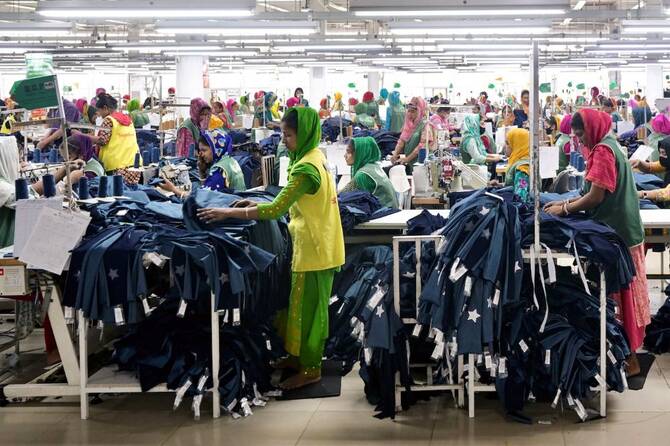
Bangladeshi garment workers tailor clothes at their sewing stations in a factory in Tongi, on the outskirts of Dhaka on July 6, 2025. (AFP)
Short Url
Updated 08 July 2025
Follow

Bangladesh’s garment industry eying GCC growth as exports to Saudi Arabia rise

  • Garment exports to the Kingdom surged 7.3% YOY in 2024-25
  • Apparel producers see untapped potential for high-end fashion exports

DHAKA: Bangladesh’s ready-made garment industry is seeing growing demand in Saudi Arabia, industry leaders say, as they look to the Kingdom as a key market for expansion in the Gulf region.

The garment sector is a key driver of the Bangladeshi economy. The country is one of the largest garment exporters in the world, second only to China. The industry accounts for more than 80 percent of Bangladesh’s total foreign sales revenue.

The newest data from the Export Promotion Bureau shows that garment exports to Saudi Arabia were valued at $152 million in the fiscal year 2024–25, up by 7.3 percent year-on-year.

The upward trend reflects growing interest from Saudi buyers in Bangladeshi apparel, particularly items such as T-shirts and jeans, according to Akhter Hossain Apurbo, vice president of the Bangladesh Knitwear Manufacturers and Exporters Association.

“We have strong potential for increasing exports to the GCC region, with Saudi Arabia and the UAE being the most significant markets,” he told Arab News.

Major European brands with retail outlets in Saudi Arabia place orders with Bangladeshi producers who deliver products directly to Saudi ports.

“We export to wholesale buyers and later on retailers sell these goods across the region,” Apurbo said. “Mostly Saudi locals are buying these Bangladeshi-made garments.”

Garment exports to Saudi Arabia have been growing consistently over the past few years. In the 2022–23 fiscal year, they were valued at $130 million — a major increase from the $84 million recorded in 2020-21, when production was stalled by the COVID-19 pandemic.

“Saudi Arabia is a growing and potential market for our garment exporters as there is a captive market of about 3 million Bangladeshi migrants,” said Mohiuddin Rubel, former director of the Bangladesh Garment Manufacturers and Exporters Association.

“Saudi citizens are also our target customers. Bangladesh makes world-class garment products and Saudis have good taste in clothing and they can afford it ... most of these buyers choose renowned European and American brands.”

Rubel sees significant untapped potential for high-end garment products and local Bangladeshi brands to enter the Saudi market.

“We have to focus on increasing exports to Saudi Arabia and other Middle Eastern countries, aiming to reduce our dependency on the EU and US markets. It’s the need of the hour,” he said.

“We need to focus on building our own brands (for the Middle Eastern market) besides producing clothes for internationally renowned brands. We have some competitive advantages as the goods will reach their destinations in a shorter time, with lower freight costs ... it will also help us increase product diversity.”


Lawsuit challenges Trump administration’s ending of protections for Somalis

Updated 10 March 2026
Follow

Lawsuit challenges Trump administration’s ending of protections for Somalis

  • The lawsuit cites a series of statements Trump has made describing Somalis as “garbage” and “low IQ people” who “contribute nothing.”

BOSTON: Immigrant rights advocates filed a lawsuit on Monday seeking to stop US President Donald Trump’s administration from next ​week ending legal protections that allow nearly 1,100 Somalis to live and work in the United States. The lawsuit, brought by four Somalis and two advocacy groups, challenges the US Department of Homeland Security’s decision to end Temporary Protected Status for Somali immigrants, whom Trump has derided in public remarks. Outgoing Homeland Security Secretary Kristi Noem in January announced that TPS for Somalis would end on March 17, arguing that Somalia’s conditions had improved, despite fighting continuing between Somali forces and Al-Shabab militants. The plaintiffs, who ‌include the groups ‌African Communities Together and Partnership for the Advancement ​of ‌New ⁠Americans, in the ​lawsuit filed ⁠in Boston federal court argue the move was procedurally flawed and driven by a discriminatory, predetermined agenda.
The lawsuit cites a series of statements Trump has made describing Somalis as “garbage” and “low IQ people” who “contribute nothing.”
The plaintiffs said the administration is ending TPS for Somalia and other countries due to unconstitutional bias against non-white immigrants, not based on objective assessments of country conditions.
“The termination of TPS for Somalia is racism masking as immigration policy,” ⁠Omar Farah, executive director at the legal group Muslim Advocates, said ‌in a statement.
DHS did not respond to ‌a request for comment. It has previously said TPS ​was “never intended to be a de ‌facto amnesty program.”
TPS is a form of humanitarian immigration protection that shields eligible migrants ‌from deportation and allows them to work. Under Noem, DHS has moved to end TPS for a dozen countries, sparking legal challenges. The administration on Saturday announced plans to pursue an appeal at the US Supreme Court in order to end TPS for over 350,000 Haitians. It ‌also wants the high court to allow it to end TPS for about 6,000 Syrians.

SOMALI COMMUNITY TARGETED
Somalia was first designated ⁠for TPS in ⁠1991, with its latest extension in 2024. About 1,082 Somalis currently hold TPS, and 1,383 more have pending applications, according to DHS. Somalis in Minnesota in recent months had become a target of Trump’s immigration crackdown, with officials pointing to a fraud scandal in which many people charged come from the state’s large Somali community. The Trump administration cited those fraud allegations as a basis for a months-long immigration enforcement surge in Democratic-led Minnesota, during which about 3,000 immigration agents were deployed, spurring protests and leading to the killing of two US citizens by federal agents.
In November, Trump announced he would end TPS for Somalis in Minnesota, and a month later said ​he wanted them sent “back to where they ​came from.”
The US Department of State advises against traveling to Somalia, citing crime and civil unrest among numerous factors.