

Cambodian garment workers fret Trump’s new tariff threat

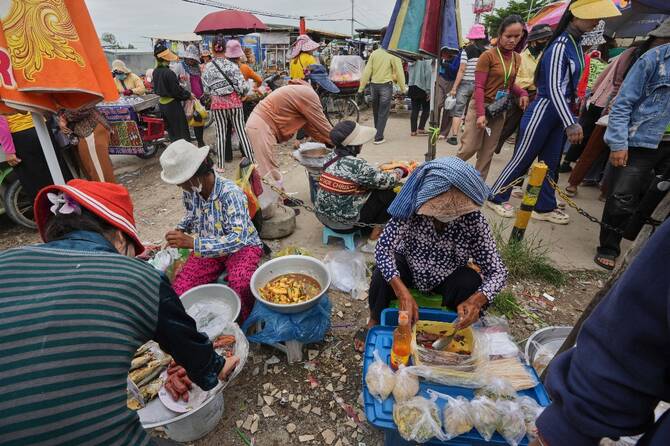
Cambodian garment workers buy food for lunch during their lunch break on a sidewalk at Ang Tako village outside Phnom Penh, Cambodia. (AP)
Short Url
Updated 08 July 2025
Follow

Cambodian garment workers fret Trump’s new tariff threat

  • Cambodia, a major manufacturer of low cost clothing for Western brands, was among the nations hardest hit by Trump’s “Liberation Day” blitz of tariff threats in April

PHNOM PENH: As Cambodian garment workers took breaks from toiling in sweltering factories on Tuesday, they feared for their jobs after US President Donald Trump’s threat to impose a 36 percent tariff.

“I beg the US to reduce the tariff for the sake of workers in Cambodia,” 38-year-old Im Sothearin told AFP as she rested from her work in an underwear factory in the capital Phnom Penh.

“If they charge a high tariff, it is only workers who are going to suffer,” said the mother-of-three who earns only $300 a month.

“Factories might be closed or workers will have their wages lowered, or be forced to work faster.”

Cambodia — a major manufacturer of low-cost clothing for Western brands — was among the nations hardest hit by Trump’s “Liberation Day” blitz of tariff threats in April.

The US president originally outlined a 49-percent rate if Cambodia failed to broker a deal with Washington. On Monday, he lowered it to 36 percent and extended the negotiation deadline to August 1.

While the levy is lower than the original eye-watering figure, it has done little to allay anxieties.

“If the tariff is that high, companies won’t have money to pay,” 28-year-old pregnant worker Sreymom, who goes by only one name, told AFP as she bought fruit on her lunch break.

“I am worried that we won’t have jobs to do,” the 11-year veteran of the factory floor said. “I want the tariff to be reduced more.”

Cambodia’s chief negotiator in talks with Washington called the reduction in the proposed rate — announced in a letter among more than a dozen Trump despatched to trade partners — a “huge victory.”

“We are so successful in negotiations,” Deputy Prime Minister Sun Chanthol told reporters in Phnom Penh. “We still have a chance to negotiate further to reduce the tariff rate more.”

But back in April commerce ministry spokesman Penn Sovicheat told AFP that harsh US tariffs on his country were “not reasonable.”

Cambodia said it had about $10 billion in exports to the United States last year, mainly garment products.

The nation has been paying a 10-percent standby rate as negotiators rush to make a deal.

Many factories in Cambodia are Chinese-owned. The White House previously accused the kingdom of allowing Chinese goods to stop over on the way to US markets, thereby skirting steeper rates imposed on Beijing.

Yi Mom has had a two-decade career in the garment industry. But she frets it may be ended if Cambodia fails to soften the blow threatened by the United States.

“I fear that the high tariff will affect factories and will result in fewer jobs for workers,” said the 47-year-old.

“Then we will have low wages and will not be able to support our families.”


Taiwan police rule out ‘terrorism’ in metro stabbing

Updated 59 min 26 sec ago
Follow

Taiwan police rule out ‘terrorism’ in metro stabbing

  • Taiwan police on Sunday ruled out “terrorism” in a metro stabbing in the capital Taipei, where an attacker killed three and wounded 11

TAIPEI: Taiwan police on Sunday ruled out “terrorism” in a metro stabbing in the capital Taipei, where an attacker killed three and wounded 11.
A 27-year-old man, identified by police by his family name Chang, set off smoke bombs at Taipei Main Station metro on Friday afternoon before launching into a three hour stabbing spree.
The attacker then moved to a shopping district near Zhongshan station, authorities said.
“Based on what we have established so far in the investigation, the suspect Chang did not make or display any statements or views related to politics, religion, or any specific ideology, and we have preliminarily ruled out terrorism,” a senior Taipei City Police Department official told AFP, under the condition of anonymity.
“Terrorist attacks have a specific definition and the suspect does not meet that definition,” he added.
Taipei Mayor Chiang Wan-an said the suspect was found dead the same day, after jumping off a nearby building.
The senior police official said investigators also found searches for “random killings” on Chang’s iPad, including material related to a Taipei metro stabbing in 2014 when a man killed four people.
Chang had served in the military but was discharged over driving under the influence of alcohol, according to police, who said he was wanted after he failed to report for reserve military training.
Taiwan requires former soldiers to undergo seven to 14 days of reserve training within eight years of discharge. Failure to report is treated as evasion of military service.
In the immediate aftermath of the Friday stabbing, officials called the attack “deliberate” but said the motive was not clear.
Police said they believe Chang had acted alone and planned to “randomly kill people.” He rented an apartment in the district in January and scouted the area in advance.
The city doubled its police deployment for the Taipei Marathon on Sunday and is expected to conduct a “high-intensity” drill at metro stations ahead of New Year’s Eve, the mayor said.
Taiwan’s President Lai Ching-te said on Saturday that authorities should be “more cautious and proactive” and improve emergency protocols.
Lai said the police must be “trained and equipped for counter-terrorism operations” to protect citizens.
Metro Taipei announced that it had shut down a Christmas market near Zhongshan station on Saturday, which will remain closed for three days in honor of the victims.