

Pakistan urges world to accept Taliban’s de facto rule to avoid new Afghan conflict

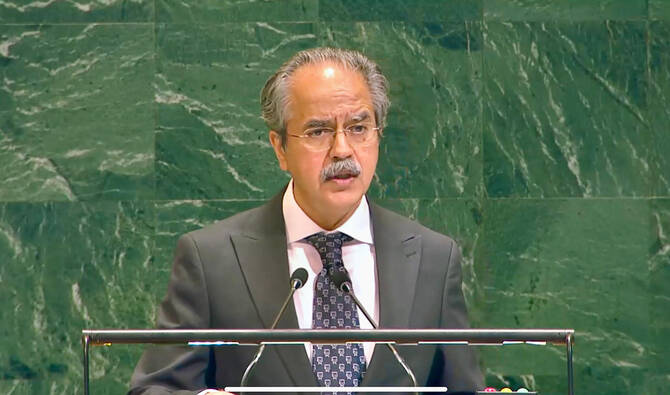
Pakistan's Ambassador to the United Nations, Asim Iftikhar Ahmad, speaking to the United Nations General Assembly in New York, US, on July 7, 2025. (@PakistanUN_NY/X)
Short Url
Updated 08 July 2025
Follow

Pakistan urges world to accept Taliban’s de facto rule to avoid new Afghan conflict

  • Pakistan has not officially recognized Taliban government in Afghanistan, which seized Kabul in August 2021
  • Pakistan’s UN ambassador says militant groups from Afghanistan are a threat to Islamabad’s national security

ISLAMABAD: Pakistan’s United Nations Ambassador Asim Iftikhar Ahmad this week called on the international community to acknowledge the de facto Taliban rule in Afghanistan, warning that failure to do so could risk igniting another conflict in the war-torn country. 

Pakistan has not officially recognized the Taliban government in Afghanistan, which seized Kabul in August 2021 after the chaotic withdrawal of US-led coalition forces from the country, but has retained high-level diplomatic engagement with Kabul. Islamabad has also called on the international community to engage with the Taliban government and unfreeze Afghanistan’s financial assets to ward off the country’s humanitarian crisis. 

Ahmad’s statement follows Russia’s move to become the first country to recognize the Taliban last week as it accepted the credentials of a new ambassador of Afghanistan. 

“We should acknowledge that there is one authority that controls the territory of Afghanistan with no credible challenge to it,” Ahmad said on Monday, during a UN General Assembly plenary meeting on Afghanistan. “We must avoid actions that could ignite another conflict in Afghanistan which can affect the entire region.”

Pakistan and Afghanistan have had rocky relations mainly due to a spike in militancy in Pakistan’s western regions that border Afghanistan. Islamabad says anti-Pakistan militants carry out cross-border attacks using safe havens in Afghanistan, a charge Kabul denies. Another source of tension has been Pakistan’s drive to expel Afghans, which first began in Nov. 2023.

Ahmad warned that “terrorism” emanating from Afghanistan continues to be a serious threat to its neighbors, particularly Pakistan. He said Daesh and other militant entities such as the Al-Qaeda, the Tehreek-e-Taliban Pakistan (TTP) and Baloch militant groups continue to operate from “ungoverned spaces” in Afghanistan.

He said the TTP is directly threatening Pakistan’s national security with 6,000 fighters at its disposal, alleging that Islamabad has evidence of the outfit’s collaboration with Baloch militant groups to disrupt infrastructure and economic development projects in Pakistan.

“The international community must speak with a unified voice to hold the de facto authorities to their commitments, including not to allow the use of Afghan soil against any country and to ensure the shared goal of a stable and prosperous Afghanistan free from terrorism, at peace within, and without,” Ahmad said. 

The Pakistani envoy said Islamabad is ready to support regional and international engagement efforts with Afghanistan via clear objectives, reciprocal steps and a realistic roadmap. 

“What could not be realized through force, will not be achieved through isolation, sanctions or financial coercion,” he said. 

The development took place the same day that Pakistan and Afghanistan held the inaugural additional secretary-level talks between the two countries, pursuant to the decisions reached during the visit of Pakistan’s Deputy Prime Minister Ishaq Dar to Kabul in April. 

The two sides discussed deepening trade and transit cooperation, militancy, the deportation of Afghan refugees from the country and the legal travel of the citizens of the two nations in the talks on Monday.


Pakistan, UK sign £35 million Green Compact to strengthen climate resilience

Updated 21 December 2025
Follow

Pakistan, UK sign £35 million Green Compact to strengthen climate resilience

  • Pakistan ranks among nations most vulnerable to climate change and has seen erratic changes in its weather patterns
  • UK will help Pakistan mobilize climate finance, strengthen regulatory frameworks and develop bankable climate projects

ISLAMABAD: Pakistan and the United Kingdom (UK) have formalized a comprehensive climate partnership with the launch of a Green Compact that aims to enhance climate resilience, accelerate clean energy transition and scale up nature-based solutions, including mangrove conservation, Pakistani state media reported on Sunday.

The agreement, signed in Islamabad by Federal Minister for Climate Change and Environmental Coordination Dr. Musadik Malik and UK Minister for International Development Jennifer Chapman, unlocks £35 million in targeted support for green development and long-term climate action, according to Radio Pakistan broadcaster.

Pakistan ranks among nations most vulnerable to climate change and has seen erratic changes in its weather patterns that have led to frequent heatwaves, untimely rains, storms, cyclones, floods and droughts in recent years. In 2022, monsoon floods killed over 1,700 people, displaced another 33 million and caused over $30 billion losses, while another 1,037 people were killed in floods this year.

Mohammad Saleem Shaikh, a spokesperson for Pakistan’s Ministry of Climate Change, described the compact as a “decisive move toward action-oriented climate cooperation,” noting that its implementation over the next decade will be critical for Pakistan which regularly faces floods, heatwaves and water stress.

“The Compact is structured around five core pillars: climate finance and investment, clean energy transition, nature-based solutions, innovation and youth empowerment, and adaptation and resilience,” the report read.

“Under the agreement, the UK will work with Pakistan to mobilize public and private climate finance, strengthen regulatory frameworks for green investment, and develop bankable climate projects.”

Clean energy forms a central component of Pakistan’s transition, with Islamabad planning to expand solar and wind generation to reduce fossil fuel dependence, improve energy security and stabilize power costs, according to Shaikh.

“Renewable energy is now economically competitive, making the transition both environmentally and financially viable,” he was quoted as saying.

“Nature-based solutions, particularly large-scale mangrove restoration, will protect coastal communities from storm surges and erosion while enhancing biodiversity and carbon sequestration.”

Under the Compact, technical support, mentoring and access to investors will be provided to climate-smart startups and young innovators, reflecting Pakistan’s recognition of youth-led initiatives as central to future climate solutions.

On the occasion, Chapman, on her first official visit to Pakistan, underscored the urgency of climate action, highlighting the UK’s support for renewable energy, mangrove and ecosystem restoration, early-warning systems, climate budgeting and international investment flows into Pakistan.

Shaikh described the Green Compact as “a strategic turning point” in Pakistan–UK relations on climate change, saying its effective implementation is essential for Pakistan to meet its national climate targets.