

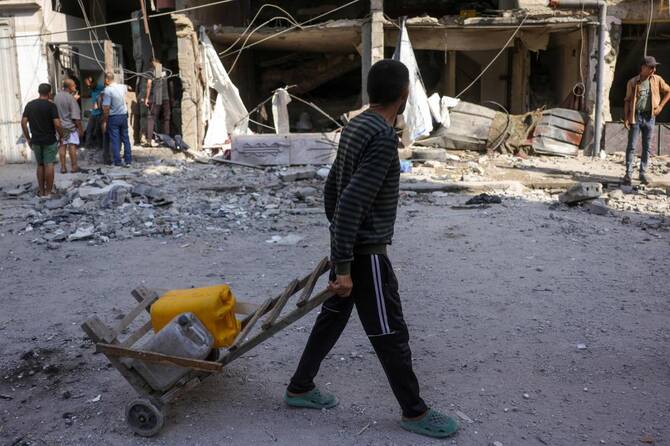
Israeli airstrikes in Gaza kill 33 Palestinians

The Israeli military had no immediate comment on the individual strikes, but said it struck 130 targets across the Gaza Strip in the last 24 hours. (AFP)
Short Url
Updated 06 July 2025
Follow

Israeli airstrikes in Gaza kill 33 Palestinians

  • Israel’s military said it has struck over 100 targets in the embattled enclave in the past day
  • The strikes occur as efforts to reach a ceasefire deal appeared to gain momentum

DEIR Al-BALAH, Gaza Strip: Israeli airstrikes killed at least 33 Palestinians in Gaza, hospital officials said on Sunday, as Israel’s military said it has struck over 100 targets in the embattled enclave in the past day.

The fighting came as Israeli Prime Minister Benjamin Netanyahu was preparing to fly to Washington for talks at the White House aimed at pushing forward ceasefire efforts.

President Donald Trump has floated a plan for an initial 60-day ceasefire that would include a partial release of hostages held by Hamas in exchange for an increase in humanitarian supplies allowed into Gaza. The proposed truce calls for talks on ending the 21-month war altogether.

Israel strikes dozens of targets

Twenty people were killed and 25 wounded after Israeli strikes hit two houses in Gaza City, according to Mohammed Abu Selmia, the director of Shifa Hospital that services the area.

In southern Gaza, 13 Palestinians were killed by strikes in Muwasi, an area on Gaza’s Mediterranean where many displaced people live in tents, officials at Nasser Hospital in neaby Khan Younis said. Five of the dead belonged to the same family according to the hospital.

The Israeli military had no immediate comment on the individual strikes, but said it struck 130 targets across the Gaza Strip in the last 24 hours.

It said the strikes targeted Hamas command and control structures, storage facilities, weapons and launchers, and that they killed a number of militants in northern Gaza.

The war began when Hamas attacked Israel on Oct. 7, 2023, killing some 1,200 people and taking 251 others hostage.

Israel responded with an offensive that has killed over 57,000 Palestinians, more than half of them women and children, according to Gaza’s Health Ministry.

The ministry, which is under Gaza’s Hamas government, does not differentiate between civilians and combatants. The UN and other international organizations see its figures as the most reliable statistics on war casualties.

Ceasefire deal being discussed

The strikes occur as efforts to reach a ceasefire deal appeared to gain momentum. Israeli Prime Minister Benjamin Netanyahu ‘s office said his government will send a negotiating team to talks in Qatar on Sunday to conduct indirect talks, adding that Hamas was seeking “unacceptable” changes to the proposal.

The planned talks in Qatar comes ahead of Netanyahu’s planned visit on Monday to Washington to meet US President Donald Trump to discuss the deal. It is unclear if a deal will be reached ahead of Netanyahu’s White House meeting.

Hamas has sought guarantees that the initial truce would lead to a total end to the war and withdrawal of Israeli troops from Gaza. Previous negotiations have stalled over Hamas demands of guarantees that further negotiations would lead to the war’s end, while Netanyahu has insisted Israel would resume fighting to ensure the militant group’s destruction.


Last Christians gather in ruins of Turkiye’s quake-hit Antakya

Updated 5 sec ago
Follow

Last Christians gather in ruins of Turkiye’s quake-hit Antakya

  • Saint Peter’s, one of the world’s oldest rock churches, is a sacred rallying point for the isolated Christians still left in quake-hit Antakya in southeastern Turkiye
ANTAKYA: Saint Peter’s, one of the world’s oldest rock churches, is a sacred rallying point for the isolated Christians still left in quake-hit Antakya in southeastern Turkiye, the city known in ancient times as Antioch.
“Since the earthquake, our community has scattered,” said worshipper Mari Ibri.
“Those who remain are trying to regroup. We each had our own church but, like mine, they have been destroyed.”
The landscape around the cave remains scarred by the disaster nearly three years ago, when two earthquakes devastated Hatay province on February 6, 2023 and its jewel, Antakya, the gateway to Syria.
Sad fields of rubble and the silhouettes of cracked, abandoned buildings still scar the city — all enveloped in the ever-present grey dust.
Since the earthquakes, Antakya city has emptied and the Christian community has shrunk from 350 families to fewer than 90, Father Dimitri Dogum told AFP.
“Before, Christmas at our house was grandiose,” Ibri recalled.
“Our churches were full. People came from everywhere.”
Ibri’s own church in the city center was rendered inaccessible by the earthquakes.
Now she and other worshippers gather at the cave on December 24 — Christmas Eve in some Christian calendars.
It is here, they believe, that Peter, the disciple Jesus assigned to found the Christian church, held his first religious service in the 1st century.
The rock church was later enlarged and 11th-century crusaders added a pale stone facade.
It is now a museum, opened to the faithful only on rare occasions.
Christmas Eve is one.
The morning sun was still glowing red in the sky when Fadi Hurigil, leader of Antakya’s Orthodox Christian community, and his assistants prepared the service.
They draped the stone altar and unpacked candles, holy oil, chalices and plastic chairs.
Out in front they placed figurines of Christ and three saints near a bottle of rough red wine, bread baskets and presents for the children.
The sound system played a recording of the bells of Saint Peter and Paul church, which now stands empty in Antakya city center.
“That was my church,” said Ibri, crossing herself. “They recorded the peals.”
Around one hundred worshippers soon squeezed into the incense-filled cave and at least as many congregated outside.
A large police contingent looked on. Sniffer dogs had already inspected the cave and esplanade.
“It’s normal,” said Iliye, a 72-year-old from Iskenderun, 60 kilometers (40 miles) further north. “We’re a minority. It’s to protect us.”
The slow chanting of Orthodox hymns heralded the start of the two-hour service, conducted entirely in chants sung in Arabic and Turkish by Dogum and another cleric.
“It’s very moving for us to be here in the world’s first cave church, where the first disciples gathered,” the priest said.
“There used to be crowds here,” he added.
“In 2022, there were at least 750 people outside, Christians and non-Christians alike.”
Since the earthquakes, the gathering has been much smaller, although it is now starting to grow again.
At the end of the service, when Christmas carols fill the air, Dogum and Hurigil cut a huge rectangular cake.
The Nativity scene at its center — Mary, baby Jesus, the ox and the ass — was edged with whipped cream.
“There’s the religious dimension but it’s also important that people can gather here again,” a worshipper said.
“After February 6, our fellow citizens scattered. But they’re starting to come back. We’re happy about that.”