



WASHINGTON/KYIV: US President Donald Trump said Russia just wanted to “keep killing people” and hinted at sanctions after Moscow launched its largest ever drone and missile attack on Ukraine in the three-year-old war.
Trump said Friday he was “very unhappy” about his telephone call with Russian leader Vladimir Putin, saying: “He wants to go all the way, just keep killing people, it’s no good.”
The US president said he and Putin talked about sanctions “a lot,” adding: “He understands that it may be coming.”
Hours-long Russian bombardments sent Ukrainians scurrying for shelters across the country and came after the call between Trump and Putin, which ended without a breakthrough.
The attack on Kyiv began the same day a phone call took place between Trump and Putin.
Asked if he made any progress during his call with Putin on a deal to end the fighting in Ukraine, Trump said: “No, I didn’t make any progress with him today at all.”
“I’m very disappointed with the conversation I had today with President Putin because I don’t think he’s there. I don’t think he’s looking to stop (the fighting), and that’s too bad,” Trump said.
According to Yuri Ushakov, Putin’s foreign affairs adviser, the Russian leader emphasized that Moscow will seek to achieve its goals in Ukraine and remove the “root causes” of the conflict.
“Russia will not back down from these goals,” Ushakov told reporters after the call.
Russia’s army crossed the border on Feb. 24, 2022, in an all-out invasion that Putin sought to justify by falsely saying it was needed to protect Russian-speaking civilians in eastern Ukraine and prevent the country from joining NATO.
Zelensky has repeatedly called out Russian disinformation efforts.
The Kremlin said Friday it was “preferable” to achieve the goals of its invasion through political and diplomatic means.
“But as long as that is not possible, we are continuing the special operation,” spokesman Dmitry Peskov said, referring to Russia’s invasion.
At least three people were wounded in Russian drone and artillery strikes on several parts of Eastern Ukraine overnight Friday to Saturday, regional governor Sergiy Lysak said on Telegram.
Zelensky said Friday air alerts began echoing out across the country as the Trump-Putin call was getting under way.
He urged the United States in particular to increase pressure on Moscow, which on Friday announced fresh territorial gains on the front line with the capture of a village in the Donetsk region.
Poland said its embassy building in Kyiv had been damaged in the attack but that staff were unharmed.
In Kyiv, one person was pulled from the rubble after the strikes, which also wounded at least 26 people, emergency services said.
The barrage, according to the air force, comprised 539 drones and 11 missiles.
A representative of Ukraine’s air force told Ukrainian media that the attack was the largest of the Russian invasion.
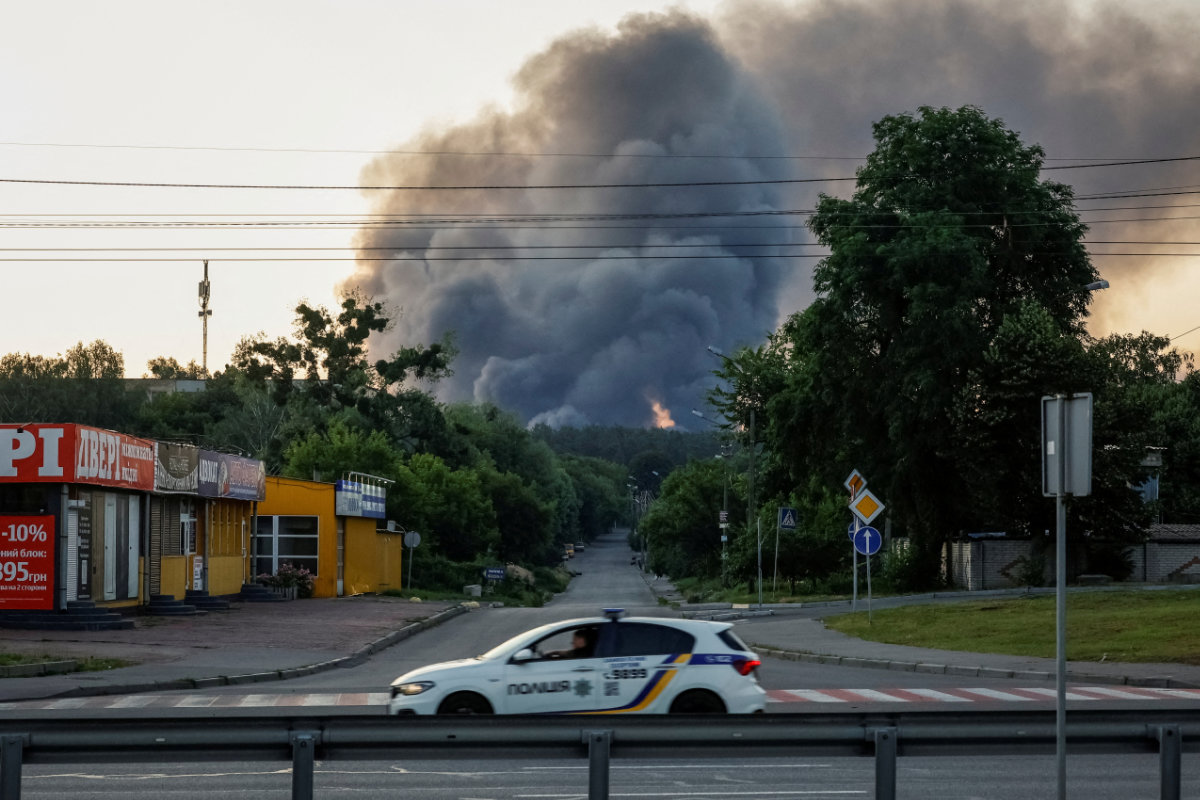
Smoke is seen from outskirts of Kyiv after a Russian drone and missile strike on July 4, 2025. (REUTERS)
Russia has been stepping up its long-range attacks on Ukrainian cities. Less than a week ago, Russia launched what was then the largest aerial assault of the war. That strategy has coincided with a concerted Russian effort to break through parts of the roughly 1,000-kilometer (620-mile) front line, where Ukrainian troops are under severe pressure.
Russia launched 550 drones and missiles across Ukraine during the night, the country’s air force said. The majority were Shahed drones, but Russia also launched 11 missiles in the attack.
Alya Shahlai, a 23-year-old Kyiv wedding photographer, said that her home was destroyed in the attack.
“We were all in the (basement) shelter because it was so loud, staying home would have been suicidal,” she told The Associated Press. “We went down 10 minutes before and then there was a loud explosion and the lights went out in the shelter, people were panicking.”
Five ambulances were damaged while responding to calls, officials said, and emergency services removed more than 300 tons of rubble.
Trump, Zelensky talks
In Friday’s call, Zelensky said he congratulated Trump and the American people on Independence Day and thanked the United States for its continued support.
They discussed a possible future meeting between their teams to explore ways of enhancing Ukraine’s protection against air attacks, Zelensky said.
He added that they talked in detail about defense industry capabilities and direct joint projects with the US, particularly in drone technology. They also exchanged views on mutual procurement, investment, and diplomatic cooperation with international partners, Zelensky said.
Peace efforts have been fruitless so far. Recent direct peace talks have led only to sporadic exchanges of prisoners of war, wounded troops and the bodies of fallen soldiers. No date has been set for further negotiations.
Ukrainian officials and the Russian Defense Ministry said another prisoner swap took place Friday, though neither side said how many soldiers were involved. Zelensky said most of the Ukrainians had been in Russian captivity since 2022. The Ukrainian soldiers were classified as “wounded and seriously ill.”
Constant buzzing of drones
The Ukrainian response needs to be speedy as Russia escalates its aerial attacks. Russia launched 5,438 drones at Ukraine in June, a new monthly record, according to official data collated by The Associated Press. Ukrainian Foreign Minister Andrii Sybiha said earlier this week that Russia also launched more than 330 missiles, including nearly 80 ballistic missiles, at Ukrainian towns and cities that month.
Throughout the night, AP journalists in Kyiv heard the constant buzzing of drones overhead and the sound of explosions and intense machine gun fire as Ukrainian forces tried to intercept the aerial assault.
“Absolutely horrible and sleepless night in Kyiv,” Ukrainian Foreign Minister Andrii Sybiha wrote on social media platform X. “One of the worst so far.”
Ukraine’s Economy Minister Yuliia Svyrydenko described “families running into metro stations, basements, underground parking garages, mass destruction in the heart of our capital.”
“What Kyiv endured last night, cannot be called anything but a deliberate act of terror,” she wrote on X.
Kyiv was the primary target of the countrywide attack. At least 14 people were hospitalized, according to Kyiv Mayor Vitali Klitschko.
Zelensky called the Kyiv attack “cynical.” In Moscow, the Defense Ministry claimed its forces targeted factories producing drones and other military equipment in Kyiv.
Russia strikes 5 Ukrainian regions
Ukrainian air defenses shot down 270 targets, including two cruise missiles. Another 208 targets were lost from radar and presumed jammed.
Russia successfully hit eight locations with nine missiles and 63 drones. Debris from intercepted drones fell across at least 33 sites.
In addition to the capital, the Dnipropetrovsk, Sumy, Kharkiv, Chernihiv and Kyiv regions also sustained damage, Zelensky said.
Emergency services reported damage in at least five of Kyiv’s 10 districts.



