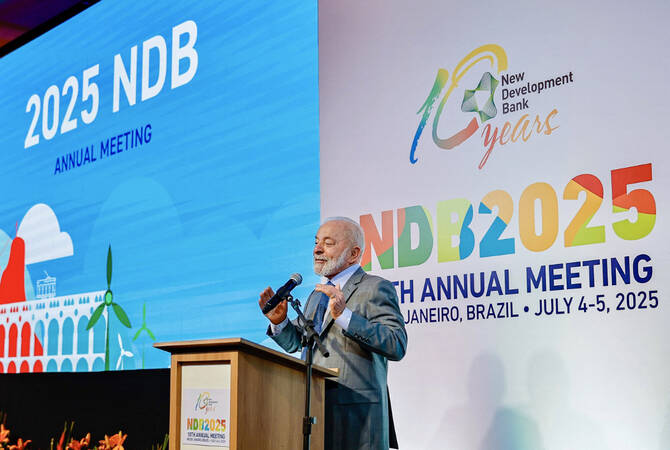

RIO DE JANEIRO, Brazil: BRICS leaders meeting in Rio de Janeiro from Sunday are expected to decry Donald Trump’s hard-line trade policies, but are struggling to bridge divides over crises roiling the Middle East.
Emerging nations representing about half the world’s population and 40 percent of global economic output are set to unite over what they see as unfair US import tariffs, according to sources familiar with summit negotiations.
Since coming to office in January, Trump has threatened allies and rivals alike with a slew of punitive tariffs.
His latest salvo comes in the form of letters due to be sent starting Friday informing trading partners of new tariff rates expected next week on July 9.
Diplomats from 11 emerging nations, including Brazil, Russia, India, China and South Africa, have been busy drafting a statement condemning the economic uncertainty.
Any final summit declaration is not expected to mention the United States or its president by name. But it is expected to be a clear political shot directed at Washington.
“We’re anticipating a summit with a cautious tone: it will be difficult to mention the United States by name in the final declaration,” Marta Fernandez, director of the BRICS Policy Center at Rio’s Pontifical Catholic University said.
This is particularly the case for China, which has only recently negotiated with the US to lower steep tit-for-tat levies.
“This doesn’t seem to be the right time to provoke further friction” between the world’s two leading economies, Fernandez said.
China leader to skip annual meeting
Conceived two decades ago as a forum for fast-growing economies, the BRICS have come to be seen as a Chinese-driven counterbalance to Western power.
But the summit’s political punch will be depleted by the absence of China’s Xi Jinping, who is skipping the annual meeting for the first time in his 12 years as president.
“I expect there will be speculation about the reasons for Xi’s absence,” said Ryan Hass, a former China director at the US National Security Council who is now with the Brookings Institution think tank.
“The simplest explanation may hold the most explanatory power. Xi recently hosted Lula in Beijing,” said Hass.
The Chinese leader will not be the only notable absentee. War crime-indicted Russian President Vladimir Putin is also opting to stay away, but will participate via video link, according to the Kremlin.
Hass said Putin’s non-attendance and the fact that India’s prime minister will be a guest of honor in Brazil could also be factors in Xi’s absence.
“Xi does not want to appear upstaged by Modi,” who will receive a state lunch, he said.
“I expect Xi’s decision to delegate attendance to Premier Li (Qiang) rests amidst these factors.”
Still, the Xi no-show is a blow to host President Luiz Inacio Lula da Silva, who wants Brazil to play a bigger role on the world stage.
In the year to November 2025, Brazil will have hosted a G20 summit, a BRICS summit, and COP30 international climate talks, all before heading into fiercely contested presidential elections next year, in which he is expected to run.
No consensus on response to Gaza, Iran wars
Iran’s President Masoud Pezeshkian, whose nation is still reeling from a 12-day conflict with Israel is also skipping the meeting.
A source familiar with the negotiations said the BRICS countries were still in disagreement over how to respond to the wars in Gaza and between Iran and Israel.
Iranian negotiators are pushing for a tougher collective stance that goes beyond referencing the need for the creation of a Palestinian state and for disputes to be resolved peacefully.
Artificial intelligence and health will also be on the agenda at the summit.
Original members of the bloc Brazil, Russia, India, and China have been joined by South Africa and, more recently, by Iran, the United Arab Emirates, Egypt, Ethiopia and Indonesia.
Analysts say that it has given the grouping more potential international punch.
But it has also opened many new fault lines.
Brazil hopes that countries can take a common stand at the summit, including on the most sensitive issues.
“BRICS (countries), throughout their history, have managed to speak with one voice on major international issues, and there’s no reason why that shouldn’t be the case this time on the subject of the Middle East,” Brazil’s Foreign Minister Mauro Vieira told AFP.