

Gaza’s Nasser Hospital operating as ‘one massive trauma ward’

1 / 5
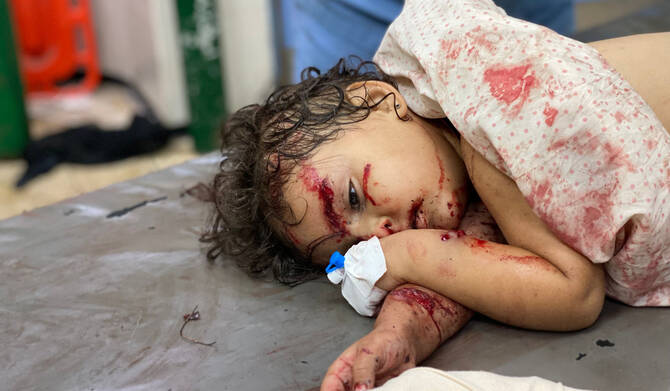
A girl receives treatment for her wounds, sustained in an Israeli strike on a camp housing displaced Palestinians, at Khan Yunis' Nasser hospital in the southern Gaza Strip on July 2, 2025. (AFP)
2 / 5
Palestinian men, wounded in gunfire as people were receiving humanitarian aid in Rafah, arrive for treatment at the congested Nasser Hospital in Khan Yunis in the southern Gaza Strip on July 3, 2025. (AFP)
3 / 5
Palestinian men wounded in the latest strikes on the southern Gaza Strip receiving treatment at the Nasser hospital in Khan Yunis on July 4, 2025. (AFP)
4 / 5
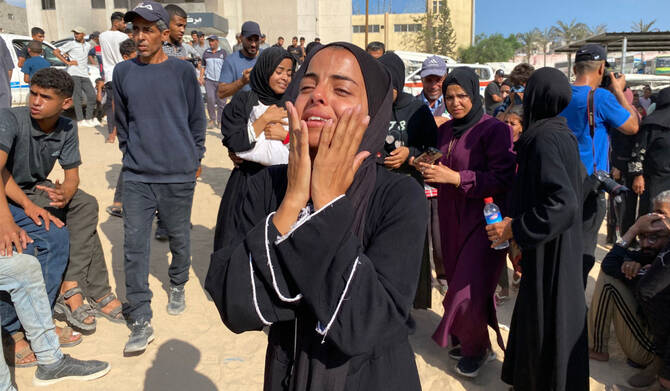
A Palestinian woman weeps as she bids farewell to a loved one during the funeral of Palestinians killed in Israeli strikes on the southern Gaza Strip the previous day, outside the Nasser Hospital in Khan Yunis on July 4, 2025. (AFP)
5 / 5
Palestinian casualties from the latest Israeli air strikes, artillery or gunfire on the southern Gaza Strip are kept on the ground outside the congested Nasser Hospital in Khan Yunis on July 3, 2025. (AFP)
Short Url
Updated 04 July 2025
Follow

Gaza’s Nasser Hospital operating as ‘one massive trauma ward’

  • 613 killed at aid distribution sites, near humanitarian convoys, says UN human rights office

GENEVA: Nasser Hospital in Gaza is operating as “one massive trauma ward” due to an influx of patients wounded at non-UN food distribution sites run by the Gaza Humanitarian Foundation, the World Health Organization said on Friday.

The US- and Israeli-backed GHF began distributing food packages in Gaza at the end of May, overseeing a new model of deliveries that the UN says is neither impartial nor neutral. It has repeatedly denied that incidents involving people killed or wounded at its sites have occurred.
The GHF said on Friday that “the most deadly attacks on aid sites have been linked to UN convoys,” and said the UN and humanitarian groups should work “collaboratively” with the GHF to “maximize the amount of aid being securely delivered into Gaza.” The UN in Geneva was immediately available for comment.

FASTFACT

Hundreds of patients, mainly young boys, were being treated for traumatic injuries, including bullet wounds to the head, chest, and knees, according to the WHO.

Referring to medical staff at the Nasser Hospital, Rik Peeperkorn, WHO representative in the West Bank and Gaza, told reporters in Geneva: “They’ve seen already for weeks, daily injuries ... (the) majority coming from the so-called safe non-UN food distribution sites. The hospital is now operating as one massive trauma ward.”
Israel lifted an 11-week aid blockade on Gaza on May 19.
The UN human rights office said on Friday that it had recorded at least 613 killings, both at aid points run by the Gaza Humanitarian Foundation and near humanitarian convoys.
“We have recorded 613 killings, both at GHF points and near humanitarian convoys — this is a figure as of June 27. Since then ... there have been further incidents,” Ravina Shamdasani, the spokesperson for the UN Office of the High Commissioner for Human Rights, said in Geneva.
The OHCHR said 509 of the 613 were killed near GHF distribution points. The GHF dismissed these numbers as coming “directly from the Hamas-controlled Gaza Health Ministry” and were being used to “falsely smear” its effort.
The GHF has previously said it has delivered more than 60 million meals to hungry Palestinians in five weeks “safely and without interference,” while other humanitarian groups had “nearly all of their aid looted.”
The UN Office for the Coordination of Humanitarian Affairs said that there have been some instances of violent looting and attacks on aid truck drivers, which it described as unacceptable.
Hundreds of patients, mainly young boys, were being treated for traumatic injuries, including bullet wounds to the head, chest, and knees, according to the WHO.
Peeperkorn said health workers at Nasser Hospital and testimonies from family members and friends of those wounded confirmed that the victims had been trying to access aid at sites run by the GHF.
Peeperkorn recounted the cases of a 13-year-old boy shot in the head, as well as a 21-year-old with a bullet lodged in his neck, which rendered him paraplegic.
“There is no chance for any reversal or any proper treatment. Young lives are being destroyed forever,” Peeperkorn said, urging for the fighting to stop and for more food aid to be allowed into Gaza.


Syrian leader to meet Putin, Russia seeks deal on military bases

Updated 28 January 2026
Follow

Syrian leader to meet Putin, Russia seeks deal on military bases

  • Russia’s continued sheltering of Assad and his wife since their ouster remains a thorny issue

MOSCOW: Syrian President Ahmed Al-Sharaa will meet Russian counterpart Vladimir Putin in Moscow on Wednesday, as the Kremlin seeks to secure the future of its military bases in the country.
Putin and Sharaa struck a conciliatory tone at their previous meeting in October, their first since Sharaa’s rebel forces toppled Moscow-ally Bashar Assad in 2024.
But Russia’s continued sheltering of Assad and his wife since their ouster remains a thorny issue. Sharaa has repeatedly pushed Russia for their extradition.
Sharaa, meanwhile, has embraced US President Donald Trump, who on Tuesday praised the Syrian leader as “highly respected” and said things were “working out very well.”
Putin, whose influence in the Middle East has waned since Assad’s ouster, is seeking to maintain Russia’s military footprint in the region.
Russia withdrew its forces from the Qamishli airport in Kurdish-held northeast Syria earlier this week, leaving it with only the Hmeimim air base and Tartus naval base on Syria’s Mediterranean coast — its only military outposts outside the former Soviet Union.
“A discussion is planned on the status of bilateral relations and prospects for developing them in various fields, as well as the current situation in the Middle East,” the Kremlin said of the upcoming meeting in a statement on Tuesday.
Russia was a key ally of Assad during the bloody 14-year Syrian civil war, launching air strikes on rebel-held areas of Syria controlled by Sharaa’s Islamist forces.
The toppling of Assad dealt a major blow to Russia’s influence in the region and laid bare the limits of Moscow’s military reach amid the Ukraine war.
The United States, which cheered Assad’s demise, has fostered ever-warmer ties with Sharaa — even as Damascus launched a recent offensive against Kurdish forces long backed by the West.
Despite Trump’s public praise, both the United States and Europe have expressed concern that the offensive in Syria’s northeast could precipitate the return of Islamic State forces held in Kurdish-held jails.