

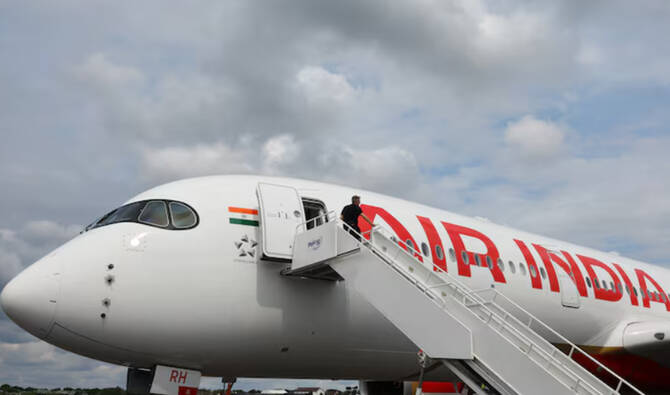

NEW DELHI: India’s aviation watchdog reprimanded Air India’s budget carrier in March for not timely changing engine parts of an Airbus A320 as directed by European Union’s aviation safety agency, and falsifying records to show compliance, a government memo showed.
In a statement, Air India Express told Reuters it acknowledged the error to the Indian watchdog and undertook “remedial action and preventive measures.”
Air India has been under intense scrutiny since the June Boeing Dreamliner crash in Ahmedabad which killed all but one of the 242 people onboard. The world’s worst aviation disaster in a decade is still being investigated.
The engine issue in the Air India Express’ Airbus was raised on March 18, months before the crash. But the regulator has this year also warned parent Air India for breaching rules for flying three Airbus planes with overdue checks on escape slides, and in June warned it about “serious violations” of pilot duty timings.
Air India Express is a subsidiary of Air India, which is owned by the Tata Group. It has more than 115 aircraft and flies to more than 50 destinations, with 500 daily flights.
The European Union Aviation Safety Agency in 2023 issued an airworthiness directive to address a “potential unsafe condition” on CFM International LEAP-1A engines, asking for replacement of some components such as engine seals and rotating parts, saying some manufacturing deficiencies had been found.
The agency’s directive said “this condition, if not corrected, could lead to failure of affected parts, possibly resulting in high energy debris release, with consequent damage to, and reduced control of, the aeroplane.”
The Indian government’s confidential memo in March sent to the airline, seen by Reuters, said that surveillance by the Directorate General of Civil Aviation (DGCA) revealed the parts modification “was not complied” on an engine of an Airbus A320 “within the prescribed time limit.”
“In order to show that the work has been carried out within the prescribed limits, the AMOS records have apparently been altered/forged,” the memo added, referring to the Aircraft Maintenance and Engineering Operating System software used by airlines to manage maintenance and airworthiness.
The mandatory modification was required on Air India Express’ VT-ATD plane, the memo added. That plane typically flies on domestic routes and some international destinations such as Dubai and Muscat, according to the AirNav Radar website.
The lapse “indicates that the accountable manager has failed to ensure quality control,” it added.
Air India Express told Reuters its technical team missed the scheduled implementation date for parts replacement due to the migration of records on its monitoring software, and fixed the problem soon after it was identified.
It did not give dates of compliance or directly address DGCA’s comment about records being altered, but said that after the March memo it took “necessary administrative actions,” which included removing the quality manager from the person’s position and suspending the deputy continuing airworthiness manager.
The DGCA and the European safety agency did not respond to Reuters queries.
Airbus and CFM International, a joint venture between General Electric and Safran, also did not respond.
The lapse was first flagged during a DGCA audit in October 2024 and the plane in question took only a few trips after it was supposed to replace the CFM engine parts, a source with direct knowledge said.
“Such issues should be fixed immediately. It’s a grave mistake. The risk increases when you are flying over sea or near restricted airpsace,” said Vibhuti Singh, a former legal expert at the India’s Aircraft Accident Investigation Bureau.
The Indian government told parliament in February that authorities warned or fined airlines in 23 instances for safety violations last year. Three of those cases involved Air India Express, and eight Air India.
The Tata Group acquired Air India from the Indian government in 2022 and the Dreamliner crash has cast a shadow on its ambitions of making it a “world class airline.”
While Air India has aggressively expanded its international flight network over the months, it still faces persistent complaints from passengers, who often take to social media to show soiled seats, broken armrests, non-operational entertainment systems and dirty cabins.


