

Germany to seek direct contact with Taliban on deportations

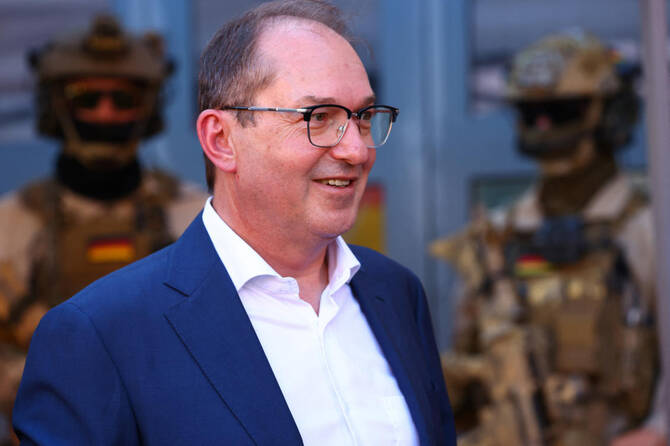
German Interior Minister Alexander Dobrindt says he wants to make making agreements directly with the Taliban government in Afghanistan to enable deportations. (Reuters/File))
Short Url
Updated 04 July 2025
Follow

Germany to seek direct contact with Taliban on deportations

  • German interior minister says he wants direct contact with the Taliban to ensure criminals can be deported back to Afghanistan

BERLIN: Germany’s interior minster on Thursday said he wanted direct contact with the Taliban authorities in a bid to enable criminals to be deported back to Afghanistan.

“I envision us making agreements directly with Afghanistan to enable deportations,” Alexander Dobrindt said in an interview with Focus magazine.

Berlin currently has only indirect contact with the Taliban through third parties, an arrangement Dobrindt said “cannot remain a permanent solution.”


Germany stopped deportations to Afghanistan and closed its embassy in Kabul following the Taliban’s return to power in 2021.

But a debate over resuming expulsions has flared as migration becomes a key issue amid the rise of the far-right Alternative for Germany (AfD) party.

Twenty-eight Afghan nationals who had been convicted of crimes were deported in August last year after Germany’s previous government carried out indirect negotiations with the Taliban.

No further deportations have taken place. But the debate has continued to rage, especially since a series of deadly attacks last year blamed on asylum seekers — with several of the suspects from Afghanistan.

Germany’s new government, a coalition between the conservative CDU/CSU and the center-left Social Democrats (SPD), has promised to expel more foreign criminals alongside a crackdown on irregular migration.

Dobrindt also said he was in contact with authorities to enable deportations to Syria, which have been suspended since 2012.

Longtime Syrian ruler Bashar Assad was toppled in December. The country is now under the control of Islamist leaders, some of whom were once linked with the Al-Qaeda jihadist network.

Germany has made tentative contact with the new authorities and has sent several delegations to Damascus for talks.

Chancellor Friedrich Merz this week said he believed “deportations to Syria are possible today, given the current circumstances and situation.”

Austria on Thursday deported a Syrian convict back to Syria, becoming the first EU country to do so officially in recent years.


Swiss interior minister open to social media ban for children

Updated 3 sec ago
Follow

Swiss interior minister open to social media ban for children

ZURICH: Switzerland must do more to shield children from social media risks, Interior Minister Elisabeth Baume-Schneider was quoted as ​saying on Sunday, signalling she was open to a potential ban on the platforms for youngsters.
Following Australia’s recent ban on social media for under-16s, Baume-Schneider told SonntagsBlick newspaper that Switzerland should examine similar measures.
“The debate in Australia and the ‌EU is ‌important. It must also ‌be ⁠conducted ​in Switzerland. ‌I am open to a social media ban,” said the minister, a member of the center-left Social Democrats. “We must better protect our children.”
She said authorities needed to look at what should be restricted, listing options ⁠such as banning social media use by children, ‌curbing harmful content, and addressing ‍algorithms that prey on ‍young people’s vulnerabilities.
Detailed discussions will begin ‍in the new year, supported by a report on the issue, Baume-Schneider said, adding: “We mustn’t forget social media platforms themselves: they must ​take responsibility for what children and young people consume.”
Australia’s ban has won praise ⁠from many parents and groups advocating for the welfare of children, and drawn criticism from major technology companies and defenders of free speech.
Earlier this month, the parliament of the Swiss canton of Fribourg voted to prohibit children from using mobile phones at school until they are about 15, the latest step taken at ‌a local level in Switzerland to curb their use in schools.