

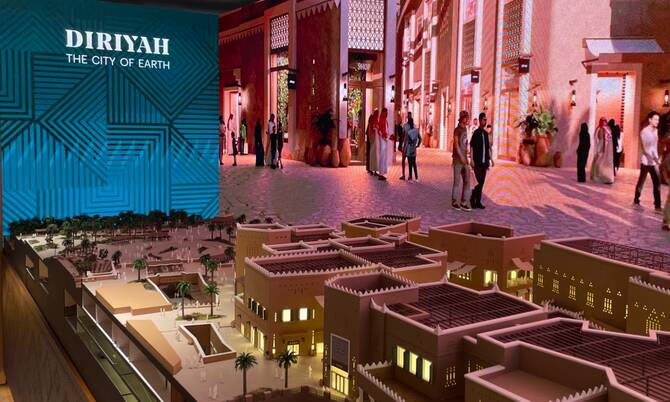

LONDON: The Diriyah Company launched an interactive pavilion this week in London’s Knightsbridge area to broaden the brand reach of one of Saudi Arabia’s ambitious real estate projects that combines tradition, sustainability and modern design.
The Diriyah House London, located at One Hyde Park, features interactive models that highlight the various components of Diriyah city’s master plan, including residential units, boulevards, squares, cultural venues, hotels, offices and nature parks.
The Diriyah Company, established in 2023, is also offering visitors to Harrods a pop-up showroom of the budding and historical districts of the town, following a successful month-long event held in London in July 2024.

The Diriyah House London, located at One Hyde Park, features interactive models that highlight the various components of Diriyah city’s master plan. (SPA)
Diriyah is a historic site situated a 15-minute drive away from downtown Riyadh and 25 minutes from King Khalid International Airport. It is renowned for its significant political and religious importance, as it is the birthplace of the Kingdom. The Al-Saud family lived there during the establishment of the first state in 1727.
It is also known as the City of Earth, due to its distinctive qualities, which include being built from bricks made from a mixture of mud, ash, sand and water. In 2010, the UNESCO designated the At-Turaif district in Diriyah as a World Heritage site, citing its Najdi architectural style.
The whole vision (of Diriyah) is to unlock what it means to live and reside in a manner in which we were accustomed to doing hundreds of years ago
Kiran Haslam, chief marketing officer, Diriyah Company
Since 2017, Crown Prince Mohammed bin Salman has initiated a new vision to develop Diriyah into a pedestrian-friendly city where residents can live, work and entertain, while preserving the city’s historical significance and incorporating Najdi architecture into the designs of the units for luxury brands, hotels and residential districts.
“Diriyah brings design and sustainability together. The whole vision is to unlock what it means to live and reside in a manner in which we were accustomed to doing hundreds of years ago,” Kiran Haslam, chief marketing officer for Diriyah Company, told Arab News.
“(At the same time), remain sympathetic to what you want the future urban environment to deliver — safety and community prosperity,” he said.

On the completion of Diriyah, an estimated 100,000 residents will live there, and another 180,000 will commute to work. (AN Photo: Mustafa Abu Sneineh)
At least 3.5 million people have visited the At-Turaif historic district since it partially opened to the public in 2022, known for its mud exterior walls that are beautifully illuminated at night, creating an enchanting sight. Since then, the developed dining areas of Buajiri Terrace and Zallal have provided their 120,000 monthly visitors with a taste of what it is like to live in a city within a 15-minute drive of the Saudi metropolis.
Diriyeh is a $64 billion project covering 14 sq. km, or six and a half times the size of Monaco. Mohamed Saad, the president of the Diriyah Development Company, told Arab News that there are currently 45,000 workers on the site, along with 85 tower cranes. However, the project is expected to employ at least 60,000 workers and use 158 tower cranes next year when construction begins on the second phase of the project.
(The challenge) was trying to figure out how to build modern amenities of luxury offerings and experience, but keeping the true traditional architecture of Diriyah
Mohamed Saad, president of Diriyah Development Company
His team is currently completing a pedestrianized district in Diriyeh, which spans 3.5 km in length and 1.2 km in width. They have excavated 45 meters deep to create three underground levels that include parking and the essential infrastructure a city needs, such as water and electricity.
Saad said that the main challenge of building such a project was “trying to figure out how to build modern amenities of luxury offerings and experience, but keeping the true traditional architecture of Diriyah.”

The Diriyah Development Company has excavated 45 meters deep to create three underground levels that include parking and city infrastructure. (AN Photo: Mustafa Abu Sneineh)
There are no motorized vehicles allowed in the pedestrianized district of Diriyah. Residents, visitors and shoppers will park their cars in the underground facility before heading to the surface. It is a complicated task of engineering, logistics and meeting sustainability standards, Saad admits. During the construction of the subterranean levels, 12.3 million cubic meters of rock and rubble have been excavated.
In 2023, the US Green Building Council awarded the Diriyah Company an accolade for achieving leadership in energy and environmental design in the first phase of Diriyah’s plan.
The town was established in the mid-15th century in Wadi Hanifah, a floodplain that has historically provided a vital source of water for the residents of Diriyah. The valley is situated on a water reservoir, and the Diriyeh Company decided to preserve it, using Saudi Arabia’s desalination technology to supply water to the town instead.
On the completion of Diriyah, an estimated 100,000 residents will live there, and another 180,000 will commute to work.

There are no motorized vehicles allowed in the pedestrianized district of Diriyah. (AN Photo: Mustafa Abu Sneineh)
Significant parts of Diriyah are set to be completed by 2030, a pivotal year for the Kingdom across multiple sectors, including tourism, technology, aviation, energy, health and sports, as outlined in its Vision 2030. Diriyah is set to fully open the gates of At-Turaif, making it a significant attraction for visitors during the Riyadh Expo 2030.
Haslam said that Diriyah “is not separate, far-flung, it is very much in the center of the capital city. It is a city within the city.
“Riyadh is an incredible bustling city now with global recognition and Diriyah is almost like this wonderful little jewel in the landscape of Riyadh,” he said.
* Schedule a visit to the Diriyah House London


