

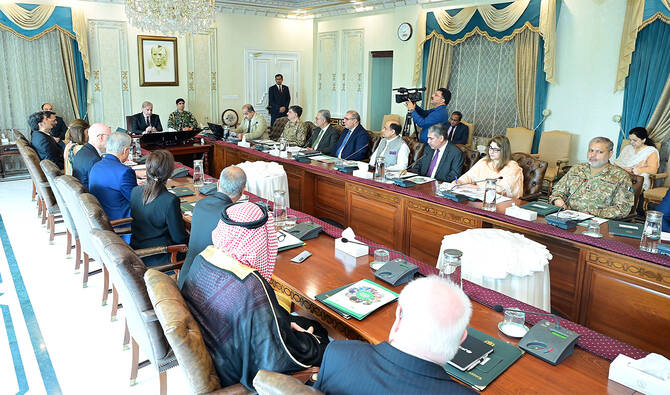

ISLAMABAD: Prime Minister Shehbaz Sharif on Thursday thanked Saudi Arabia for its continued support in Pakistan’s fight against polio, as the country recorded its 14th case of the year amid growing concerns over persistent virus transmission in high-risk districts.
Chairing a meeting of the National Anti-Polio Task Force in Islamabad, Sharif said targeted immunization campaigns were being intensified to reach every child, particularly in parts of the northwestern Khyber Pakhtunkhwa province where the most cases have been reported this year.
“We pledge to protect every child in Pakistan from this crippling disease and to make Pakistan polio-free,” Sharif said, according to an official statement from his office.
“I am also thankful to His Royal Highness Crown Prince and Prime Minister of Saudi Arabia, Mohammed bin Salman, who is extending all possible support to Pakistan in the fight against polio.”
Last year, Saudi Arabia pledged $500 million to global polio eradication efforts, according to WHO. The Kingdom, alongside the Gates Foundation and other partners, is providing both technical and financial assistance to Pakistan.
Pakistan remains one of only two countries in the world where wild poliovirus is still endemic, alongside Afghanistan. According to official data, the 14 confirmed cases this year include eight from Khyber Pakhtunkhwa, four from Sindh, and one each from Punjab and Gilgit-Baltistan. In comparison, Pakistan reported 74 cases in 2024 and six in 2023.
“Despite all difficulties and challenges, the government, with the help of its international, provincial, and local teams, will soon achieve the goal of a polio-free Pakistan,” he said.
Sharif emphasized that district-level campaigns were being developed to address “unique challenges” in southern Khyber Pakhtunkhwa, where security threats and vaccine hesitancy have long impeded eradication efforts. He also reiterated that the safety of frontline polio workers remained a “top priority.”
The meeting was attended by senior health officials, provincial leaders, and members of the international Polio Oversight Board, including Dr. Christopher Elias of the Gates Foundation, WHO Regional Director Dr. Hanan Balkhy, UNICEF’s Sanjay Wijesekera, and representatives from Rotary International and Saudi Arabia’s KS Relief.
Polio immunization campaigns have been launched in more than 80 districts this year, reaching tens of millions of children. But officials have repeatedly warned that virus circulation in environmental samples signals the need for sustained vigilance.
“We must ensure, with full dedication and seriousness, that every child across the country receives multiple doses of the vaccine and remains protected from polio,” Sharif added.
Pakistan and Afghanistan are the only two countries where polio remains endemic. Islamabad made significant progress in curbing the virus, with annual cases dropping from around 20,000 in the early 1990s to just eight in 2018. Pakistan reported six cases in 2023 and only one in 2021 but witnessed an intense resurgence in 2024, with 74 cases reported.
Pakistan has faced years of setbacks in its eradication drive, with vaccination teams often targeted by militants and health misinformation slowing uptake in rural areas.


