

Pakistan PM orders doubling of digital payment targets to boost cashless economy

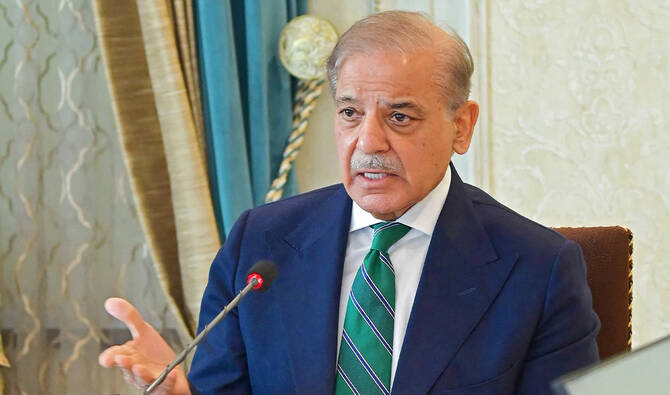
In this handout photograph taken and released by Pakistan's Prime Minister Office on April 24, 2025, Pakistan's Prime Minister Shehbaz Sharif chairs a high level security meeting with the chiefs of the Pakistan forces and other government officials at the Prime Minister House in Islamabad. (AFP/File)
Short Url
Updated 03 July 2025
Follow

Pakistan PM orders doubling of digital payment targets to boost cashless economy

  • Move aims to deepen transparency, widen tax net as mobile app users set to rise from 95-120 million
  • Government targets expansion of QR code usage, e-payments and Internet access across the country

ISLAMABAD: Prime Minister Shehbaz Sharif has ordered the doubling of all key digital economy targets, including mobile-based payments, QR code adoption, and overall transaction volumes, as part of Pakistan’s push to accelerate its transition to a cashless economy, his office said on Thursday.

The directive comes as authorities aim to increase mobile payment users from 95 million to 120 million, and QR code-enabled merchants from 0.9 million to 2 million. The total value of digital transactions is expected to rise from Rs7.5 billion ($26.9 million) to Rs12 billion ($43 million), according to figures shared in a meeting chaired by Sharif on Thursday. A statement released after the discussions did not provide a timeline for meeting these targets.

Sharif said the targets were not ambitious enough and must be doubled across the board to match the scale of Pakistan’s digital transformation agenda.

“A digital transaction system is essential for bringing transparency to the economy,” Sharif said. “It is an urgent need of the hour to ease payments between citizens and businesses and raise awareness about the use of digital systems.”

Pakistan, a country of over 240 million people, has a vast informal economy and low tax compliance. The government has long identified digitization as a key tool to improve governance, reduce corruption, and expand the country’s narrow tax base.

Three committees — the Digital Payments Innovation and Adoption Committee, the Digital Public Infrastructure Committee, and the Government Payments Committee — have already been formed to oversee the transition. 

At Thursday’s meeting, Sharif directed the bodies to present “workable proposals in collaboration with all stakeholders,” the statement said.

The State Bank of Pakistan is developing strategies to simplify digital transactions for traders, including special incentive packages for small businesses. The government also plans to expand the use of digital mobile apps and improve access to digital public infrastructure.

Sharif was also briefed on new services set to launch soon, including e-stamping, as well as public Wi-Fi expansion across hospitals, schools, parks, government offices and metro lines in Islamabad.

He instructed officials to roll out these facilities across all federal territories, as well as Azad Jammu and Kashmir and Gilgit-Baltistan.


Pakistan military says 13 militants killed in counterterror operations across northwest

Updated 08 March 2026
Follow

Pakistan military says 13 militants killed in counterterror operations across northwest

  • Military says counterterror operations launched in Bajaur, Bannu, Dera Ismail Khan, Khyber and South Waziristan districts
  • The counterterror operations take place as Afghanistan and Pakistan remain locked in conflict since late last month 

ISLAMABAD: Pakistani security forces this week killed 13 militants in five separate counterterror operations in the northwestern Khyber Pakhtunkhwa (KP) province, the military’s media wing said on Sunday, vowing to eliminate militancy from the country. 

The counterterror operations were conducted on Mar. 6-7, with Pakistani troops killing five militants in the northwestern Bajaur district in the first operation. In two other encounters in Bannu and Dera Ismail Khan district, security forces killed three militants belonging to the Tehreek-e-Taliban Pakistan (TTP) militants, the Inter-Services Public Relations (ISPR) said. 

Meanwhile, five other militants were killed in two separate counterterror operations in Khyber and South Waziristan districts in which five more militants were slain. 

“Weapons and ammunition were also recovered from Indian-sponsored killed khwarij, who remained actively involved in numerous terrorist activities in the area,” ISPR said in a statement. 

Pakistan’s military frequently uses the term “Fitna al Khwarij” to describe TTP militants. The militant outfit has carried out some of the deadliest attacks against Pakistani civilians and security forces since 2007 in a bid to impose their strict brand of Islamic law across the country. 

Islamabad accuses Afghanistan of sheltering the TTP and facilitating their attacks against Pakistan, a charge Kabul has denied. Pakistan also accuses India of supporting these militant groups, which New Delhi has repeatedly rejected. 

The counterterror operations take place as Pakistan remains locked in conflict with Afghanistan since late February. 

The worst fighting between the two sides began late last month when Afghan forces launched a surprise attack on Pakistani military installations along their shared border. Afghanistan said the assault was in retaliation for Pakistan’s earlier airstrikes in February on what Islamabad described as militant camps inside Afghanistan.

Pakistan’s Information Minister Attaullah Tarar said on Saturday that Islamabad has killed 527 Afghan Taliban fighters and injured more than 755 since clashes began.

Afghanistan has also claimed attacking multiple Pakistani military bases and killing several Pakistani soldiers. Arab News has not independently verified the claims by both sides. 

Pakistan has ruled out talks with Afghanistan and said it will continue its military operations in the country till it withdraws support for militant groups that Islamabad says operate from Afghanistan.