Pakistan PM orders doubling of digital payment targets to boost cashless economy

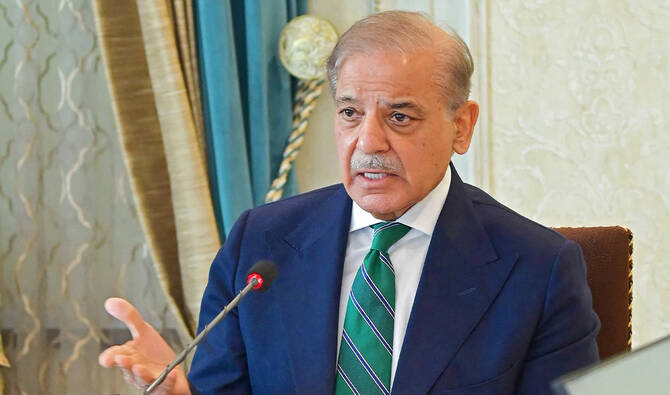
In this handout photograph taken and released by Pakistan's Prime Minister Office on April 24, 2025, Pakistan's Prime Minister Shehbaz Sharif chairs a high level security meeting with the chiefs of the Pakistan forces and other government officials at the Prime Minister House in Islamabad. (AFP/File)
Short Url
Updated 03 July 2025
Follow

Pakistan PM orders doubling of digital payment targets to boost cashless economy

  • Move aims to deepen transparency, widen tax net as mobile app users set to rise from 95-120 million
  • Government targets expansion of QR code usage, e-payments and Internet access across the country

ISLAMABAD: Prime Minister Shehbaz Sharif has ordered the doubling of all key digital economy targets, including mobile-based payments, QR code adoption, and overall transaction volumes, as part of Pakistan’s push to accelerate its transition to a cashless economy, his office said on Thursday.

The directive comes as authorities aim to increase mobile payment users from 95 million to 120 million, and QR code-enabled merchants from 0.9 million to 2 million. The total value of digital transactions is expected to rise from Rs7.5 billion ($26.9 million) to Rs12 billion ($43 million), according to figures shared in a meeting chaired by Sharif on Thursday. A statement released after the discussions did not provide a timeline for meeting these targets.

Sharif said the targets were not ambitious enough and must be doubled across the board to match the scale of Pakistan’s digital transformation agenda.

“A digital transaction system is essential for bringing transparency to the economy,” Sharif said. “It is an urgent need of the hour to ease payments between citizens and businesses and raise awareness about the use of digital systems.”

Pakistan, a country of over 240 million people, has a vast informal economy and low tax compliance. The government has long identified digitization as a key tool to improve governance, reduce corruption, and expand the country’s narrow tax base.

Three committees — the Digital Payments Innovation and Adoption Committee, the Digital Public Infrastructure Committee, and the Government Payments Committee — have already been formed to oversee the transition. 

At Thursday’s meeting, Sharif directed the bodies to present “workable proposals in collaboration with all stakeholders,” the statement said.

The State Bank of Pakistan is developing strategies to simplify digital transactions for traders, including special incentive packages for small businesses. The government also plans to expand the use of digital mobile apps and improve access to digital public infrastructure.

Sharif was also briefed on new services set to launch soon, including e-stamping, as well as public Wi-Fi expansion across hospitals, schools, parks, government offices and metro lines in Islamabad.

He instructed officials to roll out these facilities across all federal territories, as well as Azad Jammu and Kashmir and Gilgit-Baltistan.


Bangladesh approves new rice imports from Pakistan amid price pressures

Updated 23 December 2025
Follow

Bangladesh approves new rice imports from Pakistan amid price pressures

  • The deal follows Bangladesh’s resumption of direct rice trade with Pakistan earlier this year ⁠for the first time since independence in 1971
  • Diplomatic ties between the two nations have improved since the ouster of prime minister Sheikh Hasina after mass protests last year

DHAKA: Bangladesh has approved the import of 50,000 metric tons of white rice from Pakistan under a government-to-government deal as ​part of efforts to stabilize domestic prices, officials said on Tuesday.

The Cabinet Committee on Government Purchase cleared the deal at $395 per ton, reinforcing Dhaka’s renewed trade engagement with Islamabad.

Rice prices in Bangladesh have jumped by between 15 percent and 20 percent over ‌the past ‌year, with medium-quality ‌rice ⁠selling ​at about ‌80 taka ($0.66) per kilogram. Despite increased imports and the removal of duties to ease supply constraints, prices for the staple grain remain stubbornly high.

The deal follows Bangladesh’s resumption of direct rice trade with Pakistan earlier this year ⁠for the first time since independence in 1971. In ‌February, it imported 50,000 ‍tons of rice from ‍Pakistan at $499 per ton under a ‍similar agreement.

Diplomatic ties between the two South Asian nations have improved since an interim government led by Nobel laureate Muhammad Yunus took office after ​mass protests forced then prime minister Sheikh Hasina to flee to neighboring ⁠India last year.

Formerly East Pakistan, Bangladesh gained independence after a nine-month war in 1971, and relations with Pakistan have remained fraught in the decades since the conflict.

Separately, the government approved another 50,000 tons of parboiled rice through an international tender, part of a series of recent purchases aimed at cooling local prices. India’s Pattabhi Agro Foods secured ‌the contract with the lowest bid of $355.77 per ton.