

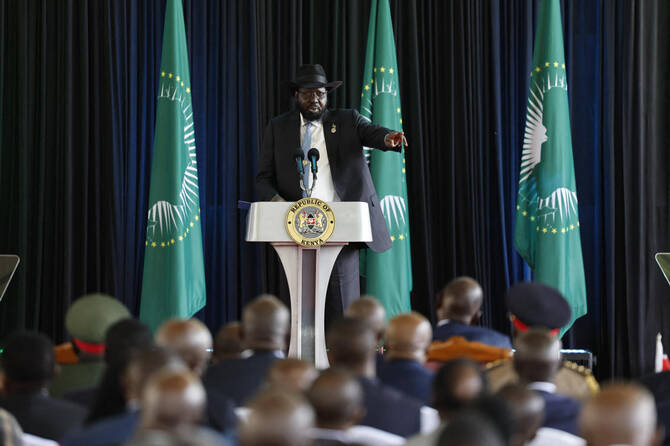

JUBA: With South Sudan’s President Salva Kiir undergoing medical tests abroad after years of rumors about his health, analysts say a long-gestating plan has been set in motion to secure his succession.
Kiir returned from at least 10 days in the United Arab Emirates on Wednesday, with state media saying he had been “exploring new avenues for economic cooperation.”
But members of his entourage, speaking on condition of anonymity, previously told AFP he was there for medical tests — reinforcing long-held concerns about the 73-year-old’s health.
The world’s youngest country, South Sudan has been plagued by poverty and violence since gaining independence in 2011, including a civil war that killed some 400,000 people in 2013-2018.
After a few relatively calm years, the country has been thrown back into turmoil in recent months, prompted, say analysts, by Kiir’s declining health and his efforts to install his heir-apparent, businessman Benjamin Bol Mel, in power.
Bol Mel is a controversial figure, who gained prominence as a construction magnate and was said to handle the Kiir family’s finances.
He was placed on a sanctions list by the United States in 2017 for corruption.
For months, Kiir has been manoeuvring to sideline rivals.
His old foe, Riek Machar, against whom he fought the civil war, was placed under house arrest in March and many of his political allies disappeared into detention.
Kiir’s forces have attacked Machar’s military bases and other armed groups drawn from his ethnic group, the Nuer.
More than 700 people were killed in clashes between January and March alone, according to the United Nations.
Rumours about Kiir’s health have long circulated but the topic is absolutely off-limits for discussion in official circles.
“If you want to visit a grave quickly, talk about it,” said a local activist, requesting anonymity for safety reasons.
Nonetheless, the frailty was obvious in April when Kiir hosted Ugandan President Yoweri Museveni, who walked briskly despite his 80 years while Kiir moved in tiny steps.
In May, the foreign ministry had to issue a statement assuring that the head of state was still alive following rumors to the contrary on social media.
State media footage of Kiir’s return from the UAE on Wednesday cut away every time he was about to take a step.
During his absence, it was Bol Mel — who was named second vice president in February and deputy head of the ruling party in May — who chaired last week’s cabinet meeting.
“It seems to be a script written a long time ago and being implemented in phases,” said Wani Michael, a former activist now in exile.
“They had to take away Riek Machar to pave the way for Bol Mel because... Riek would give Bol Mel a hard time,” he added.
In October, Kiir also fired his intelligence chief, Akol Koor, another potential rival who held that post for 13 years.
Bol Mel “has taken control of the security forces by installing loyalists. He has taken over the security and financial apparatus since last November-December,” said a diplomat based in Juba, also speaking on condition of anonymity.
Despite an uptick in violence, the moves have not triggered renewed war as many feared.
“It’s devastating on a humanitarian level, but it’s nothing compared to the colossal massacres of a few years ago when thousands died each month,” said the diplomat, adding that the government “has been fairly successful in subduing the various rebellions.”
Machar’s forces have barely retaliated to attacks and his party is split on the way forward.
But success is not guaranteed for Bol Mel, either, warned local analyst James Boboya.
“The government has not gained legitimacy at home or internationally,” he told AFP.
There is particular disillusionment at the failure to hold the country’s first-ever elections, which were again postponed last year to 2026.
“Elections are the only viable way for a peaceful transfer of power,” said Edmund Yakani, president of the Community Empowerment for Progress Organization, a local NGO.
“We need the power of our vote in shaping the future. Not the bullet, and not leaders imposed on us.”


