Pakistan’s Bioniks fits first prosthetic limb on Gaza child survivor Sidra

1 / 2
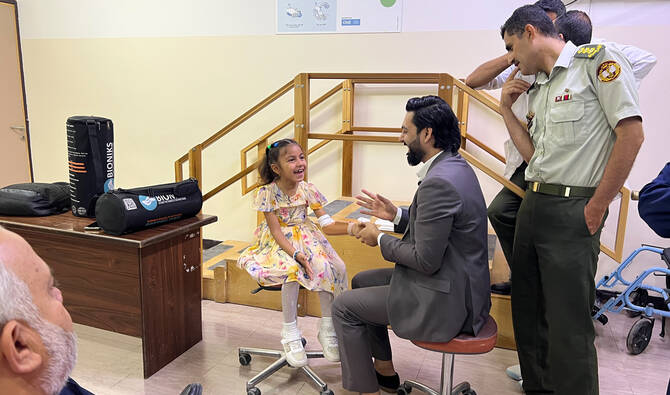
Anas Niaz, head of Pakistani health-tech startup Bioniks, tests a prosthetic limb as Sidra, a young girl from Gaza, smiles during a fitting session in Amman, Jordan, on July 2, 2025. Bioniks recently announced the successful fitting of its first prosthetic limb in Gaza for a girl injured in the ongoing Israel-Hamas war — marking a milestone in its broader mission to support amputees in the besieged territory. (AN Photo by Zainab Jamal)
2 / 2
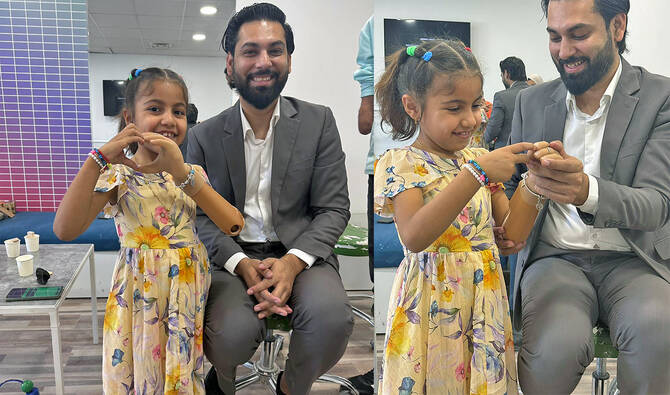
This combination of handout photos, created on July 3, 2025, shows Anas Niaz, head of the Pakistani health-tech startup Bioniks, with Sidra, a young girl from Gaza, after a prosthetic limb fitting session in Amman, Jordan, on July 2, 2025. (Handout/Bioniks)
Short Url
Updated 03 July 2025
Follow

Pakistan’s Bioniks fits first prosthetic limb on Gaza child survivor Sidra

  • Pakistani startup provides arm to young girl through Jordan partnership as part of Gaza amputee support mission
  • Founded in Karachi, Bioniks specializes in low-cost, customizable prosthetics using 3D printing and smart sensors

KARACHI: Pakistani health-tech Bioniks has successfully fitted its first prosthetic limb in Gaza for a young girl injured in the ongoing Israel-Hamas war, the firm said on social media on Thursday, marking the start of its broader effort to support amputees in the besieged territory.

The company said the fitting was made possible through its partnership with Mafaz, Bioniks’ official collaborator in Jordan. The recipient, Sidra, lost her arm during the war and now becomes the first beneficiary of Bioniks’ long-term humanitarian initiative aimed at war victims in Gaza.

“This marks the beginning of Bioniks’ mission to support amputees in Gaza,” the company said in a statement posted to X on Thursday, adding that Sidra’s journey “reflects the resilience of so many in Gaza.”

Bioniks said it hopes to give survivors “mobility, confidence, hope, dignity, and independence ... in a place where conflict has taken so much.”

Bioniks did not specify how many Gaza patients it plans to support or the timeline for future fittings but said its mission will be sustained and scaled in coordination with regional partners.

Founded in Karachi, Bioniks specializes in low-cost, customizable prosthetics using 3D printing and smart sensors. It has gained international recognition for its work with children and war survivors across Pakistan, and has begun expanding its outreach to conflict zones in the region.

The latest war in Gaza began on October 7, 2023, when Hamas carried out a cross-border attack on Israeli communities, killing around 1,200 people and seizing 251 hostages according to Israeli tallies. Israel has since been carrying out a devastating air and ground assault on Gaza, whose health ministry says the offensive has killed over 56,000 Palestinians, most of them women and children, and tens of thousands more have been injured. The fighting has displaced nearly 80 percent of the population and decimated the strip’s already fragile health infrastructure.

Aid organizations have widely reported a growing number of amputations, especially among children, due to Israeli airstrikes and the collapse of trauma care. UNICEF estimates that between 3,000 and 4,000 children in Gaza have had one or more limbs amputated. The besieged enclave is now home to more child amputees per inhabitant than anywhere else in the world.

Bioniks said its goal is to reach more children and adults in Gaza with personalized prosthetic limbs and follow-up care.

“Bioniks believes that no one should be left behind when it comes to mobility and dignity,” the company said in the press release. “Through this initiative, our goal is to reach more children and adults affected by war with customized prosthetic limbs and long-term care.”

The company has previously worked with Pakistani hospitals and rehabilitation centers to provide smart prosthetics to underprivileged children and adults, often using crowd-funding and donor support to cover costs.


PIA denies social media claim its entire flight crew went missing abroad

Updated 10 sec ago
Follow

PIA denies social media claim its entire flight crew went missing abroad

  • Airline says the allegation emerged from ‘anti-Pakistan quarters’ to defame both the national carrier
  • Some social media posts recently said a PIA flight crew had gone missing during a layover in Toronto

ISLAMABAD: Pakistan International Airlines (PIA) on Sunday dismissed as “fake news” a social media claim that the entire crew of one of its flights had disappeared overseas, saying the post was circulated to defame both the national carrier and the country.

The statement came after social media posts said a PIA flight crew had gone missing during a layover in Toronto, Canada.

Previously, there have been reports that individual crew members have used layovers to remain abroad, often linked by analysts to economic conditions at home and perceived asylum opportunities under Canada’s immigration policies. However, PIA has adopted measures such as holding passports with station managers and assigning older crew to Canada routes to curb the trend.

“A tweet, circulated by certain anti-Pakistan quarters, claiming that the whole crew of a particular #PIA flight is missing, is entirely baseless,” the airline announced in a post on X, adding that the purpose of the message “seems to malign PIA and #Pakistan.”

“There has been no such incident, and the news is fake,” it said.

According to local media reports, the information had been circulated by an “Afghan and anti-Pakistan account.”

“The misleading tweet is part of a well-conceived plan based on hostility toward Pakistan and is aimed at damaging the reputation of the national airline and the country,” Pakistan’s English-language broadsheet, Dawn, quoted the airline spokesperson as saying.

Pakistan has been striving to privatize PIA along with other state-owned enterprises under an International Monetary Fund (IMF) loan program.

The airline was banned from operating in Britain and Europe, though those restrictions have been removed more recently.