

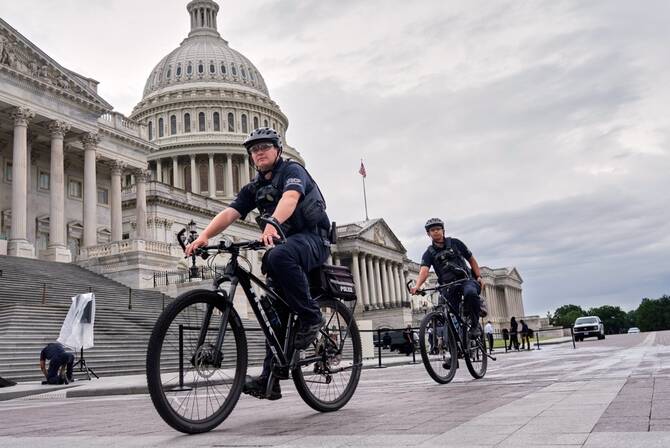
Trump tax bill stalled by Republican rebellion in Congress

The bill would extend and make permanent various individual and business tax breaks from Trump’s first term. (AP)
Short Url
Updated 03 July 2025
Follow

Trump tax bill stalled by Republican rebellion in Congress

Washington: Donald Trump’s signature tax and spending bill was in limbo early Thursday as Republican leaders in the US Congress scrambled to win over a group of rebels threatening to torpedo the centerpiece of the president’s domestic agenda.

Trump is seeking final approval in the House of Representatives for his Senate-passed “One Big Beautiful Bill” — but faces opposition on all sides of his fractious party over provisions set to balloon the national debt while launching a historic assault on the social safety net.

As midnight (0400 GMT) struck, House Speaker Mike Johnson was still holding open a key procedural vote — the bill’s last hurdle before it can advance to be considered for final approval — more than two hours after it was first called.

With no clear sign of the stalemate breaking, his lieutenants huddled in tense meetings behind the scenes with the rebels who had either voted no or had yet to come to the House floor.

“We’re going to get there tonight. We’re working on it and very, very positive about our progress,” Johnson told reporters at the Capitol, according to Politico.

Originally approved by the House in May, Trump’s sprawling legislation squeezed through the Senate on Tuesday by a solitary vote but had to return to the lower chamber Wednesday for a rubber stamp of the Senate’s revisions.

The package honors many of Trump’s campaign promises, boosting military spending, funding a mass migrant deportation drive and committing $4.5 trillion to extend his first-term tax relief.

But it is expected to pile an extra $3.4 trillion over a decade onto the country’s fast-growing deficits, while forcing through the largest cuts to the Medicaid health insurance program since its 1960s launch.

While moderates in the House are anxious that the cuts will damage their prospects of reelection, fiscal hawks are chafing over savings that they say fall short of what they were promised by hundreds of billions of dollars.

Johnson has to negotiate incredibly tight margins, and can likely only lose three lawmakers among more than two dozen who have declared themselves open to rejecting Trump’s bill.

Republican leaders had been hoping to spend just a few hours on Wednesday afternoon green-lighting the package, although they have a cushion of two days before Trump’s self-imposed July 4 deadline.

The 887-page text only passed in the Senate after a flurry of tweaks that pulled the House-passed text further to the right.

Republicans lost one conservative who was angry about adding to the country’s $37 trillion debt burden and two moderates worried about almost $1 trillion in health care cuts.

Some estimates put the total number of recipients set to lose their health insurance at 17 million, while scores of rural hospitals are expected to close.

Legislation in the House has to go through multiple “test” votes before it can come up for final approval, and a majority must wave it through at each of these stages.

There were warning signs early in the day as the package stumbled at one of the first steps, with a straightforward vote that ought to have taken minutes remaining open for seven hours and 31 minutes — making it the longest House vote in history.

Johnson had made clear that he was banking on Trump leaning on waverers, as he has in the past to turn around contentious House votes that were headed for failure.

The president has spent weeks cajoling Republicans torn between angering welfare recipients at home and incurring his wrath.

Trump pressured House Republicans to get the bill over the line in a private White House meeting with several holdouts on Wednesday.

“What are the Republicans waiting for?,” he posted on his Truth Social platform just after midnight.

“What are you trying to prove??? MAGA IS NOT HAPPY, AND IT’S COSTING YOU VOTES!!!“

House Democrats have signaled that they plan to campaign on the bill to flip the chamber in the 2026 midterm elections, pointing to analyzes showing that it represents a historic redistribution of wealth from the poorest Americans to the richest.

“Shame on Senate Republicans for passing this disgusting abomination,” House Minority Leader Hakeem Jeffries told reporters.


Rohingya refugees hope new leaders can pave a path home

Updated 6 sec ago
Follow

Rohingya refugees hope new leaders can pave a path home

  • Some 1.7 million Rohingya Muslims displaced in Myanmar's military crackdown live in squalid camps in Cox’s Bazar, Bangladesh

COX’S BAZAR, Bangladesh: Rohingya refugees living in squalid camps in Bangladesh have elected a leadership council, hoping it can improve conditions and revive efforts to secure their return home to Myanmar.
Spread over 8,000 acres in Cox’s Bazar in Bangladesh, the camps are home to 1.7 million members of the stateless group, many of whom fled a 2017 military crackdown that is now subject to a genocide probe at the UN court.
In July, the refugees held their first elections since their influx began eight years ago, resulting in the formation of the United Council of Rohang (UCR).
“They are working to take us home,” said Khairul Islam, 37, who back home had a thriving timber business.
The new council has brought him a glimmer of hope amid an uncertain future.
“We can hardly breathe in these cramped camp rooms... all our family members live in a single room,” he said.
“It’s unbearably hot inside. Back in Myanmar, we didn’t even need a ceiling fan. In summer, we used to sit under tall trees,” Islam said, his eyes welling up.
More than 3,000 voters from across 33 refugee camps cast their ballots to elect an executive committee and five rotating presidents to focus on human rights, education and health.
Addressing a gathering at one of the camps, UCR president Mohammad Sayed Ullah urged refugees not to forget the violence that forced the mostly Muslim group to flee Myanmar’s Rakhine state.
“Never forget that we left our parents’ graves behind. Our women died on the way here. They were tortured and killed... and some drowned at sea,” said Sayed Ullah, dressed in a white full-sleeved shirt and lungi.
“We must prepare ourselves to return home,” he said, prompting members of the audience to nod in agreement.

A seat at the table 

“UCR wants to emerge as the voice of the Rohingyas on the negotiation table,” Sayed Ullah later told AFP.
“It’s about us, yet we were nowhere as stakeholders.”
The council is not the first attempt to organize Rohingya refugees.
Several groups emerged after 2017, including the Arakan Rohingya Society for Peace and Human Rights, once led by prominent activist Mohib Ullah.
But he was murdered in 2021.
And even before that, many organizations were shut down after a major 2019 rally, when the Rohingya said they would go home only with full rights and safety guarantees.
“Some newspapers misrepresented us, claiming we wanted to stay permanently in Bangladesh,” Sayed Ullah said.
“Many organizers were detained. The hardest blow was the assassination of Mohib Ullah.”
But trust is slowly building up again among the Rohingya crammed in the camps in Cox’s Bazar.
“Of course we will return home,” said 18-year-old Mosharraf, who fled the town of Buthidaung with his family.
“UCR will negotiate for better education. If we are better educated, we can build global consensus for our return,” he told AFP.

Security threats 

Many refugees have started approaching the body with complaints against local Rohingya leaders, reflecting a slow but noticeable shift in attitudes.
On a recent sunny morning, an AFP reporter saw more than a dozen Rohingya waiting outside the UCR office with complaints.
Some said they were tortured while others reported losing small amounts of gold they had carried while fleeing their homes.
Analysts say it remains unclear whether the new council can genuinely represent the Rohingya or if it ultimately serves the interests of Bangladeshi authorities.
“The UCR ‘elections’ appear to have been closely controlled by the authorities,” said Thomas Kean, senior consultant at the International Crisis Group.
Security threats also loom large, undermining efforts to forge political dialogue.
Armed groups like the Arakan Rohingya Salvation Army and Rohingya Solidarity Organization continue to operate in the camps.
A report by campaign group Fortify Rights said at least 65 Rohingyas were killed in 2024.
“Violence and killings in the Rohingya camps need to stop, and those responsible must be held to account,” the report quoted activist John Quinley as saying.