
LONDON: When global attention shifted to the conflict between Israel and Iran, the urgency around ending the war in Gaza appeared to dissipate. But for Palestinian civilians living under fire and the families of hostages still awaiting news, the nightmare remained very much alive.
On Wednesday, US President Donald Trump announced on Truth Social that Israel had accepted the key conditions required for a 60-day ceasefire, although he did not detail the specific terms of the agreement.
He said Qatar and Egypt, which have played significant roles in the negotiations, would present the final proposal to Hamas. Trump urged Hamas to accept the deal, warning that if they reject it, the situation “will not get better — IT WILL ONLY GET WORSE.”
Trump’s announcement came ahead of a scheduled meeting with Israeli Prime Minister Benjamin Netanyahu at the White House next week, where Trump indicated he would take a “very firm” stance.
He expressed optimism that a ceasefire agreement could be finalized as soon as next week.

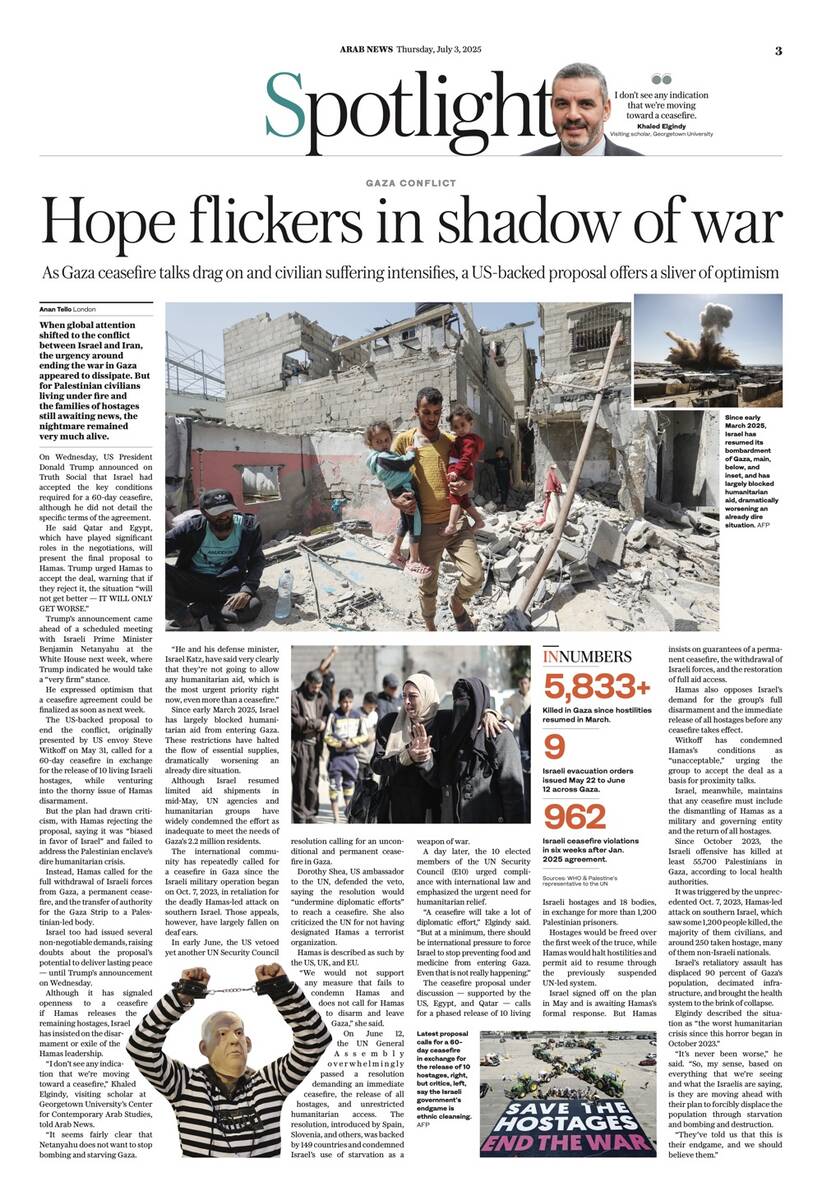
Aid agencies say the blockade has caused acute shortages of food. (AFP)
Despite these statements, the fighting has escalated. Israeli military spokesperson Avichay Adraee has announced renewed operations in northern Gaza, the aim being the elimination of “terrorists and terrorist infrastructure.”
On June 29, Israeli forces ordered mass evacuations from northern Gaza and Jabalia to Sheikh Radwan, warning residents to move south ahead of intensified strikes.
The US-backed proposal to end the conflict, originally presented by US envoy Steve Witkoff on May 31, called for a 60-day ceasefire in exchange for the release of 10 living Israeli hostages, while venturing into the thorny issue of Hamas disarmament.
But the plan had drawn criticism, with Hamas rejecting the proposal, saying it was “biased in favor of Israel” and failed to address the Palestinian enclave’s dire humanitarian crisis.
Instead, Hamas called for the full withdrawal of Israeli forces from Gaza, a permanent ceasefire, and the transfer of authority for the Gaza Strip to a Palestinian-led body.
Israel too had issued several non-negotiable demands, raising doubts about the proposal’s potential to deliver lasting peace — until Trump’s announcement on Wednesday.
Although it has signaled openness to a ceasefire if Hamas releases the remaining hostages, Israel has insisted on the disarmament or exile of the Hamas leadership. Some Israeli ministers have even threatened to resign over any deal that does not secure Hamas’s defeat.

Hamas called for the full withdrawal of Israeli forces from Gaza, a permanent ceasefire, and the transfer of authority for the Gaza Strip to a Palestinian-led body. (AFP)
“The current proposed framework will be difficult for Hamas to accept, since it does not include any mention of a permanent ceasefire and basically allows Israel to resume the bombing and starvation after 60 days — just as it did when it broke the last ceasefire in March,” Khaled Elgindy, visiting scholar at Georgetown University’s Center for Contemporary Arab Studies, told Arab News.
“But given the daily killing and mass starvation in Gaza, Hamas may have no choice but to go along and hope that the Trump administration will put pressure on Netanyahu to keep that from happening.”
Since early March 2025, Israel has largely blocked humanitarian aid from entering Gaza. These restrictions have halted the flow of essential supplies — including food, medicine, and fuel — dramatically worsening an already dire situation.
Although Israel resumed limited aid shipments in mid-May, UN agencies and humanitarian groups have widely condemned the effort as inadequate to meet the needs of Gaza’s 2.2 million residents.
International rights groups have denounced the aid restrictions as violations of international law, accusing Israel of using starvation as a weapon of war and pushing Gaza toward a man-made catastrophe — claims the Israeli government denies.
Aid agencies say the blockade has caused acute shortages of food, clean water, fuel, and medical supplies, driving the population to the brink of famine.
Despite growing international pressure, Israeli officials insist on retaining control over aid distribution, arguing that the measures are necessary to prevent supplies from falling into the hands of Hamas.

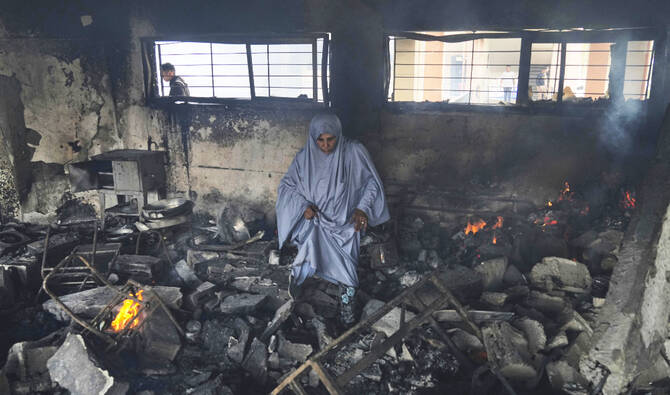
Since October 2023, the Israeli offensive has killed at least 55,700 Palestinians in Gaza, according to local health authorities. (AP)
In May, this stance led to the launch of a controversial new mechanism: the Gaza Humanitarian Foundation, or GHF. Backed by the US and Israel but rejected by the UN, the GHF has come under fire for failing to meet humanitarian standards and for relying on Israeli military oversight.
The GHF replaces the longstanding UN-led aid system, which Israel claims allowed Hamas to divert supplies — an allegation firmly denied by the UN and most humanitarian organizations.
Operating through four military-controlled distribution hubs in southern Gaza, the GHF forces civilians to travel long distances to collect prepackaged food, water, and hygiene kits — often under the watch of Israeli troops.
Critics, including the UN and major aid groups, say the GHF politicizes aid and enables Israel to weaponize relief by tightly regulating access.
Deadly incidents have occurred near distribution sites, with video footage showing scenes that observers have compared to concentration camps.
One such incident took place on June 15, when Israeli forces opened fire on a crowd of Palestinians gathered near an aid center in Rafah. At least eight were killed and dozens wounded, according to witnesses and Gaza health officials.

A tractor protest organised by the Kibbutz Movement and the Hostages Families (AFP)
Survivors described the scene as a trap, with no safe way to evacuate the wounded amid the chaos.
The UN and international rights groups condemned the violence. The Council on American-Islamic Relations labeled the aid centers “human slaughterhouses” due to repeated fatal shootings of civilians seeking food and water.
The international community has repeatedly called for a ceasefire in Gaza since the Israeli military operation began on Oct. 7, 2023, in retaliation for the deadly Hamas-led attack on southern Israel. Those appeals, however, have largely fallen on deaf ears.
In early June, the US vetoed yet another UN Security Council resolution calling for an unconditional and permanent ceasefire in Gaza.
Dorothy Shea, US ambassador to the UN, defended the veto, saying the resolution would “undermine diplomatic efforts” to reach a ceasefire. She also criticized the UN for not having designated Hamas a terrorist organization.

The international community has repeatedly called for a ceasefire in Gaza since the Israeli military operation began on Oct. 7, 2023. (AFP)
Hamas is described as such by the US, UK, and EU.
“We would not support any measure that fails to condemn Hamas and does not call for Hamas to disarm and leave Gaza,” she said.
Still, pressure continues to mount. On June 18, the World Food Programme emphasized the urgent need for another ceasefire to allow safe and consistent delivery of critical food supplies to families in Gaza.
On June 12, the UN General Assembly overwhelmingly passed a resolution demanding an immediate ceasefire, the release of all hostages, and unrestricted humanitarian access. The resolution, introduced by Spain, Slovenia, and others, was backed by 149 countries and condemned Israel’s use of starvation as a weapon of war.
A day later, the 10 elected members of the UN Security Council (E10) urged compliance with international law and emphasized the urgent need for humanitarian relief.
“A ceasefire will take a lot of diplomatic effort,” Elgindy said. “But at a minimum, there should be international pressure to force Israel to stop preventing food and medicine from entering Gaza. Even that is not really happening.”
The ceasefire proposal under discussion — supported by the US, Egypt, and Qatar — calls for a phased release of 10 living Israeli hostages and 18 bodies, in exchange for more than 1,200 Palestinian prisoners.
INNUMBER
• 5,833+ Killed in Gaza since hostilities resumed in March.
• 9 Israeli evacuation orders issued May 22 to June 12 across Gaza.
• 962 Israeli ceasefire violations in six weeks after Jan. 2025 agreement.
(Sources: WHO & Palestine’s representative to the UN)
Hostages would be freed over the first week of the truce, while Hamas would halt hostilities and permit aid to resume through the previously suspended UN-led system.
Israel signed off on the plan in May and is awaiting Hamas’s formal response. But Hamas insists on guarantees of a permanent ceasefire, the withdrawal of Israeli forces, and the restoration of full aid access.
Hamas also opposes Israel’s demand for the group’s full disarmament and the immediate release of all hostages before any ceasefire takes effect.
Witkoff has condemned Hamas’s conditions as “unacceptable,” urging the group to accept the deal as a basis for proximity talks.
Israel, meanwhile, maintains that any ceasefire must include the dismantling of Hamas as a military and governing entity and the return of all hostages.
It was triggered by the unprecedented Oct. 7, 2023, Hamas-led attack on southern Israel, which saw some 1,200 people killed, the majority of them civilians, and around 250 taken hostage, many of them non-Israeli nationals.
Israel’s retaliatory assault has displaced 90 percent of Gaza’s population, decimated infrastructure, and brought the health system to the brink of collapse.

Israeli officials, including Netanyahu and members of his far-right coalition, have openly discussed annexing parts of Gaza. (AFP)
Elgindy described the situation as “the worst humanitarian crisis since this horror began in October 2023.”
“It’s never been worse,” he said. “So, my sense, based on everything that we’re seeing and what the Israelis are saying, is they are moving ahead with their plan to forcibly displace the population through starvation and bombing and destruction.
“They’ve told us that this is their endgame, and we should believe them.”
Indeed, Israel’s strategy appears aimed at concentrating Gaza’s population in a small southern zone while seizing control of roughly 75 percent of the territory. The plan, approved by Israel’s security cabinet and supported by the US, has prompted alarm from human rights groups.
Organizations including Amnesty International and Human Rights Watch have condemned the effort as ethnic cleansing and a possible war crime, citing forced displacement and collective punishment.
With supplies blocked and civilians trapped in an ever-shrinking space, Gaza’s 2.2 million residents face escalating desperation and a vanishing hope of survival.
Israeli officials, including Netanyahu and members of his far-right coalition, have openly discussed annexing parts of Gaza and “conquering” the territory. Some have called for its depopulation, drawing global condemnation and renewed calls to end arms sales and military aid to Israel.
According to Elgindy, Israeli leaders claim to have informal agreements with some countries to accept Palestinians from Gaza — although several regional powers have flatly rejected such plans.
“Jordan and Egypt and Saudi Arabia and others have completely rejected the idea,” he said.
“But of course, since the most powerful nation in the world, the US, is endorsing the idea of expelling the population, the Israelis feel that it’s not only likely, but probable. And where they go is not of concern to Israel.

Since early March 2025, Israel has largely blocked humanitarian aid from entering Gaza. (AFP)
“The only thing that this Israeli leadership cares about is that they leave. And that is why they’re continuing to use starvation as a weapon while targeting aid workers, ambulances, and civilian infrastructure.
“So, all we know is that they want them to leave, but they don’t care where they go or how they go. I think they’re calling it voluntary relocation. But of course, when you bomb and starve the population, nothing is voluntary.
“There are even reports that they’re willing to pay $5,000 per family for a job and a house. They’re willing to spend billions on expelling the population rather than on rebuilding what they’ve destroyed.”
That possibility of forced mass displacement raises urgent questions about the future of international law.
“I think this is a test right now for the international community,” Elgindy said.
“Does international law mean anything at all? And if Israel is allowed to carry out its plan of ethnic cleansing of Gaza after it’s destroyed it, after broadcasting its intentions for many months — if this is allowed to go ahead, then we know for certain that international law is a complete farce and means nothing and will never mean anything going forward.
“It will be impossible to try and revive the idea of a rules-based order after Gaza.”