

Israel says it’s serious about reaching ceasefire, cites positive signs

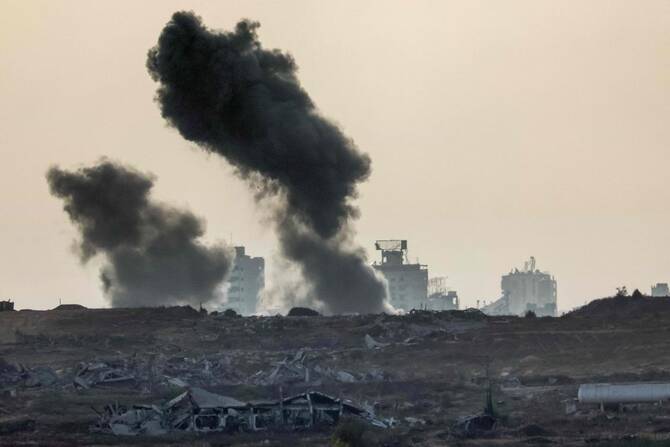
This picture taken from a position at Israel’s border with the Gaza Strip shows smoke billowing during an Israeli strike on the besieged Palestinian territory on July 1, 2025. (AFP)
Short Url
Updated 02 July 2025
Follow

Israel says it’s serious about reaching ceasefire, cites positive signs

  • Saar said: “We are serious in our will to reach a hostage deal and a ceasefire”
  • “Our goal is to begin proximity talks as soon as possible,” said Saar

TALLINN: Israeli Foreign Minister Gideon Saar said on Wednesday that his country was serious about reaching a deal with the Palestinian Hamas group to end the war in Gaza and return the hostages held there to Israel.

US President Donald Trump said on Tuesday that Israel had accepted the conditions needed to finalize a 60-day ceasefire with Hamas after what he called a “long and productive” meeting of his representatives with Israeli officials.

At a press conference in the Estonian capital Tallinn, Saar said: “We are serious in our will to reach a hostage deal and a ceasefire. We said yes to (US) special envoy (Steve) Witkoff’s proposals.

“There are some positive signs. I don’t want to say more than that right now. But our goal is to begin proximity talks as soon as possible,” said Saar, who spoke after holding talks with Estonia’s Foreign Minister Margus Tsahkna.

“But it must be clear: Hamas is not only responsible for initiating this war on October 7 (2023). It is responsible also for its continuation. Pressure must be applied on Hamas. The international community must now back the American initiatives. It must shatter any illusions that Hamas may have,” he said.

In a statement on Wednesday, Hamas said it was studying new ceasefire offers it received from the mediators Egypt and Qatar but stressed it aimed to reach an agreement that would ensure an end to the war and an Israeli pullout from Gaza.


New Riyadh Air route to boost Dubai airport’s growth projection

Updated 4 sec ago
Follow

New Riyadh Air route to boost Dubai airport’s growth projection

  • World’s busiest travel hub adding more routes to Saudi Arabia
  • Dubai Airports forecasts 99.5 million passengers in 2026
DUBAI: Dubai International Airport (DXB), the world’s busiest travel hub, is expected to handle close to 100 million passengers this year, its operator said on Wednesday, building on a record performance in 2025.
Dubai Airports forecasts 99.5 million passengers in 2026, ‌it said in a ‌statement, as demand strengthens across several major markets.
DXB ‌handled ⁠95.2 million passengers ⁠last year, up 3.1 percent from 2024. India, Saudi Arabia and Britain remained among its largest markets, while China, Egypt and Italy recorded double-digit growth.
“We’ve had some pretty good growing markets … and those, I think, are the markets where there’s going to be considerable potential,” Dubai Airports CEO Paul Griffiths said in an interview, mentioning countries including ⁠China and Russia.
“We’re adding more routes to ‌Saudi Arabia,” he said, adding that ‌Riyadh Air, which is owned by the kingdom’s sovereign wealth fund and commenced ‌operations last year, will start operating a route to and ‌from DXB “over the next few months.”
Dubai, home to the world’s tallest tower and palm-shaped islands, is the Middle East’s biggest tourism and trade hub. It is also a key connecting point for flights between Europe ‌and Asia, and last year welcomed 19.6 million international overnight visitors, according to government data.
DXB had its ⁠busiest day, ⁠month, quarter and year on record in 2025, operating “at the edge of physical capacity,” Dubai Airports said.
Griffiths said investment to roll out advanced hand baggage screening machines was helping to smooth the flow of traffic.
To meet rising demand and a fast-growing population, the emirate has announced a major $35 billion expansion at its second airport, Al Maktoum International, also operated by Dubai Airports.
That airport reported 30 percent growth in flights over the last year and handled 1.4 million passengers.
The expansion is designed to allow it to handle 150 million passengers per year over the next decade, before reaching an annual capacity of 260 million passengers when complete.