

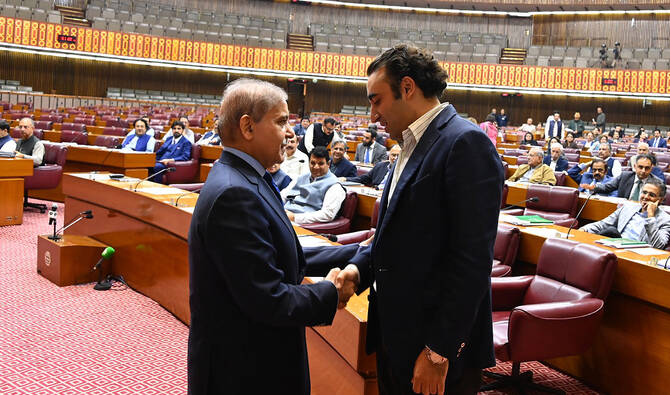

ISLAMABAD: Pakistan’s ruling coalition government finally secured a two-thirds majority in parliament on Wednesday after the Election Commission of Pakistan’s (ECP) latest notification, allocating reserved seats in the national and provincial assemblies to parties other than the Pakistan Tehreek-e-Insaf (PTI) in line with the top court’s recent ruling.
The Supreme Court’s constitutional bench on June 27 ruled that former prime minister Imran Khan’s PTI is not entitled to reserved seats in the national and provincial assemblies, upholding an earlier verdict by the Peshawar High Court. The dispute arose after PTI lost its electoral symbol ahead of the February 8 national polls and its candidates contested as independents.
Despite its candidates winning the most general seats, the PTI was denied reserved seats for women and minorities, which are allocated to parties based on proportional representation, by the ECP. The government lost its two-thirds majority in parliament in July 2024 when the top court reversed the ECP’s decision, terming it unconstitutional and ordering the reserved seats to be allocated to PTI. The ECP and the political parties had filed a review petition, which were accepted by the top court last week.
“Pursuant to the Order dated 27 June, 2025 passed by the Hon’ble Supreme Court of Pakistan (Constitutional Bench) in Civil Review Petitions, the ECP hereby notifies the names of under-mentioned returned candidates against various categories of Reserved Seats with immediate effect,” the ECP’s notification said.
Furthermore, the ECP also withdrew its notifications of July 24 and July 29, 2024, which declared the successful candidates on general seats in the national and provincial assemblies as PTI-returned candidates.
Sixteen reserved seats for women and three for minorities in the National Assembly were allocated to various parties, with the lion’s share going to the ruling Pakistan Muslim League-Nawaz (PML-N), the PTI’s chief rival. The PML-N were allocated 13 seats, while four were allocated to the Pakistan Peoples Party Parliamentarians (PPPP) and two to the Jamiat Ulema-e-Islam Pakistan (JUI-F).
With this development, the ruling coalition has crossed the two-thirds majority mark, securing 233 seats in the 336-member National Assembly, the lower house of parliament. A political party or a coalition government needs 224 seats to reach the threshold.
As per the notification, 21 reserved seats for women were reinstated in the Khyber Pakhtunkhwa (KP) Assembly, with eight allocated to the JUI-F, six to the PML-N and five to the PPPP. One seat each was also allotted to the PTI Parliamentarians and the Awami National Party (ANP).
Meanwhile, out of the four reserved seats for minorities in KP Assembly, two were given to the JUI-F and one each to the PML-N and the PPPP.
The ECP restored 24 reserved seats for women in the Punjab Assembly, of which the PML-N received 21, while one seat each was allocated to the PPPP, the Istehkam-e-Pakistan Party (IPP) and the Pakistan Muslim League-Quaid (PML-Q).
Additionally, three minority seats were allocated--two to the PML-N and one to the PPPP.
Two reserved seats for women and one for minorities were reinstated in the Sindh Assembly, with two allotted to the PPP and one to the Muttahida Qaumi Movement-Pakistan (MQM-P).
‘GRAVE INJUSTICE’
PTI’s spokesperson for international media, Sayed Zulfikar Abbas Bukhari, vowed the party would do everything to expose the latest “injustice” before the public.
“The judgment on reserved seats must be highlighted as a grave injustice and the undemocratic nature of the decision should be exposed before the entire nation,” he told Arab News.
Political analysts noted the development would further weaken the PTI’s position at the center.
“This move is likely to further undermine democracy in Pakistan and encourage horse-trading, as the ruling coalition may try to woo legislators particularly in KP,” Mazhar Abbas, a political analyst and journalist, told Arab News.
The PTI has a large support base in KP, where it has been emerging as the largest party since the 2013 polls.
Zahid Hussain, another political analyst, said the move has given the ruling coalition government the much-desired two-thirds majority, enabling them to make constitutional changes as per their will.
“The government and [military] establishment appear intent on securing a two-thirds majority to push through legislation and constitutional amendments of their choosing,” he noted.
Ahmed Bilal Mehboob, president of the Islamabad-based think tank Pakistan Institute of Legislative Development and Transparency (PILDAT) said the move would further strengthen the ruling PML-N as it would reduce the party’s reliance on the PPP.
“In National Assembly, PML-N-led coalition has come closer to having a simple majority without the PPP,” Mehboob said.
He added that after securing the reserved seats, the PML-N-led coalition needed only 11 seats to secure a simple majority on its own.


