

Ukraine struggles to contain Russian summer advances as US aid stalls

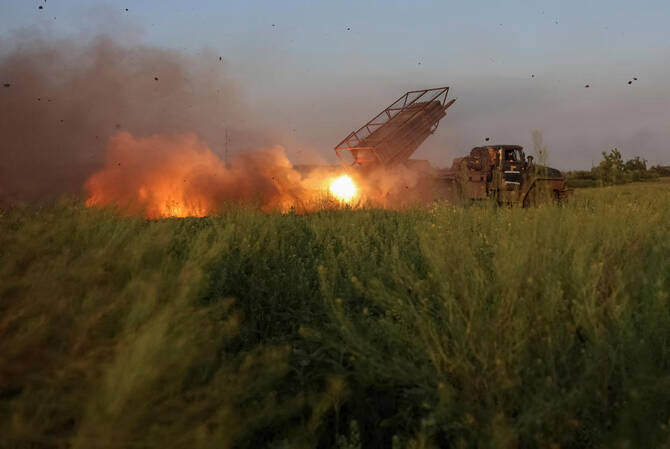
Servicemen of the 25th Separate Airborne Brigade of the Armed Forces of Ukraine fire a BM-21 Grad multiple rocket launch system toward Russian troops, amid Russia’s attack on Ukraine, near the frontline town of Pokrovsk, in Donetsk, Jun. 8, 2025. (Reuters/File)
Short Url
Updated 02 July 2025
Follow

Ukraine struggles to contain Russian summer advances as US aid stalls

  • Russia’s advances on the front are matched by an intensification of drone and missile strikes on Kyiv and other cities
  • “There are constant attacks with the intent of breaking through” to the border of the Dnipropetrovsk region at any cost, Trehubov said

KYIV: Russia has made incursions near two towns key to army supply routes in eastern Ukraine, a Ukrainian military official said on Wednesday, as Moscow seeks a breakthrough in a summer offensive at a time of uncertainty over US support for Kyiv.

In recent weeks, Russia has amassed forces and despite heavy losses has advanced in rural areas either side of Pokrovsk and Kostiantynivka, which both sit on crossroads running to the frontline from larger cities in Ukrainian-controlled territory.

Russia’s advances on the front are matched by an intensification of drone and missile strikes on Kyiv and other cities, following signs that Washington’s support for Ukraine’s war effort is faltering.

So far, the efforts by US President Donald Trump have failed to achieve a ceasefire in the full-scale invasion launched by Russia in 2022.

One of the aims of the Russian offensive is to occupy the rest of the Donetsk region. Now, they are using small assault groups, light vehicles, and drones to push toward the neighboring region, said Viktor Trehubov, a spokesperson for the Khortytsia group of forces.

“There are constant attacks with the intent of breaking through” to the border of the Dnipropetrovsk region at any cost, Trehubov said in written comments to Reuters.

Russia now has 111,000 soldiers in the Pokrovsk area, which it has been trying to seize since early last year, Ukraine’s top armed forces commander Oleksandr Syrskyi said last week, describing dozens of battles in the area every day.

A decision by Washington to halt some deliveries of various weapons including precision rocket artillery to Kyiv will worsen the situation on the ground for Ukraine’s forces, said Jack Watling, a senior researcher at the Royal United Services Institute, a think-tank.

“The loss of these supplies will significantly degrade Ukraine’s ability to strike Russian forces beyond 30 km (19 miles) from the front line and therefore allow Russia to improve its logistics,” Watling said.

RUSSIAN GAINS
Ukrainian blog DeepState, which uses open-source data to map the frontline, said the Russian military in June had seized 556 square kilometers of Ukrainian territory, which it said was the largest monthly loss of ground since November.

Russian forces, which have numerical superiority, cut the main road linking Pokrovsk and Kostiantynivka in May, complicating Ukrainian movements and resupply efforts.

“The Russian advance is being contained, but their crossing of the Pokrovsk-Kostyantynivka highway is a strategic and logistical setback,” Trehubov said.

Heavy Russian losses have prevented Russian advances toward Kostiantynivka via Chasiv Yar, or along the western Pokrovsk front. “Now they are attempting (to advance) further away from populated areas,” Trehubov said.

DeepState also reported that Russian advances in June near Pokrovsk and nearby Novopavlivka accounted for more than half of all Russian gains along the entire frontline in all of Ukraine.

Trehubov said Pokrovsk and Kostyantynivka remain Ukrainian logistical hubs, despite setbacks and drone activity which make some defensive fortifications less effective.

“(Drones) hinder logistics for both sides but don’t make it impossible. Drones after all are not invulnerable,” he said.


Zelensky presses EU to tap Russian assets at crunch summit

Updated 3 sec ago
Follow

Zelensky presses EU to tap Russian assets at crunch summit

  • “Russian assets must be used to defend against Russian aggression and rebuild what was destroyed by Russian attacks. It’s moral. It’s fair. It’s legal,” Zelensky said
  • German Chancellor Friedrich Merz was among those agreeing strongly as he said there was “no better option“

Brussels: Ukrainian President Volodymyr Zelensky told EU leaders Thursday they had the “moral” and legal right to use frozen Russian assets to fund Kyiv — as pressure grew on key player Belgium to drop its opposition at a summit showdown.
The 27-nation bloc is scrambling to bolster its ally Ukraine, as US President Donald Trump pushes for a deal with President Vladimir Putin to end the fighting.
Officials have insisted leaders’ talks in Brussels will last as long as it takes to hammer out an agreement, saying both Ukraine’s survival — nearly four years into the war — and Europe’s credibility are at stake.
“We will not leave the European summit without a solution for the funding of Ukraine,” European Commission head Ursula von der Leyen said.
The EU’s executive wants to fund a loan to Ukraine by using frozen assets from Russia’s central bank, though it is holding on to a back-up plan for the bloc to raise the money itself.
The EU estimates Ukraine needs an extra 135 billion euros ($159 billion) to stay afloat over the next two years — with the cash crunch set to start in April.
Zelensky said Kyiv needed a decision on its financing by the end of the year and that the move could give it more leverage in talks to end the war.
“Russian assets must be used to defend against Russian aggression and rebuild what was destroyed by Russian attacks. It’s moral. It’s fair. It’s legal,” Zelensky said.
German Chancellor Friedrich Merz was among those agreeing strongly as he said there was “no better option.”
But Belgium’s Prime Minister Bart De Wever — who held talks with Zelensky on the sidelines — seemed unconvinced so far.
“I have not seen a text that could persuade me to give Belgium’s agreement,” he told Belgian lawmakers before the summit kicked off.
The vast bulk of the assets are held by international deposit organization Euroclear in Belgium, and the government fears it could face crippling financial and legal reprisals from Moscow.
EU officials say they have gone out of their way to allay Belgian worries and that multiple layers of protection — including guarantees from other member states — mean the risks are minimal.
“At this stage, the guarantees offered by the Commission remain insufficient,” De Wever said.

- Ukraine’s looming cash crunch -

In a bid to plug Kyiv’s yawning gap, the Commission has proposed tapping 210 billion euros of frozen assets, initially to provide Kyiv 90 billion euros over two years.
The unprecedented scheme would see the funds loaned to the EU, which would then loan them on to Ukraine.
Kyiv would then only pay back the “reparations loan” once the Kremlin compensates it for the damage.
In theory, other EU countries could override Belgium and ram the initiative through with a weighted majority, but that would be a nuclear option that few see as likely for now.
De Wever insisted that the EU should go for its alternative plan of raising money itself — but diplomats said that option had been shelved as it needed unanimity and Hungary was firmly against.
Bubbling close to the surface of the EU’s discussion are the US efforts to forge a deal to end the war.
Zelensky said Ukrainian and US delegations would hold new talks on Friday and Saturday in the United States.
He said he wanted Washington to give more details on the guarantees it could offer to protect Ukraine from another invasion.
“What will the United States of America do if Russia comes again with aggression?” he asked. “What will these security guarantees do? How will they work?“