

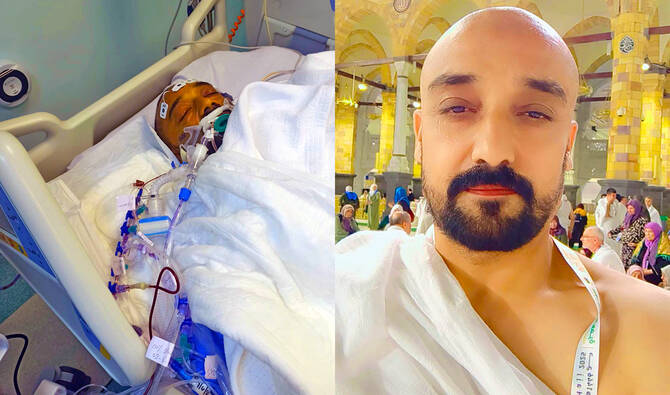

ISLAMABAD: On the Day of Arafat, as the Hajj sermon began under the blazing sun, Pakistani pilgrim Imran Khan collapsed, his heart stopping not once, but five times. Saudi authorities swiftly intervened, airlifting him to a nearby medical facility for life-saving treatment, prompting him to describe his survival weeks later as a “miracle” and his new life as “a precious gift from Allah.”
Khan, a 42-year-old father of two from Haroonabad, a modest town in Punjab’s Bahawalnagar District, had long dreamed of performing Hajj. Accompanied by his wife, he set out on the pilgrimage this year with a heart full of gratitude.
Everything went smoothly — until June 5, the most important day of Hajj, when, standing on the sun-scorched plains of Arafat, he suffered a sudden cardiac arrest and was rushed to East Arafat Hospital in critical condition.
Despite repeated resuscitation attempts, his heart stopped multiple times, putting his life at grave risk. After initial emergency care, he was airlifted again to King Abdullah Medical City in Makkah, still on a ventilator, where a team of specialized doctors treated him, and he eventually recovered.
“It is indeed a miracle that Allah has blessed me with a new life, a precious gift from Him,” Khan told Arab News over the phone from Jeddah.
From the very beginning of his pilgrimage, he said, his heart carried a single, earnest prayer for good health, recalling how he repeatedly asked Allah to grant him a life of strength and well-being.
“Had this happened in Pakistan, such a level of care might not have been possible, and I may not have survived,” he added.
Khan said he had a mild diabetes condition but no history of heart issues, and that before embarking on the Hajj journey, he underwent a medical checkup and was declared fully fit.
While standing in Arafat during the Hajj sermon, Khan recalled he began to feel an intense chest pain followed by severe palpitations. Eventually, he lost consciousness after vomiting.
“When I regained consciousness nearly 17 days later, the doctors told me that my heart had stopped five times on that day,” he said, adding his treatment in Saudi Arabia was excellent, and truly of an international standard.
After being airlifted by helicopter from the plains of Arafat to King Abdullah Hospital, he said a dedicated medical team treated him around the clock.
“At every critical moment, a full team of doctors was constantly attending to me,” he said, thanking the Saudi government for providing excellent life-saving treatment.
“The entire treatment was completely free of cost,” he continued. “They did not take a single penny from me and provided everything from medicines to food and water.”
Khan commended his wife for showing remarkable courage throughout the ordeal.
“She is still with me here in Jeddah and has stood by me every step of the way,” he said in an emotional tone. “I also had two Pakistani friends with me, but I have not seen such strength and bravery even in men as my wife displayed in Saudi Arabia.”
Khan said he would travel to Pakistan on July 8, as doctors had discharged him from the hospital and declared him fit to travel.
“It’s now been five days since I was discharged from the hospital and I am currently in Jeddah, where my health is gradually improving,” he added.
According to the Pakistan Hajj Medical Mission, a total of 239 Pakistani pilgrims with serious health issues were treated in Saudi hospitals this year, including both government and Saudi-sponsored private sector facilities.
As of now, five patients remain admitted, with four of them on ventilators.


