

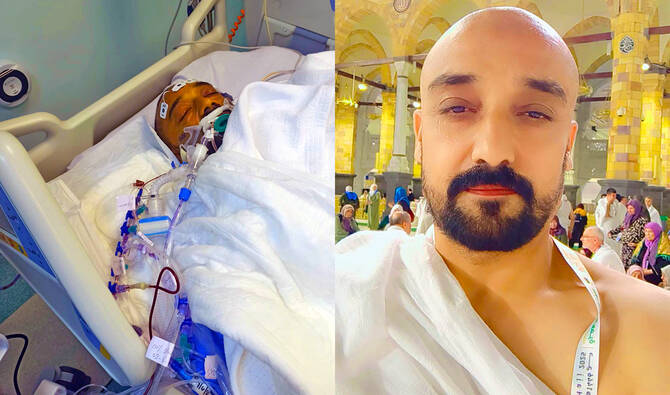
Pakistani pilgrim calls survival ‘a miracle’ after his heart stopped five times during Hajj

The collage of images created on July 2, 2025, shows Pakistani pilgrim Imran Khan (left) receiving medical treatment at King Abdullah Hospital in Makkah, Saudi Arabia. (Imran Khan)
Short Url
Updated 02 July 2025
Follow

Pakistani pilgrim calls survival ‘a miracle’ after his heart stopped five times during Hajj

  • Imran Khan was airlifted to King Abdullah Hospital in Makkah after collapsing on the Day of Arafat
  • He says he got treatment free of cost, believes he might not have survived had he been in Pakistan

ISLAMABAD: On the Day of Arafat, as the Hajj sermon began under the blazing sun, Pakistani pilgrim Imran Khan collapsed, his heart stopping not once, but five times. Saudi authorities swiftly intervened, airlifting him to a nearby medical facility for life-saving treatment, prompting him to describe his survival weeks later as a “miracle” and his new life as “a precious gift from Allah.”

Khan, a 42-year-old father of two from Haroonabad, a modest town in Punjab’s Bahawalnagar District, had long dreamed of performing Hajj. Accompanied by his wife, he set out on the pilgrimage this year with a heart full of gratitude.

Everything went smoothly — until June 5, the most important day of Hajj, when, standing on the sun-scorched plains of Arafat, he suffered a sudden cardiac arrest and was rushed to East Arafat Hospital in critical condition.

Despite repeated resuscitation attempts, his heart stopped multiple times, putting his life at grave risk. After initial emergency care, he was airlifted again to King Abdullah Medical City in Makkah, still on a ventilator, where a team of specialized doctors treated him, and he eventually recovered.

“It is indeed a miracle that Allah has blessed me with a new life, a precious gift from Him,” Khan told Arab News over the phone from Jeddah.

From the very beginning of his pilgrimage, he said, his heart carried a single, earnest prayer for good health, recalling how he repeatedly asked Allah to grant him a life of strength and well-being.

“Had this happened in Pakistan, such a level of care might not have been possible, and I may not have survived,” he added.

Khan said he had a mild diabetes condition but no history of heart issues, and that before embarking on the Hajj journey, he underwent a medical checkup and was declared fully fit.

While standing in Arafat during the Hajj sermon, Khan recalled he began to feel an intense chest pain followed by severe palpitations. Eventually, he lost consciousness after vomiting.

“When I regained consciousness nearly 17 days later, the doctors told me that my heart had stopped five times on that day,” he said, adding his treatment in Saudi Arabia was excellent, and truly of an international standard.

After being airlifted by helicopter from the plains of Arafat to King Abdullah Hospital, he said a dedicated medical team treated him around the clock.

“At every critical moment, a full team of doctors was constantly attending to me,” he said, thanking the Saudi government for providing excellent life-saving treatment.

“The entire treatment was completely free of cost,” he continued. “They did not take a single penny from me and provided everything from medicines to food and water.”

Khan commended his wife for showing remarkable courage throughout the ordeal.

“She is still with me here in Jeddah and has stood by me every step of the way,” he said in an emotional tone. “I also had two Pakistani friends with me, but I have not seen such strength and bravery even in men as my wife displayed in Saudi Arabia.”

Khan said he would travel to Pakistan on July 8, as doctors had discharged him from the hospital and declared him fit to travel.

“It’s now been five days since I was discharged from the hospital and I am currently in Jeddah, where my health is gradually improving,” he added.

According to the Pakistan Hajj Medical Mission, a total of 239 Pakistani pilgrims with serious health issues were treated in Saudi hospitals this year, including both government and Saudi-sponsored private sector facilities.

As of now, five patients remain admitted, with four of them on ventilators.


Pakistan, global crypto exchange discuss modernizing digital payments, creating job prospects 

Updated 05 December 2025
Follow

Pakistan, global crypto exchange discuss modernizing digital payments, creating job prospects 

  • Pakistani officials, Binance team discuss coordination between Islamabad, local banks and global exchanges
  • Pakistan has attempted to tap into growing crypto market to curb illicit transactions, improve oversight

ISLAMABAD: Pakistan’s finance officials and the team of a global cryptocurrency exchange on Friday held discussions aimed at modernizing the country’s digital payments system and building local talent pipelines to meet rising demand for blockchain and Web3 skills, the finance ministry said.

The development took place during a high-level meeting between Finance Minister Muhammad Aurangzeb, Pakistan Virtual Assets Regulatory Authority (PVARA) Chairman Bilal bin Saqib, domestic bank presidents and a Binance team led by Global CEO Richard Teng. The meeting was held to advance work on Pakistan’s National Digital Asset Framework, a regulatory setup to govern Pakistan’s digital assets.

Pakistan has been moving to regulate its fast-growing crypto and digital assets market by bringing virtual asset service providers (VASPs) under a formal licensing regime. Officials say the push is aimed at curbing illicit transactions, improving oversight, and encouraging innovation in blockchain-based financial services.

“Participants reviewed opportunities to modernize Pakistan’s digital payments landscape, noting that blockchain-based systems could significantly reduce costs from the country’s $38 billion annual remittance flows,” the finance ministry said in a statement. 

“Discussions also emphasized building local talent pipelines to meet rising global demand for blockchain and Web3 skills, creating high-value employment prospects for Pakistani youth.”

Blockchain is a type of digital database that is shared, transparent and tamper-resistant. Instead of being stored on one computer, the data is kept on a distributed network of computers, making it very hard to alter or hack.

Web3 refers to the next generation of the Internet built using blockchain, focusing on giving users more control over their data, identity and digital assets rather than big tech companies controlling it.

Participants of the meeting also discussed sovereign debt tokenization, which is the process of converting a country’s debt such as government bonds, into digital tokens on a blockchain, the ministry said. 

Aurangzeb called for close coordination between the government, domestic banks and global exchanges to modernize Pakistan’s payment landscape.

Participants of the meeting also discussed considering a “time-bound amnesty” to encourage users to move assets onto regulated platforms, stressing the need for stronger verifications and a risk-mitigation system.

Pakistan has attempted in recent months to tap into the country’s growing crypto market, crack down on money laundering and terror financing, and promote responsible innovation — a move analysts say could bring an estimated $25 billion in virtual assets into the tax net.

In September, Islamabad invited international crypto exchanges and other VASPs to apply for licenses to operate in the country, a step aimed at formalizing and regulating its fast-growing digital market.