RIYADH: A special screening of the documentary “Rewriting Arab News” took place at the EU Embassy in Riyadh on Tuesday as part of the 50th anniversary celebrations of Saudi Arabia’s first English-language newspaper.
The film, presented by the London-based Global Arab Network, sheds light on the 2018 relaunch of Arab News, at a time when the Kingdom itself was transforming.
A ceremony, held in honor of Arab News, was attended by European ambassadors to Saudi Arabia and other notable guests, including Saudi dignitaries, diplomats, policymakers, media industry professionals, and staff of the Arab News Riyadh bureau.
Speaking at the ceremony, Christophe Farnaud, the EU ambassador to Saudi Arabia, said: “It’s a great pleasure to be here with you on … the 50th anniversary of Arab News.”
He added: “You don’t just cover the news; you also analyze them. You decipher what’s going on in the world, in the Kingdom, in the region. And you also allow dialogue and comments. And you are an open space, which I think every country needs.
“And I think it comes at the very right time, right now in the Kingdom. So, when you are also part of Vision 2030 and I must say this new Saudi Arabia and many of you in this room are an embodiment of this new Saudi Arabia.

A ceremony, held in honor of Arab News, was attended by European ambassadors to Saudi Arabia and other notable guests. (AN Photo)
“It is something that we not just support, but also, admire, in a way, my European colleagues, they came tonight in numbers — I think would share what I’ve just said.
“Once again I want to congratulate you and your team at Arab News for your work.”
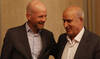
Also speaking at the ceremony, Arab News’ Editor-in-Chief Faisal Abbas said: “On behalf of the Arab News family, we wish to extend our gratitude to the EU ambassador in the Kingdom for hosting this screening occasion as part of our 50th anniversary celebrations this year.
“This documentary tells a small — albeit an exciting — chapter in the history of our newspaper and the country as it accounts for an exciting and transformative period in our country’s progress.
“Of course, Arab News would have not been where it is today without the hard work, passion and dedication of my predecessor editors in chief, and of course, not without our founders — the Hafez Brothers — who started the newspaper in 1975.”
Part of the documentary is narrated by Prince Turki Al-Faisal, the former Saudi ambassador to the US, who in the film delves into the paper’s origins.
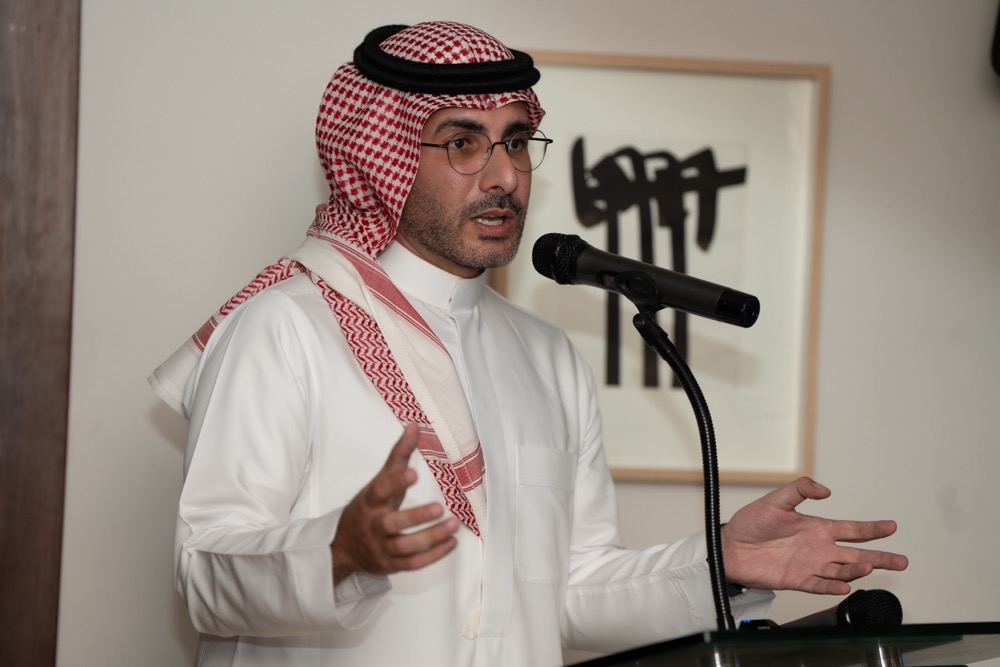
Arab News’ Editor-in-Chief Faisal Abbas. (AN photo)
Arab News was established in Jeddah in 1975 by brothers Hisham and Mohammed Ali Hafiz under the slogan to give Arabs a voice in English while documenting the major transformations taking place across the Middle East.
In April 2018, Arab News changed its 43-year-old logo with a new one as well as its motto to “The Voice of a Changing Region.” The newspaper relaunched with a new design and a new approach to stories that it believed was better suited to the internet age.
In June, an event hosted by the Global Arab Network at the Frontline Club in London paid tribute to Arab News and its founders by screening a preview of the documentary for leading editors, reporters, diplomats, and analysts.
Asked following Tuesday’s screening whether he believed the documentary reflected the changes that had been taking place in the region, EU Ambassador Farnaud said: “I would say even more. I mean, it’s one of the embodiments of these changes.
“The Kingdom is undergoing incredible changes. And so is Arab News. And I particularly appreciated, by the way, the historical dimension when it was created in 1975, that was also a project corresponding to the new role of the Kingdom, in a way.
“And yes, now the Kingdom has entered a new phase, a spectacular phase of transformation. And we see that Arab News, in its own ways, is also going through a huge phase of transformation and a successful one at that.
“I was really impressed.”
Also responding to the film, Saudi philanthropist Ameera Al-Taweel said: “A lot of the transformational story for Arab News reminded me of the transformation that was happening in Saudi Arabia back in 2015, 2016 to get to Vision 2030.

Arab News was established in Jeddah in 1975 by brothers Hisham and Mohammed Ali Hafiz. (AN Photo)
“It was right around that time that Arab News was also transforming. It’s very interesting how it aligned with a youthful leader (Crown Prince Mohammed bin Salman) who was injecting a lot of changes, believing in the younger generation, believing in keeping the legacy, but building on it.
“So a lot of what I saw in Vision 2030 and of course, His Royal Highness Crown Prince Mohammed bin Salman, you see it happening in the private sector or the public sector, even in the journalism sector, and the transformations that have that are happening in it.”
Although she only moved to the region in the spring, Ville Linnala, deputy head of mission at the Embassy of Finland, said the film raised pertinent issues.
“I have been in Riyadh and Saudi Arabia since May 5, so I’m very fairly fresh in the region, but I can really see these issues that were mentioned and raised in the documentary,” she said.
“For example, of course, when it comes to women’s rights and all these kinds of things, and with the Saudi Vision 2030 happening and moving forward.
“It was really, really, really interesting to see. I enjoyed this documentary a lot, so much.”
“Rewriting Arab News” is a short film about the newspaper’s relaunch and digital transformation between 2016 and 2018, presented by Global Arab Network.