Food supplies to some Sudan refugees could dry up within 2 months, WFP says

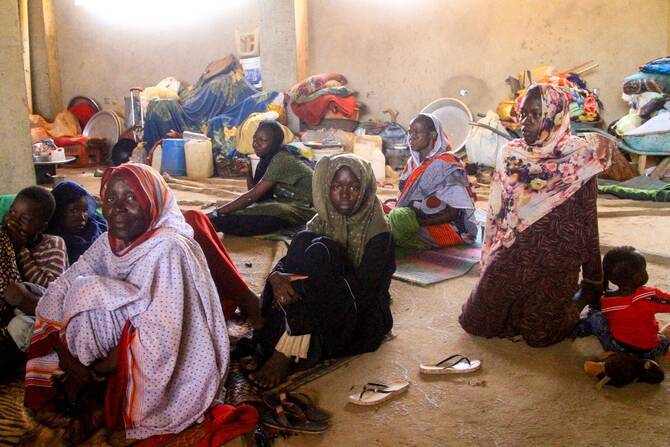
Food aid to help Sudanese refugees in four neighbouring countries could end within the next couple of months without an urgent injection of new funding, a WFP official said on Tuesday. (AFP/File)
Short Url
Updated 01 July 2025
Follow

Food supplies to some Sudan refugees could dry up within 2 months, WFP says

  • “Unless new funding is secured, all refugees will face assistance cuts in the coming months,” Hughes told a Geneva press briefing
  • Many of those fleeing are escaping from hunger hot spots in Sudan

GENEVA: Food aid to help Sudanese refugees in four neighboring countries could end within the next couple of months without an urgent injection of new funding, a World Food Programme official said on Tuesday, warning of rising malnutrition levels.

Over 4 million refugees have fled Sudan’s more than two-year civil war to seven neighboring countries where shelter conditions are widely viewed as inadequate due to chronic funding shortages.

“Unless new funding is secured, all refugees will face assistance cuts in the coming months,” Shaun Hughes, the WFP’s emergency coordinator for the Sudan regional crisis, told a Geneva press briefing, calling for $200 million over six months.

“In the case of four countries — that’s the Central African Republic, Egypt, Ethiopia and Libya — WFP’s operations are now so severely underfunded, that all support could cease in the coming months as resources run dry,” he said, clarifying later that this could happen within two months.

Many of those fleeing are escaping from hunger hot spots in Sudan. A joint UN report said last month the country was at immediate risk of famine.

Hughes said that any reduction or end to rations would leave child refugees at a greater risk of malnutrition.

Asked why the funding had fallen, he cited reductions from donors across the board and rising humanitarian needs.

He added that the United States, which has reduced its foreign aid spending dramatically under President Donald Trump, remained its top donor for Sudan.


Israel reopens West Bank-Jordan crossing for Gaza aid

Updated 52 min 31 sec ago
Follow

Israel reopens West Bank-Jordan crossing for Gaza aid

  • Israel closed the Allenby crossing to aid destined for the Gaza strip in September
  • Palestinian official says 96 trucks carrying cement meterials were allowed to pass through on Tuesday

JERUSALEM: Israel reopened the only crossing on the border it controls between Jordan and the occupied West Bank on Wednesday to aid trucks for Gaza after nearly three months of closure, Israeli and Palestinian officials told AFP.
Israel closed the crossing after a Jordanian truck driver shot dead an Israeli soldier and a reserve officer at the border in September.
The crossing in the Jordan Valley reopened to travelers a few days later, but not to humanitarian aid destined for the Gaza Strip, which has been devastated by more than two years of war.
“The Allenby crossing was open today and trucks are going from the Allenby crossing to Gaza,” said a spokesperson for COGAT, the Israeli defense ministry body that oversees civilian affairs in the Palestinian Territories.
A Palestinian official speaking on condition of anonymity confirmed that the crossing had been opened.
On Tuesday 96 trucks carrying materials for the production of cement were allowed to pass through the crossing, the official said.
On Wednesday a further 20 trucks of humanitarian aid entered, and on Thursday sand was expected to be allowed in for the construction sector, the official added.
Since the crossing’s closure, Jordan said it had been able to send some aid to Gaza via the Sheikh Hussein crossing, located north of the occupied West Bank.
On Tuesday, an Israeli official said the transfer of goods and aid from Jordan through Allenby was about to resume after a government directive.
“All aid trucks destined for the Gaza Strip will proceed under escort and security, following a thorough security inspection,” the official said.
The Allenby crossing is the only international gateway for Palestinians from the West Bank that does not require entering Israel, which has occupied the territory since 1967.