

Former Russian deputy defense minister is sentenced to 13 years for corruption

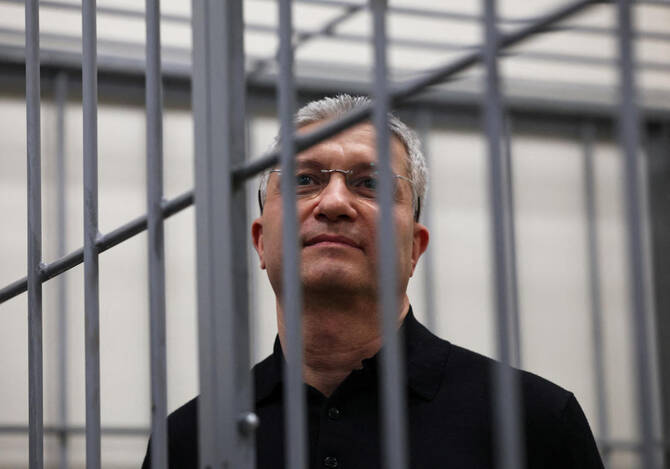
Timur Ivanov, former Russia’s Deputy Defense Minister accused of embezzlement, attends a court hearing in Moscow, July 1, 2025. (Reuters)
Short Url
Updated 01 July 2025
Follow

Former Russian deputy defense minister is sentenced to 13 years for corruption

  • Ivanov was arrested in April 2024 on suspicion of taking bribes
  • Ivanov, who had pleaded not guilty, was also stripped of all his state awards

MOSCOW: Former Russian deputy defense minister Timur Ivanov was found guilty of corruption on Tuesday and sentenced to 13 years in prison.

Ivanov was arrested in April 2024 on suspicion of taking bribes, and investigators added new embezzlement charges in October.

His case is part of the biggest slew of corruption scandals to hit the Russian defense establishment in years. More than a dozen people, including two other former deputy ministers, have been arrested in a series of investigations.

Ivanov, who had pleaded not guilty, was also stripped of all his state awards. His lawyer said he would appeal.

State media reported that the total sum alleged to have been embezzled by Ivanov and others was 4.1 billion roubles ($48.8 million), mostly in the form of bank transfers to two foreign accounts.

The trial took place behind closed doors on grounds of state secrecy. A former subordinate of Ivanov, Anton Filatov, was sentenced to 12-1/2 years.

Russian media said Ivanov and his wife owned a luxury apartment in central Moscow, a three-story English-style mansion on the outskirts of the capital and an extensive collection of classic cars including a Bentley and an Aston Martin.

Ivanov’s arrest last year was celebrated by Russia’s “Z-bloggers,” an influential group of war correspondents and analysts who support Moscow’s invasion of Ukraine but argue that front-line troops have been let down by the military top brass, whom they have frequently portrayed as incompetent, out-of-touch and corrupt.


Iceland joins Eurovision boycott over Israel’s participation

Updated 5 sec ago
Follow

Iceland joins Eurovision boycott over Israel’s participation

  • Decision follows similar moves by Spain, the Netherlands, Ireland and Slovenia over the Gaza war
  • Iceland’s national broadcaster says it pulled out 'given the public debate' in the country
LONDON: Iceland’s national broadcaster said Wednesday it will boycott next year’s Eurovision Song Contest because of discord over Israel’s participation, joining four other countries in a walkout of the pan-continental music competition.
Broadcasters in Spain, the Netherlands, Ireland and Slovenia told contest organizer the European Broadcasting Union last week that they will not take part in the contest in Vienna in May after organizers declined to expel Israel over its conduct of the war against Hamas in Gaza.
The board of Iceland’s RÚV met Wednesday to make a decision.
At its conclusion the broadcaster said in a statement that “given the public debate in this country ... it is clear that neither joy nor peace will prevail regarding the participation of RÚV in Eurovision. It is therefore the conclusion of RÚV to notify the EBU today that RÚV will not take part in Eurovision next year.”
“The Song Contest and Eurovision have always had the aim of uniting the Icelandic nation but it is now clear that this aim cannot be achieved and it is on these program-related grounds that this decision is taken,” the broadcaster said.
Last week the general assembly of the EBU — a group of public broadcasters from 56 countries that runs Eurovision — met to discuss concerns about Israel’s participation. Members voted to adopt tougher contest voting rules in response to allegations that Israel manipulated the vote in favor of its competitor, but took no action to exclude any broadcaster from the competition.
The pullouts include some big names in the Eurovision world. Spain is one of the “Big Five” large-market countries that contribute the most to the contest. Ireland has won seven times, a record it shares with Sweden.
Iceland, a volcanic North Atlantic island nation with a population of 360,000, has never won but has the highest per capita viewing audience of any country.
The walkouts cast a cloud over the future of what’s meant to be a feel-good cultural party marked by friendly rivalry and disco beats, dealing a blow to fans, broadcasters and the contest’s finances.
The contest, which turns 70 in 2026, strives to put pop before politics, but has repeatedly been embroiled in world events. Russia was expelled in 2022 after its full-scale invasion of Ukraine.
It has been roiled by the war in Gaza for the past two years, stirring protests outside the venues and forcing organizers to clamp down on political flag-waving.
Opponents of Israel’s participation cite the war in Gaza, where more than 70,000 Palestinians have been killed, according to the territory’s Health Ministry, which operates under the Hamas-run government and whose detailed records are viewed as generally reliable by the international community.
Israel’s government has repeatedly defended its campaign as a response to the attack by Hamas-led militants on Oct. 7, 2023. The militants killed around 1,200 people — mostly civilians — in the attack and took 251 hostage.
A number of experts, including those commissioned by a UN body, have said that Israel’s offensive in Gaza amounts to genocide, a claim Israel has vigorously denied.
Wednesday marked the final day for national broadcasters to announce whether they planned to participate. More than two dozen countries have confirmed they will attend the contest in Vienna, and the EBU says a final list of competing nations will be published before Christmas.