

Barcelona records the hottest June ever as a heat wave grips Europe

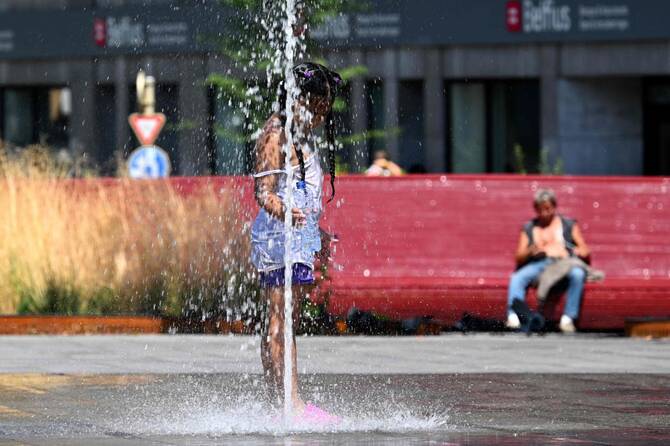
A girl cools off at the water jets of a public fountain as outside temperatures reach 37 degrees celsius in Brussels on July 1, 2025. (AFP)
Short Url
Updated 01 July 2025
Follow

Barcelona records the hottest June ever as a heat wave grips Europe

  • The previous hottest average for June was 25.6 C in 2003
  • Barcelona is usually spared the worst heat in Spain

PARIS: Barcelona recorded its hottest month of June since records started over a century ago, Spain’s national weather service said on Tuesday as Europe remained in the grip of the first major heat wave this summer.

The Fabra Observatory reported an average temperature of 26 degrees Celsius (78 degrees Fahrenheit), breaking records since 1914. The previous hottest average for June was 25.6 C in 2003. The same weather station said that a single-day high of 37.9 C (100 F) for June was recorded Monday.

Barcelona is usually spared the worst heat in Spain, thanks to its location between hills and the Mediterranean in Spain’s northeastern corner. But most of the country has been gripped by the extreme heat.

Health warnings remained in effect Tuesday in several European countries. Punishing temperatures were forecast to reach 40 C (104 F) in Paris and to stay unusually high in Belgium and the Netherlands.

Spain’s national average for June of 23.6 C (74 F) was 0.8 C hotter than the previous hottest June in 2017. It was also that first time that June was hotter than the average temperatures for both July and August.

Spain saw a new high mark for June established on Saturday when 46 C (114F) was recorded in the southern province of Huelva since national records were started in 1950.

“We are seeing these temperatures because we are experiencing a very intense heat wave that has come early in the summer and that is clearly linked to global warming,” Ramón Pascual, the regional delegate for Spain’s weather service in Barcelona, told The Associated Press on Tuesday.

France suffocates
In France, the national weather agency Météo-France placed several departments under the highest red alert, with the Paris region particularly hard hit. More than 1,300 schools were partially or fully closed in the country.

Visitors to the Eiffel Tower without tickets were told to postpone their visits as the summit of the city’s landmark was closed until Thursday.

Climate experts warn that future summers are likely to be hotter than any recorded to date. By 2100, France could be up to 4 C (39 F) warmer, with temperatures exceeding 40 C expected every year and extreme heat spikes potentially reaching 50 C (122 F).

Man dies in Italy
Farther south, 17 of Italy’s 27 major cities were experiencing a heat wave, according to the health ministry.

There were torrential rains in Italy’s north on Monday and parts of Bardonecchia near Turin were covered in sludge after the Frejus river burst its banks. Near Bologna, one of the cities under a heat alert Tuesday, the 46-year-old owner of a construction company collapsed and died while repaving a school parking lot, state-run RAI reported.

An autopsy was being conducted to determine the cause, but heat was suspected. The CGIL labor union said the death of the man, whom it identified as Ait El Hajjam Brahim, owner of Veneto Pavimenti SAS, showed the need for improved measures to protect construction workers from heat exposure.

The Netherlands sweating
An annual event in Amsterdam to commemorate the end of slavery in former Dutch colonies was moved forward to avoid the hottest part of the day. People attending the event, including the city’s mayor, sat under white parasols and tried to keep cool with paper fans.

In the central town of Soest, first responders said they were bringing a firehose to an early evening water gun fight.

“Bring your water pistol and swimming clothes with you, because you’re guaranteed to get soaked!” the firefighters said in an Instagram post.

In the northern city of Groningen, organizers of an outdoor concert featuring veteran rocker Neil Young also took measures, including adding extra drinking water taps and providing free sunblock.

Portugal record
The Portuguese weather service issued a statement Monday night confirming the highest single temperature ever recorded in mainland Portugal for the month of June at 46.6 C (115 F) on June 29 in the town of Mora, west of Lisbon. The prior record was 44.9 C (112 F) in 2017.

Wildfires in Turkiye
Firefighters across Turkiye combated wildfires for a third consecutive day on Tuesday. The fires have damaged dozens of homes and forced the evacuation of some 50,000 residents.

The crews were nearing containment of two major fires in the Aegean province of İzmir and another in neighboring Manisa, Forestry Minister İbrahim Yumaklı said. They were however, struggling with a large, wind-driven fire still sweeping through the southern province of Hatay.

Relieving animals in Prague
Temperatures were expected to reach 37 C (98.6 F) by Wednesday in large parts of the Czech Republic, including the capital.

The Prague zoo took extraordinary measures to provide some relief to their animals as zookeepers started to distribute up to 10 metric tons of ice daily across the park.

The polar bears native to the Arctic are a major concern for the zoo, director Miroslav Bobek said.

Twin brothers Aleut and Gregor looked pleased when they found parts of their open-air enclosure covered with a thick layer of ice on Tuesday morning. They used the familiar substance to lie on it and roll on their backs. As a bonus, they discovered frozen pieces of squid among the pieces of ice.


Schools closing across Gulf show children bear brunt of wars, UN chief tells Security Council

Updated 10 sec ago
Follow

Schools closing across Gulf show children bear brunt of wars, UN chief tells Security Council

  • ‘In violent conflicts, schools can be one of the only safe spaces,’ council reminded, helping to protect children from recruitment by militias, trafficking and other exploitation
  • As war with Iran entered its 3rd day on Monday, authorities in Gulf states including the UAE, Qatar, Bahrain and Oman ordered schools to remain shut and shift to remote learning

NEW YORK CITY: Closed schools across the Gulf this week are a stark reminder that when conflicts escalate, children are the first to pay the price — with their classrooms, their safety and, too often, their lives — the UN’s secretary general told the Security Council on Monday as the war with Iran entered its third day.
With military confrontations involving Iranian and US-Israeli forces continuing to escalate, causing widespread disruption in the region and growing concerns over safety, authorities in several Gulf states, including the UAE, Qatar, Bahrain and Oman, ordered schools to remain shut and shift to remote learning. The decision reflects the broader toll on daily life as geopolitical tensions cause ripples throughout the region.
Reports emerged over the weekend from southern Iran of a strike on an elementary school in the town of Minab that allegedly killed dozens of children. US officials said they were looking into the claims.
During an address to the Security Council on Monday, Rosemary A. DiCarlo delivered remarks on behalf of UN Secretary-General Antonio Guterres warning that the world is witnessing the highest number of armed conflicts since the Second World War, and the highest civilian death tolls in decades. The meeting was presided over by First Lady Melania Trump, as the US holds the rotating presidency of the 15-member Security Council this month.
“When conflicts erupt, children are among those most severely affected,” DiCarlo said. One in five children worldwide, about 473 million in total, live in or are fleeing from conflict zones, she noted, citing data from UNICEF.
Incidents of grave violations against children that have been verified by the UN rose by 25 percent between 2023 and 2024, she added, while cases of rape and other forms of sexual violence increased by 35 percent, according to the secretary-general’s annual report on children and armed conflict.
“These horrific figures should impel us to do more to protect children in conflict,” DiCarlo said. She also paid tribute to Melania Trump for highlighting the plight of children in war, and for her engagement with efforts to reunite Ukrainian children with their families.
Beyond the immediate threats conflicts pose to life and limb, they also deprive children of education and future opportunities, DiCarlo warned. About 234 million youngsters in crisis and conflict settings need educational support, and 85 million are completely out of school, according to UNICEF.
“In violent conflicts, schools can be one of the only safe spaces,” DiCarlo said, adding that they can help protect children from recruitment by armed groups, trafficking and other exploitation, while also providing healthcare services and psychosocial support.
Yet schools, teachers and education infrastructure continue to come under attack in times of conflict. In 2024, the UN verified 2,374 attacks against schools and hospitals, most of them in Ukraine, Israel, occupied Palestinian territories, and Haiti. Many more cases go unverified due to lack of access, DiCarlo said.
She recalled the provisions of Security Council Resolution 2601, adopted in 2021, which calls on all parties in conflicts to immediately cease all attacks against schools, children and teachers, and to safeguard and promote the right to education, in line with the principles of international humanitarian law.
The challenges involved in delivering quality education in war zones are immense, DiCarlo said. Key infrastructure, including classrooms, electricity supplies and digital connectivity, is often damaged or at risk, and there is a shortage of 44 million teachers in conflict settings worldwide.
Digital learning can help bridge gaps when schools are closed or inaccessible, she added, highlighting initiatives such as UNICEF’s “Learning Passport,” which was developed with Microsoft and provides 10 million children in 47 countries with access to mobile-learning platforms.
She also cited the Instant Network Schools program, a joint project of the Vodafone Foundation and the UN Refugee Agency, which enables refugee children and teachers in marginalized communities in the Democratic Republic of Congo and South Sudan to access the internet and digital educational content.
In Afghanistan, meanwhile, where 2.2 million girls are excluded from education, UNESCO is mobilizing digital technologies to bring learning into homes, reaching nearly 9,000 school communities, DiCarlo added.
However, she warned that children in conflict zones faced heightened online risks, including exploitation, trafficking, radicalization and digital recruitment by armed groups. Digital education initiatives must therefore incorporate child-protection safeguards at every stage, she said, and governments should strengthen legal and policy frameworks to help protect children’s rights online, in line with international human rights law.
Funding for education in emergencies has dropped by 24 percent despite the growing needs, DiCarlo noted, and she urged member states to help close the gap.
“The most effective way to protect children from conflict is to prevent and end wars,” she said. “Building peace is at the heart of what the United Nations does. We must all work together toward this goal.”