

Militants storm police station, torch banks, kill a boy in southwest Pakistan

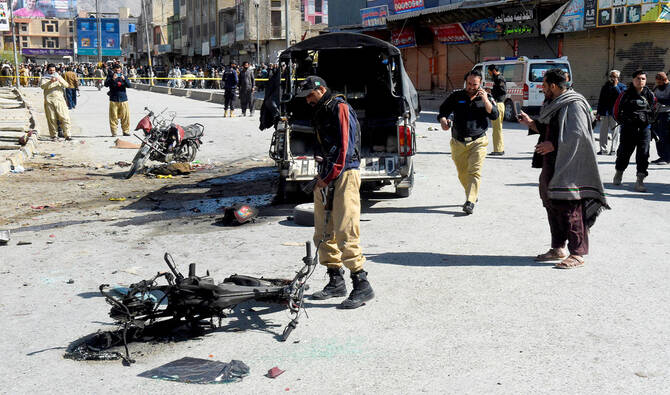
Security personnel inspect the site after militants detonated an explosive-laden motorbike along a road in Quetta on March 27, 2025. (AFP/File)
Short Url
Updated 01 July 2025
Follow

Militants storm police station, torch banks, kill a boy in southwest Pakistan

  • Local officials say some insurgents were killed in a shootout with security forces
  • No group has claimed responsibility, though suspicion is likely to fall on BLA militants

QUETTA: Dozens of militants armed with guns and rockets stormed a police station and set fire to two banks in restive southwestern Pakistan on Tuesday, killing a boy and wounding nine others before fleeing, officials said.

The boy died when the attackers fired on civilians indiscriminately during the attacks in Mastung, a district in Balochistan province, said Jan Mohammad, a local government administrator.

Mohammad said some of the insurgents were also killed in the shootout with security forces.

A provincial government spokesman, Shahid Rind, said a security operation had been launched to pursue the assailants.

No group immediately claimed responsibility, though suspicion is likely to fall on the outlawed Baloch Liberation Army, or BLA, which often targets security forces and civilians in Balochistan and elsewhere.

The United States designated the BLA a terrorist organization in 2019.

Balochistan has long been the scene of a low-level insurgency by separatist groups seeking independence from the central government.

The province is also home to militants linked to the Pakistani Taliban and Daesh group.


IMF board to meet tomorrow to consider $1.2 billion disbursement for Pakistan

Updated 11 sec ago
Follow

IMF board to meet tomorrow to consider $1.2 billion disbursement for Pakistan

  • Pakistan, IMF reached a Staff-Level Agreement for second review of $7 billion loan program 
  • Economists view disbursement crucial for cash-strapped Pakistan as it tackles economic crisis

ISLAMABAD: The International Monetary Fund’s (IMF) Executive Board will meet tomorrow, Monday, to consider and approve a $1.2 billion disbursement for Pakistan, according to the global lender’s official schedule. 

The meeting takes place nearly two months after the Fund reached a Staff-Level Agreement (SLA) with Pakistan for the second review of its $7 billion Extended Fund Facility (EFF) and the first review of its $1.4 billion Resilience and Sustainability Facility (RSF). 

The SLA followed a mission led by IMF’s Iva Petrova, who held discussions with Pakistani authorities during a Sept. 24–Oct. 8 visit to Karachi, Islamabad and Washington, DC.

“The International Monetary Fund’s (IMF) Executive Board will convene on Dec. 8 to consider Pakistan’s request for a $1.2 billion disbursement under the Extended Fund Facility (EFF) and the Resilience and Sustainability Facility (RSF), according to the Fund’s updated schedule,” the state-run Pakistan TV reported on Sunday.

Economists view IMF’s bailout packages as crucial for cash-strapped Pakistan, which has relied heavily on financing from bilateral partners such as Saudi Arabia, China and the United Arab Emirates, as well as multilateral lenders including the IMF, World Bank, Asian Development Bank and Islamic Development Bank. 

The South Asian country has been grappling with a prolonged macroeconomic crisis that has drained its financial resources and triggered a balance of payments crisis. Islamabad, however, has recorded some financial gains since 2022, which include recording a surplus in its current account and bringing inflation down considerably. 

Speaking to Arab News last month, Pakistan’s former finance adviser Khaqan Najeeb said the $1.2 billion disbursement will further stabilize Pakistan’s near-term external position and unlock additional official inflows. 

“Continued engagement also reinforces macro stability, as reflected in recent improvements in inflation, the current account, and reserve buffers,” Najeeb said. 

Pakistan came close to sovereign default in mid-2023, when foreign exchange reserves fell below three weeks of import cover, inflation surged to a record 38 percent in May, and the country struggled to secure external financing after delays in its IMF program. Fuel shortages, import restrictions, and a rapidly depreciating rupee added to the pressure, while ratings agencies downgraded Pakistan’s debt and warned of heightened default risk.

The crisis eased only after Pakistan reached a last-minute Stand-By Arrangement with the IMF in June 2023, unlocking emergency support and preventing an immediate default.