

Pakistan arrests alleged land route agent linked to deadly Morocco boat tragedy

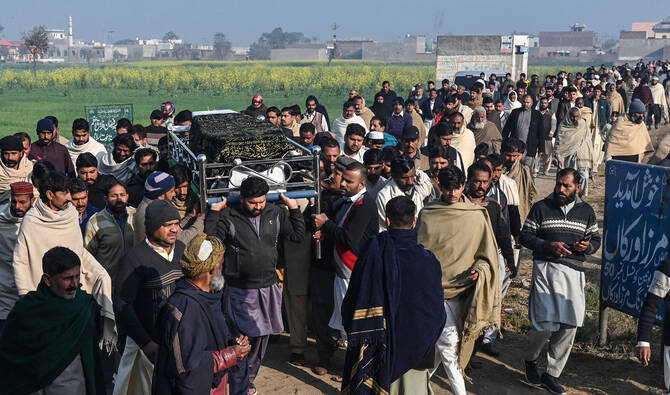
Family members and residents carry the coffin of Arslan Khan, a victim of migrant boat capsizing off North Africa, during his funeral ceremony in Mirza Virkan village, in eastern Punjab province, on February 6, 2025. (AFP/File)
Short Url
Updated 01 July 2025
Follow

Pakistan arrests alleged land route agent linked to deadly Morocco boat tragedy

  • Migrant boat, which set off from Mauritania for Spain in January with 86 on board, mostly Pakistanis, drowned near coast of Morocco
  • Land route agent Ghulam Mustafa had been sending people to Europe since 2023 via maritime routes through Morocco, says FIA

ISLAMABAD: The Federal Investigation Agency (FIA) on Tuesday announced it had arrested an agent involved in the Morocco boat tragedy, in which dozens of Pakistanis attempting to travel illegally to Europe had drowned near the African country’s coast earlier this year.

The boat had set off from Mauritania in January with 86 migrants on board, among them 66 Pakistanis, for the Canary Islands administered by Spain, international rights group Walking Borders had said. Moroccan authorities said on January 16 that 36 people were rescued from the vessel, while Pakistan confirmed survivors of the tragedy included 22 of its nationals.

Pakistani authorities have launched a crackdown against agents involved in illegally sending impoverished migrants through dangerous sea routes by offering them a chance at a better life in Europe. The FIA said its Faisalabad chapter arrested Ghulam Mustafa, a land route agent who was wanted for his involvement in the Morocco boat tragedy.

“Since 2023, the suspect had been working as a land route agent to send people to Europe via the maritime route through Morocco,” the FIA said in a press release.

It said Mustafa was part of the same network of human smugglers Abdul Ghaffar and Muhammad Sarfaraz, who were arrested by the FIA in February, for smuggling the migrants on the same boat that met an accident near Morocco.

The FIA said Mustafa, Ghaffar and Sarfraz were in contact with notorious African human smuggler Abubakar.

“The suspects were involved in extorting millions of rupees from Pakistani citizens under the pretext of sending them to Spain,” the statement said. “They were found to be facilitating the illegal transport of citizens to Spain via sea routes.”

A record 10,457 migrants, or 30 people a day, died trying to reach Spain in 2024. Most of them died while attempting to cross the Atlantic route from West African countries such as Mauritania and Senegal to the Canary Islands, according to Walking Borders.

In 2023, hundreds of migrants, including 262 Pakistanis, drowned when an overcrowded vessel sank in international waters off the southwestern Greek town of Pylos, marking one of the deadliest boat disasters ever recorded in the Mediterranean Sea.

The Pakistani government has ramped up efforts in recent months to combat human smugglers facilitating dangerous journeys for illegal immigrants to Europe, resulting in several arrests.

Prime Minister Shehbaz Sharif has also urged increased collaboration with international agencies like Interpol to ensure swift action against human trafficking networks.


Rating firm S&P says it won’t rush Iran war downgrades, sees risks for countries like Pakistan

Updated 12 March 2026
Follow

Rating firm S&P says it won’t rush Iran war downgrades, sees risks for countries like Pakistan

  • Agency says it is monitoring indebted energy importers as higher oil prices strain finances
  • Gulf economies seen better placed to weather shock, though Bahrain flagged as vulnerable

LONDON: S&P Global ‌said it would not make any knee-jerk sovereign rating cuts following the outbreak of war in the ​Middle East, but warned on Thursday that soaring oil and gas prices were putting a number of already cash-strapped countries at risk.

The firm’s top analysts said in a webinar that the conflict, which has involved US and Israeli strikes ‌against Iran and Iranian ‌strikes against Israel, ​US ‌bases ⁠and Gulf ​states, ⁠was now moving from a low- to moderate-risk scenario.

Most Gulf countries had enough fiscal buffers, however, to weather the crisis for a while, with more lowly rated Bahrain the only clear exception.

Qatar’s banking sector could ⁠also struggle if there were significant ‌deposit outflows in ‌reaction to the conflict, although there ​was no evidence ‌of such strains at the moment, they ‌said.

“We don’t want to jump the gun and just say things are bad,” S&P’s head global sovereign analyst, Roberto Sifon-Arevalo, said.

The longer the crisis ‌was prolonged, though, “the more difficult it is going to be,” he ⁠added.

Sifon-Arevalo ⁠said Asia was the second-most exposed region, due to many of its countries being significant Gulf oil and gas importers.

India, Thailand and Indonesia have relatively lower reserves of oil, while the region also had already heavily indebted countries such as Pakistan, Bangladesh and Sri Lanka whose finances would be further hurt by rising energy prices.

“We ​are closely monitoring ​these (countries) to see how the credit stories evolve,” Sifon-Arevalo said.