

Gunmen kill two traffic police officers in Pakistan’s restive northwest

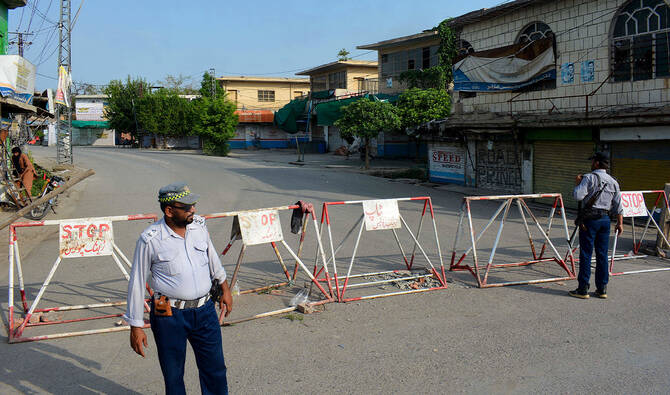
Policemen stand guard along a barricaded street near an army cantonment, a day after it was attacked by a militant suicide squad in Bannu on July 16, 2024. (AFP/File)
Short Url
Updated 01 July 2025
Follow

Gunmen kill two traffic police officers in Pakistan’s restive northwest

  • The incident took place in Lakki Marwat, which has seen militant attacks on officials and civilians
  • Chief Minister Ali Amin Gandapur directs law enforcement to arrest those involved without delay

PESHAWAR: Unidentified gunmen shot dead two traffic police officers in Pakistan’s northwestern district of Lakki Marwat on Tuesday, the latest in a series of attacks in a region with a long history of militant violence, according to an official statement.

The officers were ambushed on Longkhel Road near Gulbaz Dehqan village while they were en route to duty.

No group has claimed responsibility, but similar shootings in the past have frequently been carried out by militants from Tehreek-e-Taliban Pakistan (TTP), which remains active in the area.

“We share the grief of the bereaved families,” Khyber Pakhtunkhwa Chief Minister Ali Amin Gandapur said in a statement, confirming that two traffic police officers had been killed “after unidentified assailants opened fire on them.”

“The families of the martyrs will not be left alone and will be fully supported,” he added while directing law enforcement agencies to arrest those responsible without delay.

Lakki Marwat, located near the Pakistan-Afghanistan border, has witnessed repeated assaults on police along with other government functionaries and residents in recent years.

In 2022, six officers were killed in a TTP-claimed ambush, and in 2023, a police station was attacked with guns and explosives, killing four.

The district was also the site of one of Pakistan’s deadliest militant attacks in 2010, when a suicide bomber targeted a volleyball match, killing over 100 people.

Authorities in the area have struggled to maintain security amid a resurgence of insurgent violence I recent years.


Rating firm S&P says it won’t rush Iran war downgrades, sees risks for countries like Pakistan

Updated 12 March 2026
Follow

Rating firm S&P says it won’t rush Iran war downgrades, sees risks for countries like Pakistan

  • Agency says it is monitoring indebted energy importers as higher oil prices strain finances
  • Gulf economies seen better placed to weather shock, though Bahrain flagged as vulnerable

LONDON: S&P Global ‌said it would not make any knee-jerk sovereign rating cuts following the outbreak of war in the ​Middle East, but warned on Thursday that soaring oil and gas prices were putting a number of already cash-strapped countries at risk.

The firm’s top analysts said in a webinar that the conflict, which has involved US and Israeli strikes ‌against Iran and Iranian ‌strikes against Israel, ​US ‌bases ⁠and Gulf ​states, ⁠was now moving from a low- to moderate-risk scenario.

Most Gulf countries had enough fiscal buffers, however, to weather the crisis for a while, with more lowly rated Bahrain the only clear exception.

Qatar’s banking sector could ⁠also struggle if there were significant ‌deposit outflows in ‌reaction to the conflict, although there ​was no evidence ‌of such strains at the moment, they ‌said.

“We don’t want to jump the gun and just say things are bad,” S&P’s head global sovereign analyst, Roberto Sifon-Arevalo, said.

The longer the crisis ‌was prolonged, though, “the more difficult it is going to be,” he ⁠added.

Sifon-Arevalo ⁠said Asia was the second-most exposed region, due to many of its countries being significant Gulf oil and gas importers.

India, Thailand and Indonesia have relatively lower reserves of oil, while the region also had already heavily indebted countries such as Pakistan, Bangladesh and Sri Lanka whose finances would be further hurt by rising energy prices.

“We ​are closely monitoring ​these (countries) to see how the credit stories evolve,” Sifon-Arevalo said.