

Pakistan hikes petrol price by Rs8.36 per liter till next fortnight

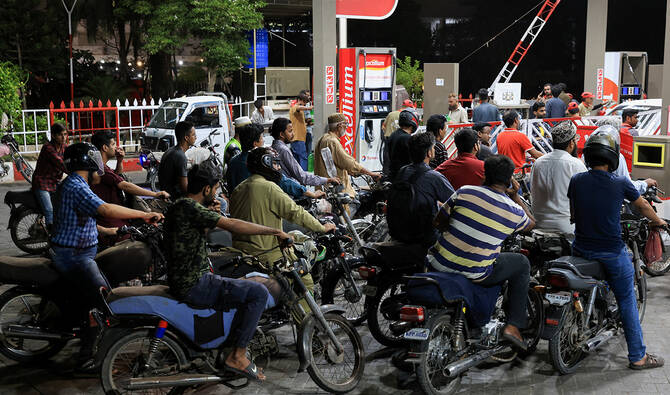
People wait for their turn to get fuel at a petrol station in Karachi, Pakistan on July 4, 2024. (Reuters/File)
Short Url
Updated 01 July 2025
Follow

Pakistan hikes petrol price by Rs8.36 per liter till next fortnight

  • Pakistan hikes price of high-speed diesel by Rs10.39 per liter on OGRA, relevant ministries’ recommendations, says Finance Division
  • Fuel prices in Pakistan are generally influenced by global oil market trends, currency fluctuations and changes in domestic taxes

ISLAMABAD: Pakistan’s government has increased the price of petrol by Rs8.36 per liter and the price of high-speed diesel (HSD) by Rs10.39 per liter till the next fortnight, a notification by the Finance Division said on Monday. 

The new prices of petroleum products became effective from July 1. As per the notification, the price of petrol has surged from Rs258.43 to Rs266.79 per liter while the price of HSD has increased from Rs262.59 to Rs272.98 per liter after the hike. 

“The Government has decided to revise the prices of petroleum products for the fortnight starting today, based on the recommendations of OGRA & the relevant Ministries,” the notification said.

The government did not provide a specific explanation for the hike, however, fuel prices in Pakistan are generally influenced by global oil market trends, currency fluctuations and changes in domestic taxes.

Fuel costs are revised every two weeks and have a direct impact on inflation. Rising fuel prices increase production and transportation costs, leading to higher prices for goods and services across the board in Pakistan, including food and other essential items. This direct relationship is further amplified by the country’s dependence on imported fuel. 

This is the second consecutive time the government has hiked prices of petroleum products. On June 16, the Finance Division announced increasing fuel prices by raising HSD’s rate by Rs7.95 per liter and petrol by Rs4.80 per liter.

The development takes place after Pakistan last week approved a 10 percent increase in natural gas prices for industrial users and power plants from July, in line with reforms mandated by the International Monetary Fund (IMF) to ensure cost recovery and tariff rationalization, the Finance Division said. 


Pakistan Navy launches fourth Hangor-class submarine ‘Ghazi’ in China 

Updated 6 sec ago
Follow

Pakistan Navy launches fourth Hangor-class submarine ‘Ghazi’ in China 

  • As per Islamabad’s agreement with Beijing, four of eight submarines will be built in China and the rest in Pakistan
  • Navy says all four submarines under construction in China undergoing sea trials, in final stages of being handed over

ISLAMABAD: The Pakistan Navy announced on Wednesday it has launched the fourth Hangor-class submarine named “Ghazi” at a Chinese shipyard in Wuhan, saying the development will help maintain peace in the region.

Pakistan’s government signed an agreement with China for the acquisition of eight Hangor-class submarines, the navy said in its press release. Under the contract, four submarines are being built in China while the remaining four will be constructed in Pakistan by the Karachi Shipyard and Engineering Works Ltd. company.

“With the launching of GHAZI, Pakistan Navy has achieved another significant milestone where all four submarines under construction in China are now undergoing rigorous sea trials and are in the final stages of being handed over to Pakistan,” the navy said. 

It further said that these submarines will be fitted with advanced weapons and sensors capable of engaging targets at standoff ranges. 

“Hangor-class submarines will be pivotal in maintaining peace and stability in the region,” the navy added. 

Pakistan’s agreement with China is set to strengthen its naval defenses, especially as ties with arch-rival India remain tense. 

India and Pakistan were involved in a four-day military confrontation in May this year before Washington intervened and brokered a ceasefire. Four days of confrontation saw the two countries pound each other with fighter jets, exchange artillery fire, missiles and drone strikes before peace prevailed. 

Pakistan’s air force used Chinese-made J-10 fighter jets in May to shoot down an Indian Air Force Rafale aircraft, made by France.

The altercation between the nuclear-armed neighbors surprised many in the military community and raised questions over the superiority of Western hardware over Chinese alternatives.

Islamabad has long been Beijing’s top arms customer, and over the 2020-2024 period bought over 60 percent of China’s weapons exports, according to data from the Stockholm International Peace Research Institute.