ISLAMABAD: Pakistan has abolished electricity duty in power bills from the month of July, the country’s energy ministry said on Monday, in a bid to ensure transparency in tariff.
Power Minister Awais Leghari had written letters to chief executives of all provinces and informed them about the decision to discontinue the collection of electricity duty, according to the ministry.
He said high electricity tariffs were already a challenge and the additional burden of various levies further complicated the billing structure, making it difficult for consumers to manage their power costs.
“As part of this initiative, the Power Division has decided to discontinue the collection of electricity duty through electricity bills starting from July 2025,” Leghari was quoted as saying.
“We request provincial governments to explore alternative mechanisms for collecting provincial levies and duties, rather than relying on electricity bills as a collection channel.”
He said the federal government was making structural reforms to reduce tariffs such as renegotiating contracts with Independent Power Producer (IPP) and lowering the Return on Equity (ROE) for government-owned power plants, according to the energy ministry statement.
Leghari sought support from the provincial chief ministers in removing the complexity arising from multiple charges, taxes and duties being collected through consumer bills.
“He expressed the confidence that this will not only make electricity bills more transparent and easier to comprehend but also ensure that consumers are paying only for the cost of electricity, rather than a mix of other charges,” the statement read.
Pakistan has aggressively pursued reforms in its energy sector recently, which has long struggled with financial strain due to circular debt, power theft and transmission losses. These problems have led to blackouts and high electricity costs throughout the country, especially during the summers when demand peaks.
On Sunday, Prime Minister Shehbaz Sharif launched a mobile application that allows power consumers to record and submit their meter readings themselves, with the government saying the initiative will lead to more transparency in the system and reduce overbilling.
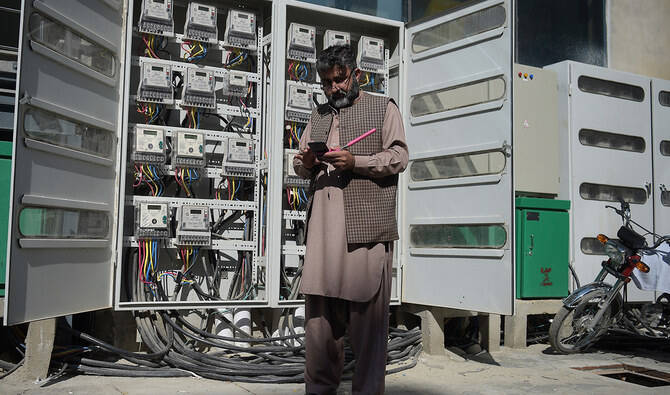
Electricity bills are generated in Pakistan every month by readings obtained from power meters installed at homes and businesses. These readings show the number of electricity units consumed during a monthly cycle and are taken by meter readers employed by power companies.
Pakistani power consumers have frequently complained of overbilling and incorrect readings taken by meter readers.
“This app... is a revolutionary technological reform whose benefit will reach every consumer in every home,” Sharif said at the app’s launch.


Pakistan abolishes electricity duty in bills to ensure tariff transparency
https://arab.news/c237c
Pakistan abolishes electricity duty in bills to ensure tariff transparency

- The move aims to simplify the billing structure, make it easier for consumers to manage power costs
- It follows launch of a mobile app that allows power consumers to record, submit their meter readings

Bangladesh approves new rice imports from Pakistan amid price pressures
- The deal follows Bangladesh’s resumption of direct rice trade with Pakistan earlier this year for the first time since independence in 1971
- Diplomatic ties between the two nations have improved since the ouster of prime minister Sheikh Hasina after mass protests last year
DHAKA: Bangladesh has approved the import of 50,000 metric tons of white rice from Pakistan under a government-to-government deal as part of efforts to stabilize domestic prices, officials said on Tuesday.
The Cabinet Committee on Government Purchase cleared the deal at $395 per ton, reinforcing Dhaka’s renewed trade engagement with Islamabad.
Rice prices in Bangladesh have jumped by between 15 percent and 20 percent over the past year, with medium-quality rice selling at about 80 taka ($0.66) per kilogram. Despite increased imports and the removal of duties to ease supply constraints, prices for the staple grain remain stubbornly high.
The deal follows Bangladesh’s resumption of direct rice trade with Pakistan earlier this year for the first time since independence in 1971. In February, it imported 50,000 tons of rice from Pakistan at $499 per ton under a similar agreement.
Diplomatic ties between the two South Asian nations have improved since an interim government led by Nobel laureate Muhammad Yunus took office after mass protests forced then prime minister Sheikh Hasina to flee to neighboring India last year.
Formerly East Pakistan, Bangladesh gained independence after a nine-month war in 1971, and relations with Pakistan have remained fraught in the decades since the conflict.
Separately, the government approved another 50,000 tons of parboiled rice through an international tender, part of a series of recent purchases aimed at cooling local prices. India’s Pattabhi Agro Foods secured the contract with the lowest bid of $355.77 per ton.


