

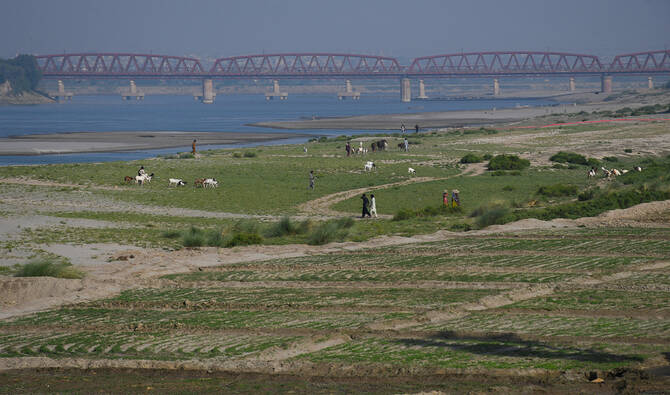

ISLAMABAD: Pakistan on Monday urged India to restore the Indus Waters Treaty (IWT), which ensures water for 80 percent Pakistani farms, and fulfil its obligations, days after the Permanent Court of Arbitration (PCA) announced a supplemental award on the proceedings instituted by Pakistan against India over Indus waters.
India announced it was putting the 1960 World Bank-mediated treaty in abeyance a day after an attack in Indian-administered Kashmir that New Delhi blamed on Pakistan, an allegation Islamabad denies. Pakistan has previously said the treaty has no provision for one side to unilaterally pull back and that any blocking of river water flowing to Pakistan will be considered “an act of war.”
In its supplemental award on the proceedings instituted by Pakistan against India over two hydroelectric projects, the court ruled on June 27 that India’s decision of holding the IWT in abeyance did not deprive the court of its competence to adjudicate Pakistan’s complaints against its neighbor. Pakistan has opposed some of hydroelectric projects by India, saying they violate the World Bank-mediated treaty on the sharing of the Indus waters.
In response to the supplemental award announced by the Court of Arbitration, Pakistan’s Foreign Office said the court found hearing the Pakistan-India dispute over Kishenganga and Ratle hydroelectric projects found that it has a continuing responsibility to advance these proceedings in a timely, efficient and fair manner.
“The Court of Arbitration decided to announce this supplemental award in the wake of India’s illegal and unilateral announcement to hold the Indus Waters Treaty in abeyance,” the Pakistani Foreign Office said in a statement.
“The award vindicates Pakistan’s position that the Indus Waters Treaty remains valid and operational, and that India has no right to take a unilateral action about it. We urge India to immediately resume the normal functioning of the Indus Waters Treaty, and fulfil its treaty obligations, wholly and faithfully.”
Last week, the PCA said it had previously found that once a proceeding before a court of arbitration is properly initiated, as in the present case, “there must be a strong presumption against the incidental loss of jurisdiction over the matters placed before it by subsequent acts, such as the appointment of a neutral expert.”
Weeks after India’s suspension of the treaty, the court issued a procedural order on May 16 and requested the parties to provide written submissions on the effect, if any, of these recent developments before the court.
Pakistan filed written submissions and no submissions were filed by India, but the court said it had considered New Delhi’s position.
“The current phase of the proceedings before the Court concerns the overall interpretation and application of the Treaty’s provisions on hydro-electric project design and operation, as well as the legal effect of past decisions of dispute resolution bodies under the Treaty,” it said.
“Accordingly, the text of the Treaty, read in light of its object and purpose, does not to allow either Party, acting unilaterally, to hold in abeyance or suspend an ongoing dispute settlement process.”
Under the IWT, India has been given the right to generate hydroelectricity through run-of-the-river projects on the western rivers subject to specific criteria for design and operation. The pact also gives the right to Pakistan to raise objections to designs of Indian hydroelectric projects on the western rivers.
On July 6, 2023, the PCA had issued its award on competence after considering India’s objections. In a unanimous decision, the court had ruled that it was competent to consider and determine the disputes set forth in
Pakistan’s request for arbitration in the case. Pakistan had initiated the present arbitral proceedings before the court on August 19, 2016.
The South Asian neighbors have been arguing over hydroelectric projects on the shared Indus river and its tributaries for decades, with Pakistan complaining that India’s planned hydropower dams will cut flows on the river, which feeds 80 percent of its irrigated agriculture.
The PCA noted on Friday that the principal issue concerned the implications, if any, that India’s decision to hold the treaty in “abeyance” may have on the competence of the court.
“Paragraph 16 of Annexure G to the Treaty provides that ‘[s]ubject to the provisions of this Treaty and except as the Parties may otherwise agree, the Court shall decide all questions relating to its competence’,” the PCA said.
“Accordingly, the Court found that it was for the Court — and the Court alone — to answer the question before it.”
New Delhi’s halting of the water agreement was one of a series of tit-for-tat diplomatic measures taken by both countries in the immediate aftermath of the April 22 attack in Kashmir, which resulted in a four-day military conflict between the neighbors in May.


