Pakistani mangoes draw crowds at China-Eurasia Expo as exporters set 125,000-ton target

Pakistan’s ​Ambassador to China, Khalil Hashmi (third right), interacts with Zhu Lifan, vice chairman of the Xinjiang government (left), at the Pakistan Pavilion, China-Eurasia Expo in Urumqi, China, on June 29, 2025. (Pakistan Embassy in China)
Short Url
Updated 30 June 2025
Follow

Pakistani mangoes draw crowds at China-Eurasia Expo as exporters set 125,000-ton target

  • Pakistan is home to over 100 mango varieties like Sindhri, Chaunsa and Anwar Ratol
  • The fruit’s popularity at Chinese exhibition highlights Pakistan’s potential for growth

ISLAMABAD: Pakistan has set a pavilion at the China-Eurasia Expo in Urumqi where mango varieties native to the South Asian country have been drawing crowds, the Pakistani embassy said on Sunday, as mango exporters eye 125,000 tons exports this season.

The 2025 China-Eurasia Commodity and Trade Expo, running from June 26 till June 30 in Xinjiang’s Urumqi, has brought together more than 2,800 enterprises and delegates from 50 countries and regions to deepen cooperation across Eurasia, according to the organizers.

Pakistan’s ​Ambassador to China Khalil Hashmi, along with Zhu Lifan, vice chairman of the Xinjiang government, inaugurated the Pakistan Pavilion, displaying a rich array of products, including fruit, jewelry, leather garments, luxury bags and contemporary clothing.

“The pavilion’s showcase of premium Pakistani mangoes drew hundreds of visitors, making it one of the most popular exhibits,” the embassy said in a statement on Sunday. “The fruit’s popularity highlighted Pakistan’s agricultural excellence and potential for growth.”

Pakistan is home to over 100 varieties of mangoes, including Sindhri, Chaunsa and Anwar Ratol.



Pakistan’s ​Ambassador to China, Khalil Hashmi (second right), along with Vice Chairman of the Xinjiang Government, Zhu Lifan (second left), inaugurates the Pakistan Pavilion at China-Eurasia Expo in Urumqi, China, on June 29, 2025. (Pakistan Embassy in China)

The South Asian country aims to export 125,000 tons of mangoes this season, a 25,000-ton increase over last year’s export volume, according to the Pakistan Fruit and Vegetable Exporters Association (PFVA). If achieved, the target could generate an estimated $100 million in foreign exchange earnings.

​At the inauguration, Ambassador Hashmi briefed Vice Chairman Zhu about Pakistan’s enhanced focus on increasing trade and investment relations with China, including Xinjiang.

“He [Ambassador Hashmi] gave the Vice Chairman a tour of the Pavilion, elaborating the high-quality of Pakistani products. The Chinese VIP also praised the taste of Pakistani mangoes,” the Pakistani embassy said.
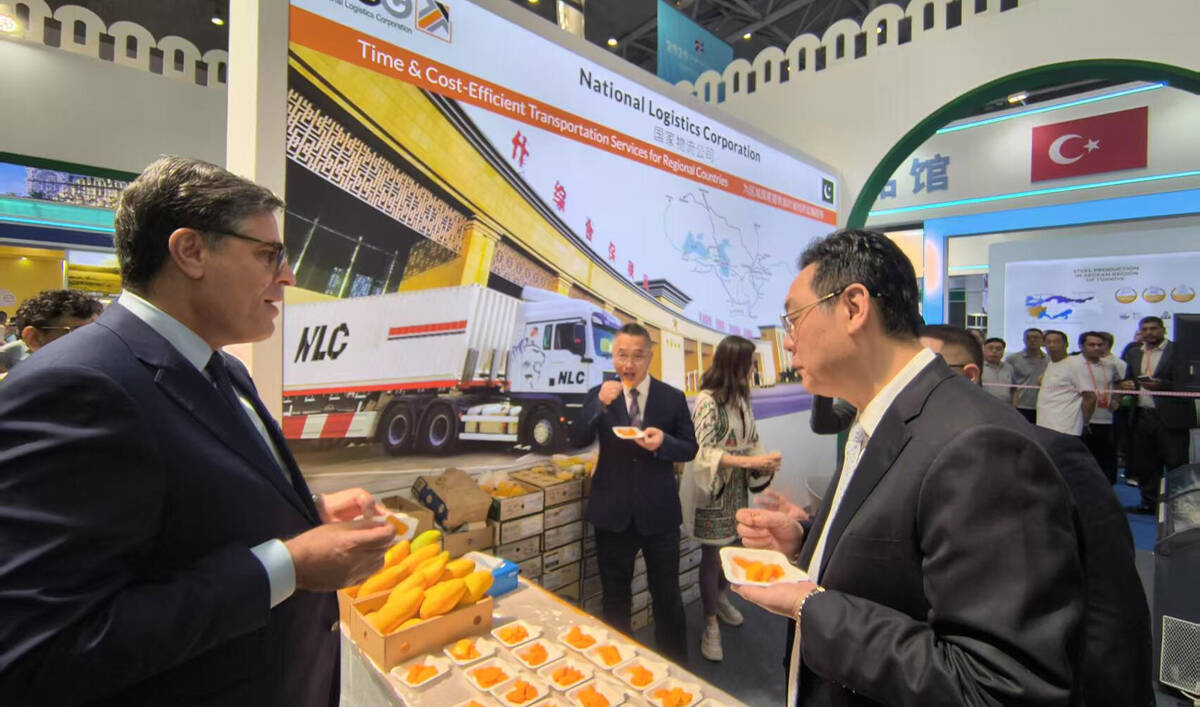


Pakistan’s ​Ambassador to China, Khalil Hashmi (left), interacts with Zhu Lifan, vice chairman of the Xinjiang government (right), at the Pakistan Pavilion, China-Eurasia Expo in Urumqi, China, on June 29, 2025. (Pakistan Embassy in China)

China is a longtime friend and strategic partner of Islamabad, with Beijing making significant investments in infrastructure and energy projects in Pakistan.

The total bilateral trade in goods between China and Pakistan reached $23.1 billion in 2024, an increase of 11.1 percent from the previous year, according to China Customs and the Pakistani embassy. China’s exports to Pakistan surged 17 percent year-on-year to $20.2 billion, while imports fell by 18.2 percent to $2.8 billion.

Islamabad, which is on path to economic recovery under a $7 billion International Monetary Fund (IMF) program, is currently making efforts to expand trade with China, Central Asian and Gulf nations to boost the $350 billion South Asian economy.


Pakistani, Bangladeshi officials discuss trade, investment and aviation as ties thaw

Updated 28 December 2025
Follow

Pakistani, Bangladeshi officials discuss trade, investment and aviation as ties thaw

  • Pakistan and Bangladesh were once one nation, but they split in 1971 as a result of a bloody civil war
  • Ties between Pakistan, Bangladesh have warmed up since last year and both nations have resumed sea trade

ISLAMABAD: Pakistan's High Commissioner to Bangladesh Imran Haider on Sunday met Chief Adviser Muhammad Yunus in Dhaka, the latter's office said on, with the two figures discussing trade, investment and aviation.

Pakistan and Bangladesh were once one nation, but they split in 1971 as a result of a bloody civil war, which saw the part previously referred to as East Pakistan seceding to form the independent nation of Bangladesh.

Ties between Pakistan and Bangladesh have warmed up since former prime minister Sheikh Hasina’s ouster as a result of a student-led uprising in August 2024. Relations remain frosty between Dhaka and New Delhi over India’s decision to grant asylum to Hasina.

Pakistan has attempted to forge closer ties with Bangladesh in recent months and both South Asian nations last year began sea trade, followed by efforts to expand government-to-government commerce.

"During the meeting, both sides discussed ways to expand cooperation in trade, investment, and aviation as well as scaling up cultural, educational and medical exchanges to further strengthen bilateral relations between the two South Asian nations," Yunus's office said in a statement on X.

In 2023-24 Pakistan exported goods worth $661 million to Bangladesh, while its imports were only $57 million, according to the Trade Development Authority of Pakistan. In Aug. this year, the Pakistani and Bangladeshi commerce ministries signed a memorandum of understanding to establish a Joint Working Group on Trade, aiming to raise their bilateral trade volume to $1 billion in the financial year that began in July.

The Pakistani high commissioner noted that bilateral trade has recorded a 20 percent growth compared to last year, with business communities from both countries actively exploring new investment opportunities, according to the statement.

He highlighted a significant increase in cultural exchanges, adding that Bangladeshi students have shown strong interest in higher education opportunities in Pakistan, particularly in medical sciences, nanotechnology, and artificial intelligence. Haider also said that Dhaka-Karachi direct flights are expected to start in January.

"Chief Adviser Professor Muhammad Yunus welcomed the growing interactions between the two countries and emphasized the importance of increased visits as well as cultural, educational and people-to-people exchanges among SAARC (South Asian Association for Regional Cooperation) member states," the statement read.

"Professor Yunus also underscored the need to further boost Bangladesh–Pakistan trade and expressed hope that during Mr. Haider’s tenure, both countries would explore new avenues for investment and joint venture businesses."