

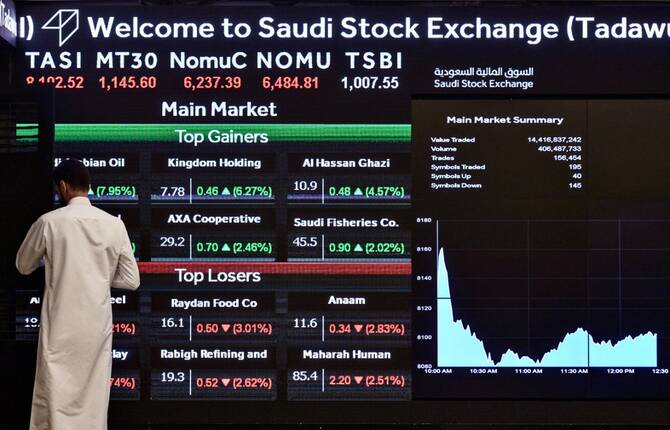

RIYADH: Saudi Arabia’s equity capital market maintained strong momentum in the first half of 2025, with six companies raising a combined $2.8 billion through initial public offerings on the main Tadawul exchange.
According to an analysis by Forbes Middle East, leading the activity was the public offering of low-cost carrier flynas, which raised SR4.1 billion ($1.1 billion) in what marked one of the region’s largest aviation listings.
The rise in IPO listings comes amid broader financial reforms in Saudi Arabia, as the Capital Market Authority introduces new frameworks — including regulations for special purpose acquisition companies — aimed at expanding funding avenues and enhancing private-sector participation.
In its analysis, Forbes stated: “The momentum underscores investors’ growing appetite for sectoral diversification across aviation, healthcare, finance, and industry, while affirming Riyadh’s long-term bet on privatization and public market expansion under Vision 2030.”
The flynas IPO drew overwhelming demand, with institutional subscriptions oversubscribed nearly 100 times, and the retail tranche covered 349.7 percent. The offering comprised 51.3 million ordinary shares, representing 30 percent of the company’s post-offering capital.
“In 2024, flynas generated $2 billion (SR7.6 billion) in revenue, marking an 18.8 percent increase from the previous year, while net profit rose 8 percent to $115.6 million (SR433.5 million),” the analysis added.

A view of the sign showing the logo of Saudi Arabia’s Stock Exchange Market (Tadawul) bourse in the capital Riyadh. File/AFP
As of June 14, the airline was operating 139 routes, connecting over 70 domestic and international destinations across 30 countries, with a weekly schedule exceeding 2,000 flights.
Diverse listings
Forbes also highlighted several other notable IPOs that reflect diversification across key sectors.
Umm Al-Qura for Development and Construction Co. raised $523.1 million by selling 130.7 million shares at $4 each — representing 9.09 percent of its total capital.
The company leads the Masar destination project, a major development transforming the western gateway of the Holy City, featuring hotels, residential units, retail spaces, and infrastructure.
Aligned with Saudi Arabia’s drive to boost religious tourism, the IPO proceeds will support ongoing construction, improve transport connectivity, and attract global hospitality brands in line with national tourism goals.
Among the companies to list this year was Riyadh-headquartered SMC Healthcare, which raised $500 million through its Tadawul debut, reflecting growing investor appetite for healthcare stocks as the Kingdom expands private sector involvement in the industry. The IPO comprised 75 million shares priced at $6.70 each, representing 30 percent of the company’s total share capital.
Derayah Financial, an asset management and brokerage firm, is another company that secured $399.6 million through its offering. Shares were priced at $8 each and attracted strong interest from both retail and institutional investors, supported by the company’s digital-first model and established brand presence.
In February, Derayah offered 20 percent of its share capital — 49.9 million shares — through a listing on the Main Market, providing investors access to its expanding digital investment platform.
The stock was listed in March. By the end of the first quarter, Derayah reported 555,000 client accounts, while assets under management rose 5 percent year-to-date to $4.8 billion.
This year also saw United Carton Industries Co. raise $160 million by offering 12 million shares at $13.30 each, representing 30 percent of its capital. The company is expanding capacity to meet rising demand for corrugated packaging, a key input in Saudi Arabia’s growing industrial sector.
Arabian Co. for Agricultural and Industrial Investment, also known as Entaj, raised $120 million through a February IPO. The poultry producer floated 9 million shares, leveraging strong demand amid the Kingdom’s drive to enhance local food security. Entaj nearly doubled its daily processing capacity to 600,000 birds by the end of 2024.
Regional dominance
The rise in listings reinforces Tadawul’s position as the Arab world’s most valuable stock exchange. According to the Arab Federation of Capital Markets, the Saudi exchange accounted for 62 percent of total market capitalization across regional bourses in 2024, far ahead of the Abu Dhabi Securities Exchange, which held 18.6 percent.
Tadawul's benchmark TASI index ended December 2024 at 12,037 points, up 3.39 percent month-on-month. Average daily trading value reached SR5.2 billion, while total monthly trading volume stood at SR119.6 billion, according to the Arab Monetary Fund.
Analysts expect IPO momentum to continue in the second half of 2025, especially in energy-adjacent sectors, fintech, and transportation, as the Capital Market Authority accelerates approvals and Vision 2030-linked corporates seek broader capital access.
The Saudi stock market was among the region’s top performers in December, buoyed by improved liquidity and investor confidence. TASI closed the month at 12,037 points, with daily trading values averaging SR5.2 billion and total trading reaching SR119.6 billion, the Arab Monetary Fund reported.


