

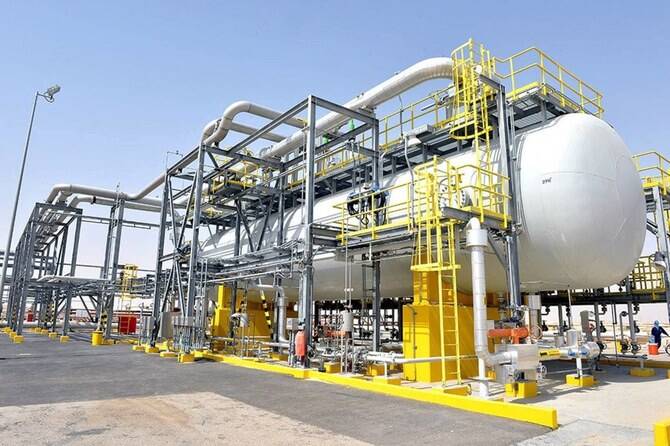
Aramco cuts July propane, butane prices amid market shifts

Propane and butane, classified as liquefied petroleum gases, are essential fuels for heating, transport, and petrochemical production.
Short Url
Updated 29 June 2025
Follow

Aramco cuts July propane, butane prices amid market shifts

  • Oil giant set propane at $575 per tonne and butane at $545 per tonne

RIYADH: Saudi Aramco has lowered its official selling prices for propane and butane for July 2025, reflecting changing global market dynamics.

In a statement released on Sunday, the oil giant set propane at $575 per tonne and butane at $545 per tonne—both down $25 from the previous month. The adjustment continues a downward trend driven by evolving supply-demand conditions.

Propane and butane, classified as liquefied petroleum gases, are essential fuels for heating, transport, and petrochemical production. Aramco’s monthly pricing serves as a key benchmark for LPG shipments from the Middle East to the Asia Pacific.

The global LPG market is undergoing a reshuffle as China shifts away from US imports due to steep tariffs, increasingly turning to Middle Eastern suppliers. In turn, American cargoes are being rerouted to Europe and other parts of Asia.

This realignment is putting pressure on global LPG prices and weakening demand for US shale byproducts, impacting both American shale producers and Chinese petrochemical firms. Meanwhile, the trend is spurring greater interest in alternative feedstocks like naphtha.

Middle Eastern exporters are benefiting from the shift, stepping in to fill the gap left by falling US exports to China. Buyers in Asia, including Japan and India, are also taking advantage of the softer prices to strike more favorable supply deals.


Saudi Arabia’s construction costs see 1% annual rise in November: GASTAT 

Updated 22 December 2025
Follow

Saudi Arabia’s construction costs see 1% annual rise in November: GASTAT 

RIYADH: Saudi Arabia’s construction costs rose at a steady pace in November, signaling resilience in the sector as the Kingdom continues to manage rising labor and energy expenses. 

The Construction Cost Index climbed to 101.75 points in November, up 1 percent from a year earlier and broadly unchanged from October, according to data from the General Authority for Statistics. 

The steady momentum in Saudi Arabia’s construction sector aligns with a broader trend across the Gulf Cooperation Council, as regional economies push to diversify away from hydrocarbons. 

In July, real estate consultancy Knight Frank said Saudi Arabia’s construction output value is expected to reach $191 billion by 2029, representing a 29.05 percent increase from 2024, driven by residential development, ongoing giga-projects and rising demand for office space. 

In its latest report, GASTAT stated: “The CCI recorded a 1 percent increase in November 2025, maintaining the same growth rate observed in October 2025. This increase is mainly attributed to a 1 percent rise in construction costs for the residential sector and a 1 percent rise in construction costs for the non-residential sector.” 

In the residential sector, labor costs rose 1.5 percent year on year in November, while equipment and machinery rental costs increased 1.3 percent over the same period. 

Energy prices recorded a sharp increase of 9.9 percent compared with November 2024. 

Basic material costs edged up 0.2 percent, driven by a 1.4 percent rise in cement and concrete prices and a 1.1 percent increase in raw material costs. 

In the non-residential sector, the Construction Cost Index increased 1 percent year on year in November, mainly due to a 1.2 percent rise in equipment and machinery rental costs. 

Labor costs increased 1.1 percent, while energy prices continued their upward trend, rising 9.9 percent over the year. 

Basic material costs rose 0.3 percent, reflecting a 2.5 percent increase in wood and carpentry prices and a 1.4 percent rise in raw material costs. 

The Construction Cost Index tracks changes in construction input costs across 51 items, with prices collected monthly from 13 regions through field surveys of contractors, engineering offices and construction material suppliers. The base year is 2023, and the index is published monthly.