

Balochistan officials say Daesh involved in high-profile kidnapping, murder of schoolboy

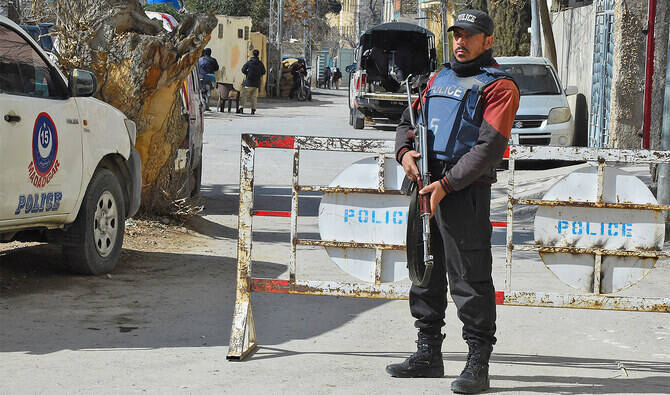
Policeman stands guard in Quetta, Pakistan, on February 5, 2024. (AFP/File)
Short Url
Updated 29 June 2025
Follow

Balochistan officials say Daesh involved in high-profile kidnapping, murder of schoolboy

  • Muhammad Musawir Khan Kakar, who was from a family of gold traders, was kidnapped by armed men in Quetta on Nov. 15
  • Balochistan government officials vow to arrest suspects involved in kidnapping and murder of 11-year-old schoolboy

ISLAMABAD: Senior officials of the Balochistan government this week said Daesh militants had abducted and murdered a schoolboy, whose kidnapping last year triggered a weeks-long protest in the province. 

Eleven-year-old Muhammad Musawir Khan Kakar, a third-grade student, was kidnapped from a school van by unidentified armed men while on his way to school in Quetta on Nov. 15, 2024. His family said they had not received any ransom call from the kidnappers since his abduction.

Kakar's relatives and other protesters had staged a sit-in protest at Quetta’s Unity Square for 14 days after his abduction. They ended the protest after Balochistan Chief Minister Sarfaraz Bugti met and assured them of setting up a team to recover the boy. 

Kakar belonged to a prominent tribal family involved in the gold trading business in Balochistan for decades. 

"I do not merely want to condemn the brutal manner in which Daesh terrorists martyred the innocent child Musawir Kakar for ransom—I consider it my responsibility to ensure that those involved in this incident are brought to justice," Balochistan Chief Minister Sarfraz Bugti wrote on social media platform X on Saturday. 

Bugti said the provincial government had undertaken hectic efforts to recover Kakar over the past seven months. 

"The entire state machinery has now been mobilized against those involved in this incident," he said. 

Separately, Quetta Commissioner Hamza Shafqaat shared details of the incident. He said militants part of a Daesh cell operating from abroad had abducted the boy and demanded Rs3 billion [$10.58 million] as ransom, following which police and intelligence agencies launched a joint operation to recover him.

Shafqaat said six suspects were identified by law enforcers, out of which five were Afghan nationals and one was a Pakistani citizen. 

The Quetta official said over 1,000 CCTV videos were analyzed while over 2,000 houses and 400 rented properties were searched. He added it was considered one of the largest search operations in which police, the Counterterrorism Department, Intelligence Bureau and Frontier Corps took part. 

Shafqaat said the operation progressed to a key hideout where one Afghan suspect detonated himself while another was killed. In a separate operation, he said the other gang members were located. 

"It was confirmed that the child had been martyred and was secretly buried," Shafqaat said. "The body was recovered, identified through DNA, and handed over to the family."

He said the provincial government was taking legal action against those involved in militant activities from across the border.

"Rest assured all of them will be arrested," he vowed.


ADB, Pakistan sign over $300 million agreements to undertake climate resilience initiatives

Updated 30 December 2025
Follow

ADB, Pakistan sign over $300 million agreements to undertake climate resilience initiatives

  • Pakistan ranks among nations most vulnerable to climate change and has seen erratic changes in weather patterns
  • The projects in Sindh and Punjab will restore nature-based coastal defenses and enhance agricultural productivity

ISLAMABAD: The Pakistani government and the Asian Development Bank (ADB) have signed more than $300 million agreements to undertake two major climate resilience initiatives, Pakistan’s Press Information Department (PID) said on Tuesday.

The projects include the Sindh Coastal Resilience Sector Project (SCRP), valued at Rs50.5 billion ($180.5 million), and the Punjab Climate-Resilient and Low-Carbon Agriculture Mechanization Project (PCRLCAMP), totaling Rs34.7 billion ($124 million).

Pakistan ranks among nations most vulnerable to climate change and has seen erratic changes in its weather patterns. In 2022, monsoon floods killed over 1,700 people, displaced another 33 million and caused over $30 billion losses, while another 1,037 people were killed in floods this year.

The South Asian country is ramping up climate resilience efforts, with support from the ADB and World Bank, and investing in climate-resilient infrastructure, particularly in vulnerable areas.

“Both sides expressed their commitment to effectively utilize the financing for successful and timely completion of the two initiatives,” the PID said in a statement.

The Sindh Coastal Resilience Project (SCRP) will promote integrated water resources and flood risk management, restore nature-based coastal defenses, and strengthen institutional and community capacity for strategic action planning, directly benefiting over 3.8 million people in Thatta, Sujawal, and Badin districts, according to ADB.

The Punjab project will enhance agricultural productivity and climate resilience across 30 districts, improving small farmers’ access to climate-smart machinery, introducing circular agriculture practices to reduce residue burning, establishing testing and training facilities, and empowering 15,000 women through skills development and livelihood diversification.

Earlier this month, the ADB also approved $381 million in financing for Pakistan’s Punjab province to modernize agriculture and strengthen education and health services, including concessional loans and grants for farm mechanization, Science, Technology, Engineering and Mathematics (STEM) education, and nursing sector reforms.