

Hong Kong’s last active pro-democracy group says it will disband amid security crackdown

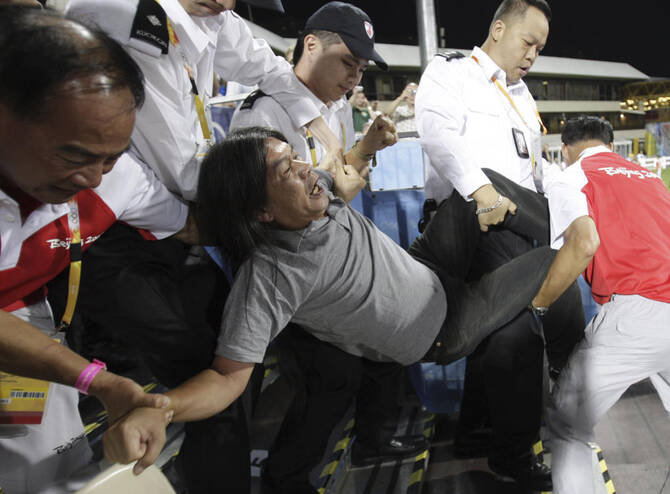
Hong Kong legislator Leung Kwok-hung is taken away by security guards during a protest on first day of Beijing Olympics Equestrian game in Hong Kong on Aug. 9, 2008. (AP file photo)
Short Url
Updated 29 June 2025
Follow

Hong Kong’s last active pro-democracy group says it will disband amid security crackdown

  • League of Social Democrats co-founded in 2006 by former lawmaker Leung Kwok-hung
  • LSD is the last group in Hong Kong to stage small protests this year

HONG KONG: Hong Kong’s League of Social Democrats said on Sunday that it would disband amid “immense political pressure” from a five year-long national security crackdown, leaving the China-ruled city with no formal pro-democracy opposition presence.

The LSD becomes the third major opposition party to shutter in Hong Kong in the past two years.

Co-founded in 2006 by former lawmaker Leung Kwok-hung as a radical wing of the pro-democracy camp, the LSD is the last group in Hong Kong to stage small protests this year.

Mass public gatherings and marches spearheaded by political and civil society groups had been common in Hong Kong until 2020, but the threat of prosecution has largely shut down organized protests since.

China imposed a national security law on the former British colony in 2020, punishing offenses like subversion with possible life imprisonment following mass pro-democracy protests in 2019.

A second set of laws, known as Article 23, was passed in 2024 by the city’s pro-Beijing legislature covering crimes such as sedition and treason.

Current chair Chan Po-ying said the group had been “left with no choice” and after considering the safety of party members had decided to shutdown. Chan declined to specify what pressures they had faced.

“We have endured hardships of internal disputes and the near total imprisonment of our leadership while witnessing the erosion of civil society, the fading of grassroots voices, the omnipresence of red lines and the draconian suppression of dissent,” Chan told reporters, while flanked by six other core members including Tsang Kin-shing, Dickson Chau, Raphael Wong, Figo Chan and Jimmy Sham.

In February, the Democratic Party, the city’s largest and most popular opposition party, announced it would disband. Several senior members told Reuters they had been warned by Beijing that a failure to do so would mean serious consequences including possible arrests.

Earlier this month, China’s top official on Hong Kong affairs, Xia Baolong, stressed national security work must continue as hostile forces were still interfering in the city.

“We must clearly see that the anti-China and Hong Kong chaos elements are still ruthless and are renewing various forms of soft resistance,” Xia said in a speech in Hong Kong.

The League of Social Democrats is one of Hong Kong’s smaller pro-democracy groups known for its more aggressive tactics and street protests in its advocacy of universal suffrage and grassroots causes including a universal pension scheme. In a 2016 incident, Leung threw a round object at former Hong Kong leader Leung Chun-ying inside the legislature.

Three LSD members were fined on June 12 by a magistrate for setting up a street booth where a blank black cloth was displayed and money was collected in public without official permission. Chan told reporters that the party had no assets to divest and no funds left after several of its bank accounts were shut down in 2023.

While never as popular as the more moderate Democratic Party and Civic Party, it gained three seats in a 2008 legislative election — its best showing.

The LSD’s founder Leung, 69, was arrested and charged with conspiracy to commit subversion in 2021 in the landmark ‘47 Democrats’ case. He is currently serving a sentence of six years and nine months in prison. Another member, Jimmy Sham, was also jailed in the same case and released in May.

The security laws have been criticized as a tool of repression by the US and Britain, but China says they have restored stability with 332 people so far arrested under these laws.

“I hope that the people of Hong Kong will continue to pay attention to the vulnerable, and they will continue to speak out for injustice,” Figo Chan said.


South Korean lawmakers pass bill targeting false information despite warnings on censorship

Updated 6 sec ago
Follow

South Korean lawmakers pass bill targeting false information despite warnings on censorship

SEOUL: South Korea’s liberal-led legislature on Wednesday passed a bill allowing heavy punitive damages against traditional news and Internet media for publishing “false or fabricated information,” brushing aside concerns the legislation could lead to greater censorship.
Journalist groups and civil liberty advocates urged President Lee Jae Myung to veto the bill pushed by his Democratic Party. They say the wording is vague about what information would be banned and lacks sufficient protections for the press, potentially discouraging critical reporting on public officials, politicians and big businesses.
The Democrats, who have failed to pass similar legislation under past governments, say the law is needed to counter a growing threat of fake news and disinformation that they argue undermine democracy by fueling divisions and hate speech.
The bill would allow courts to award punitive damages of up to five times the proven losses against news organizations and large YouTube channels that disseminate “illegal information or false, fabricated information” to cause harm or seek profit.
The bill also would allow damages of up to 50 million won ($34,200) for losses that are difficult to quantify in court. The country’s media regulator would be able to fine outlets up to 1 billion won ($684,000) for distributing information a court confirms to be false or manipulated more than twice.
The bill passed the National Assembly by a vote of 170-3 with four abstentions after many lawmakers from the main conservative opposition People Power Party boycotted the vote. The vote was delayed after a 24-hour filibuster by PPP, during which lawmakers from both parties debated the bill.
PPP lawmaker Choi Soo-jin said during the filibuster that the bill fails to define the degree of inaccuracy for information to be banned, warning it could be broadly applied to content containing minor errors or general claims and used as a tool to silence critics with the threat of lawsuits.
The Democrats argue punitive damages would apply only when there is clarity that false information has been deliberately spread for harmful or profit-seeking purposes and causes actual damage, while routine allegations or claims would not be penalized.
They note the law prohibits filing damage claims with the purpose of “obstructing just criticism or oversight conducted in the public interest,” although legal experts and journalist groups have criticized the provision as vague and unrealistic.
“What the law targets is not (legitimate) criticism but the malicious and deliberate dissemination of false information,” Democratic Party spokesperson Park Soo-hyun said. “(The bill) is based on the requirement of intent and also exempts satire and parody, clearly distinguishing (what should be respected as) freedom of expression.”
The National Union of Media Workers urged Lee’s government and the Democrats to address concerns that regulating false or manipulated information by law could infringe on freedom of expression and expose media companies to abusive lawsuits, chilling scrutiny of those in power.
“We urge (them) to clearly reaffirm that the law would target only a tiny portion (of content) that’s ‘false or fabricated information’ and to carefully review the bill to eliminate any potential infringement on freedom of the press and of expression,” the group said in a statement. “We call on them to carefully define the law’s scope when drafting (the law’s) enforcement ordinance.”